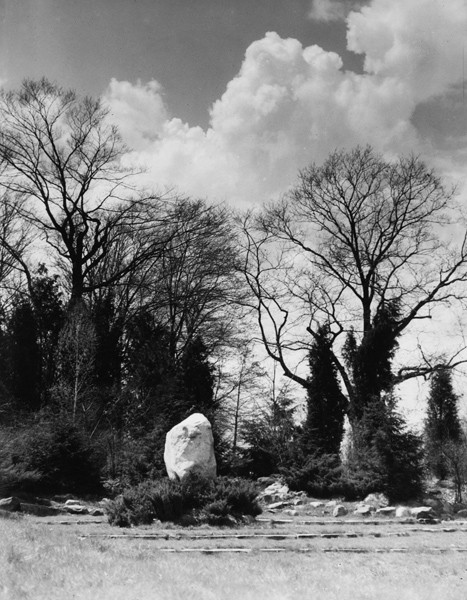
The name of Harriett L. Keeler has mingled in the memories of Cleveland park users with impressions of Brecksville Reservation's rugged woodlands and colorful wildflowers. Since the dedication of the Harriet Keeler Memorial Woods over 90 years ago, a shelter house, picnic grounds and nature trails have also shared their identity with the celebrated author and respected educator. Along the Wildflower Loop Trail that meanders through the grounds, a boulder inset with a bronze tablet reminds visitors of the "Teacher – Author – Citizen" in order that she may "liveth in the continuing generation of the woods she loved." The simple text offers a compelling, if vague, portrait of one of Cleveland's most distinguished women at the turn of the 20th century. While the inscription easily conveys to a passerby that Keeler was both revered as a Cleveland teacher and local author of nature guides, what did it mean to be a "citizen" during Keeler's lifetime or at the time of the plaque's dedication in 1936 – and why was this word chosen to honor and encapsulate her legacy for future generations?
To grasp its meaning, we must remember that Ohio women were denied a hallmark of citizenship until the ratification of the Nineteenth Amendment in 1920 – just six months before Harriet Keeler's death. For Keeler, women's inability to vote in political elections was symptomatic of the "topsy-turvy" age in which she lived. This turn of phrase offered by Keeler to the Women's Club of Cleveland during a 1913 speech reveals her sense of a society strangely off-axis and marked by poverty, inequality, political corruption and exploitation. Unable to vote and generally excluded from the inner circles of politics and business, middle and upper class women such as Keeler joined together to form clubs, leagues and reform organizations in an effort to improve their lives and recreate the American city. Lacking unity in purpose, but unprecedented in scope, a foundation of grassroots movements emerged in a collective battle against urban disorder. These organizations empowered women to influence American politics and to create professional opportunities for themselves. Harriet Keeler and her peers helped create and was actively involved in what would be called the Progressive Movement. In turn, the topsy-turvy era in which she lived shaped her legacy as a suffragist, social reformer, and leading citizen of Cleveland.
The city Harriet Keeler first encountered when she moved to Cleveland in 1871 to become superintendent of the primary schools was largely unrecognizable by the time of her speech to the Women's Club. Keeler watched as Cleveland's population grew from 93,000 to over 560,000 persons during this time. Glimpses of her prior life growing up on a New York farm, or studying at the rural confines of Oberlin College, surely contrasted with daily visions of city streets teeming with immigrants and streetcars. Year by year, she witnessed the emergence of numerous smokestacks peaking through the city's skyline. As industry flourished, it would have been impossible for Keeler to avoid the physical traces of corporations building a city – not just in the smells and sights of cast-off materials from manufacturing processes, but through her dealings with overcrowded classrooms and parents dependent on their children's labor to survive. During her 38-year career as a teacher and administrator, she experienced the transformation of public schools into replicas of factories that spit students out as quickly as they could arrive. By the mid 1880s, she needed only to glance at a newspaper or to take a short walk beyond downtown for a reminder of the disorder that characterized urban life. The influence of unbridled commercialism, political corruption, and unchecked corporate influence was hammered into the physical landscape of an industrial city.
Despite all the drab characterizations, it was still an age of optimism and hope for middle and upper class residents. Ranked the sixth largest city in the country by the time of her 1913 speech, Cleveland boasted a modern electrical plant, an elaborate park system, municipally owned public transportation, and grandiose plans for a grouping of civic buildings near the historic center of town. Additionally, city life offered a wide range of employment and social opportunities to women. Throughout her time in Cleveland, Keeler was active in women's clubs and civic organizations. Just as teaching was a socially tolerated career for unmarried women, Keeler's participation in these local clubs was a traditional and popular way for women with leisure time to socialize, further their education, and participate in cultural activities. In her late 20s and early 30s, Keeler attended female reading circles and local theater, presented papers to a teacher's club, volunteered on Ladies Committees, and participated in Oberlin College Alumni functions.
On the eve of the Progressive Era, the club movement exploded in popularity; countless American women became involved in civic affairs during these years. Working within their communities, middle and upper class women's groups expanded their activities to reforming social injustices in the industrial city. The influence of men, as found in commercialism and politics, appeared to have created quite the mess of things. With a historic precedent of the female sex being associated with duties of the home, philanthropy, education, culture and religion, these clubs exerted claims of superior morality to justify their intrusion into the male dominated world of politics and civic life. Harriet Keeler's skill as writer offered a unique path into this restricted world. Following the publication and success of her first book on wildflowers in 1893, the author became a public figure. Her work was included in the Women's Press Club exhibition at the 1893 World's Columbian Exposition. She regularly gave lectures on wildflowers and botany, and was noted as a board or executive member in multiple committees devoted to the cultural advancement of women.
In an 1896 toast given to the local National Collegiate Alumni, Keeler paid tribute to the "new woman" – one of intellect, who was destined to fill a high mission in the world. Through the turn of the century, this mission of the new woman expanded in scope and influence. Women's clubs became better organized and ingrained into the world of politics and reform, quickly progressing to the state and national level, with the goal of instituting reform through legislation and collective action such as boycotts. The concept of fulfilling a high mission in the world was evident in Keeler's civic work. By 1903, Keeler sat on the board of Cleveland's chapter of the National Consumers League, which advocated for fair working conditions as well as ending the exploitation of children and women in the workplace. As the honorary vice president of the local league in 1909, Keeler urged women to write their senators to request the creation of the National Children's Bureau. The Bureau was to gather data on illiteracy, child labor, juvenile courts, crimes against children, orphanages and infant mortality. Probably the loftiest of missions undertaken by Keeler was in her service on the board of the short-lived Cleveland Peace Society - an organization that participated in a national movement to promote peace and end all war.
While Keeler continued to volunteer with reform organizations and publish books on amateur botany, she remained a teacher and administrator with the Cleveland public schools until her retirement in 1908. The author stayed active with the school system even after leaving behind her career responsibilities. Echoing the campaigns of other women's clubs throughout America to improve conditions for both teachers and students, Keeler championed ideas such as reduced class sizes, the hiring of tutors, and providing teachers better pay and more autonomy in their classroom. In a nod to the respect garnered by Keeler from both administrators and teachers, the life-long educator and advocate for school reform was nominated to the position of Superintendent of Schools in 1912 following an unexpected resignation of the post. Initially named an "inspiration candidate" by the school board without her knowledge, Keeler quickly found herself appointed the first woman Superintendent of Schools for the City of Cleveland.
Once having completed this temporary term as Superintendent of Schools, Keeler continued to utilize her privilege and position as a prominent social figure to advocate for social reform. In January 1913, Harriet Keeler was elected president of the Woman Suffrage Party of Cleveland. Largely due to the public successes of the Progressive Era women's club movement, women's suffrage achieved new levels of popular support following the first decade of the 20th century in Cleveland and the United States. Battling against deeply entrenched social norms, however, proved daunting. A state constitutional amendment that would have granted women the vote had failed in 1912. The goal of the Suffrage Party and Harriet Keeler was to gather enough signatures to bring the issue to another vote in 1914. Keeler acted as the spokeswoman of the Suffrage Party, represented the organization at fairs and suffrage parades, circulated petitions, helped organize bi-weekly lectures and mass meetings in the different wards of Cleveland, and spoke to women's clubs throughout the city. Keeler, in ill health, resigned from her position as president in January 1914. Despite the Cleveland branch of the Ohio Woman Suffrage Association advising that it was too soon to renew a campaign for amending the Ohio constitution, the referendum was included on the 1914 ballot but failed.
Six years and one global war later, women were granted the right to vote. Harriet Keeler continued to publish nature guides all the while. Within two months of her death in 1921, plans to designate a wooded area of the Brecksville Reservation to Keeler's memory were approved by the Cleveland Metropolitan Park District commissions. Friends and associates of Keeler designed and dedicated a boulder monument by 1925 and financed Brecksville Reservation's first educational nature trail in 1929. Fifteen years following Keeler's death, a new granite boulder and memorial plaque was dedicated to the memory of the distinguished teacher and author. Occurring in the depths of the Great Depression – a time characterized by a resurgence in social reform efforts, as well as the reversal of advances achieved toward gender equality – the choice of the word "citizen" recalls the efforts of women such as Harriet Keeler who helped reshape American politics, society and the urban landscape during the Progressive Era.
Obscured by time, this fitting tribute has met with the same fate as all lasting memorials; as years passed and personal remembrances faded, new generations of park patrons were offered the opportunity to inscribe their own meaning and memories to the grounds' namesake. Only in this way can Harriet Keeler live on "in the continuing generation of the woods that she loved."
]]>