<?xml version="1.0" encoding="UTF-8"?>
<feed xmlns="http://www.w3.org/2005/Atom">
  <title type="text">Cleveland Historical</title>
  <updated>2026-04-17T13:55:26+00:00</updated>
  <generator uri="http://framework.zend.com" version="1.12.20">Zend_Feed_Writer</generator>
  <link rel="alternate" type="text/html" href="https://clevelandhistorical.org/"/>
  <link rel="self" type="application/atom+xml" href="https://clevelandhistorical.org/items/browse?output=rss2"/>
  <id>https://clevelandhistorical.org/</id>
  <author>
    <name>Cleveland Historical</name>
    <uri>https://clevelandhistorical.org</uri>
  </author>
  <link rel="hub" href="http://pubsubhubbub.appspot.com/"/>
  <entry>
    <title type="html"><![CDATA[Hart &amp; Co. Building: How One Building Helped Save a Struggling District]]></title>
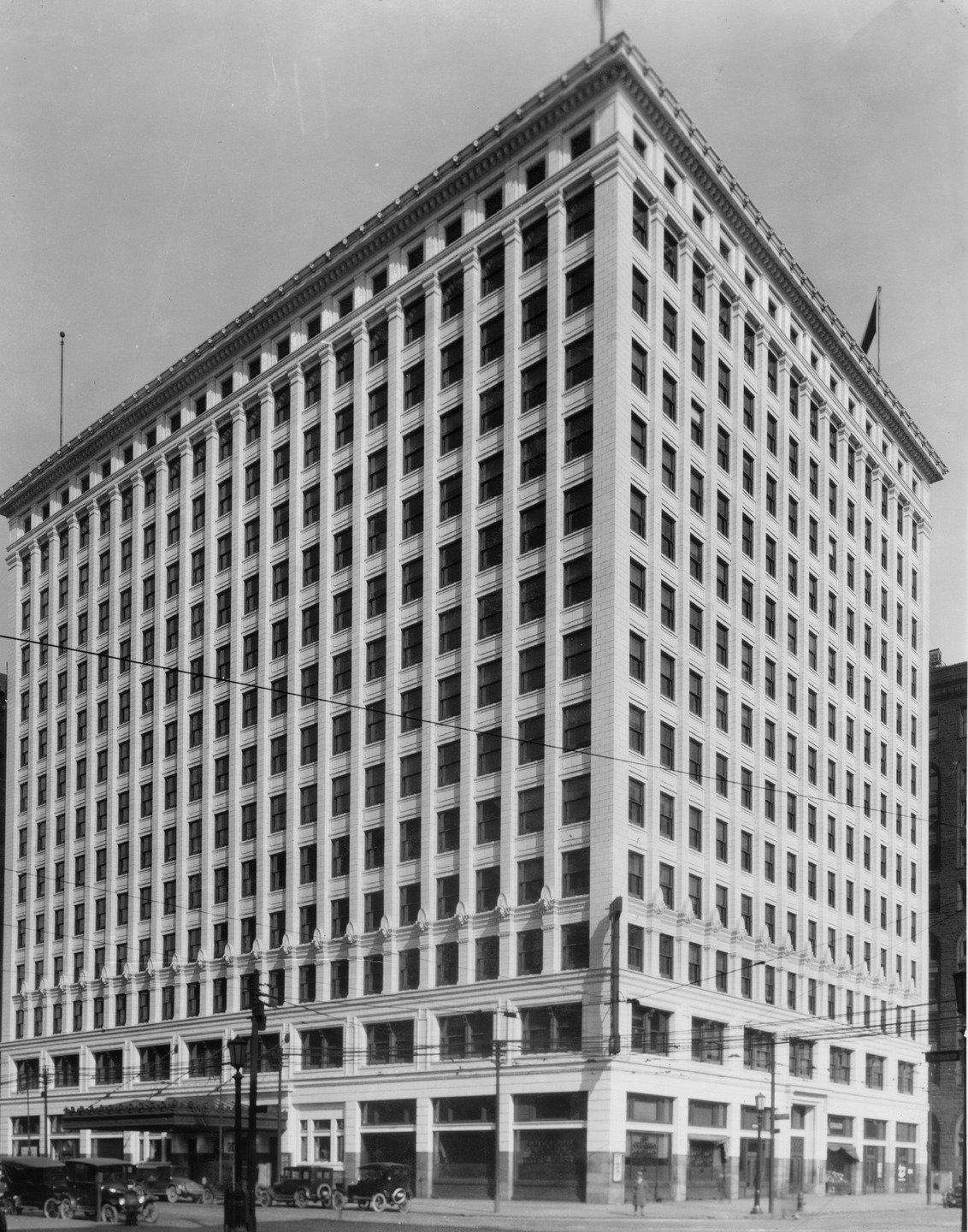
    <summary type="html"><![CDATA[<p><strong><em>By 1980, 40 percent of the structures in the Warehouse District were gone. John Cimperman, head of the Cleveland Landmarks Commission,  summed up the situation best when he stated, “We need luck, money, and cooperation, but saving and restoring this area is [a] must.” The Hart & Co. Building was a starting point for the restoration of the Warehouse District in a broader trend of adaptive reuse.</em></strong></p><img src="https://clevelandhistorical.org/files/fullsize/36069c526aa18707bd0098b219f3c1fe.jpg" alt="Hart &amp; Co. Building in 1897" /><br/><p>The Hart & Co. Building is located at 1235 West 6th Street in the Warehouse District and currently contains the Hat Factory Lofts and Richardson Design. The Hart & Co. Building was commissioned in 1888 by Elbert Irving Baldwin, one of the city’s oldest dry goods merchants, who came to Cleveland in 1857. The building’s first tenant was E. L. and F. W. Hart & Co., which leased the building until 1900. Hart & Co. was one of the most prominent millineries in a millinery market that ranked third in the nation (behind New York and Chicago) by 1895. Hart & Co. made hats for women and imported hats and materials from Europe. Hart & Co. sold straw, felt goods, feathers, flowers, ostrich plumes, ribbons, silk, velvets, ornaments, and other goods for making hats; many of these items the company sold made their way to the “far west and extreme south.” Furthermore, in 1897 it was reported that thousands of milliners (most of whom were women) came to Cleveland each year from Ohio, Indiana, Kentucky, Michigan, and Pennsylvania to see the latest spring hat designs. </p><p>On April 15, 1899, catastrophe struck Hart & Co. At noon, a fire erupted in the building occupied by Comey & Johnson behind the Hart & Co. Building. The fire threatened the entire block bounded by West St. Clair Ave and West Lakeside Avenues and West 3rd and West 6th Streets. Eventually, the fire spread to the Hart & Co. Building; by 1:00 p.m. the building was “doomed.” The heaviest loss was suffered by Hart & Co. whose building was a wreck, with damage estimated at approximately $75,000. In 1899, the building was rebuilt and redesigned by F. S. Barnum and Co. and Hart & Co. moved and rented out the Brush Building. It is unclear whether the entire building was destroyed or if only parts of it were destroyed. What is certain is the building suffered significant damage from the fire.</p><p>In 1900, the building was sold to Adams & Ford, a wholesale dealer in rubber goods that primarily made boots and shoes. In 1941, White Tool & Supply Co. bought the building and used it as a warehouse until 1983. White Tool & Supply Co. seemed especially prosperous in the 1950s. In July 1951, it was reported that the company sold more than $3,000,000 of tools, equipment and machinery each year. Business likely declined from the 1960s to 1980s as many of the businesses in Cleveland (and elsewhere) saw a decline due to deindustrialization and urban decline. Additionally, other factors that led to the decline of the machine tools industry included the failure to modernize/innovate, the failure to sell internationally, bigger companies buying smaller companies in the industry, and the dismantling of the iron and steel industry, which was linked with the machine tool industry. Hence, many buildings in cities became vacant/abandoned and left to deteriorate. The solution many cities implemented due to the crisis of deteriorating structures was demolition. From the 1940s to 1970s, approximately one-third of the buildings in the Warehouse District were cleared and replaced with surface parking. By 1980, 40 percent of the structures in the Warehouse District were gone. </p><p>In 1971, in response to demolition in Cleveland, the Cleveland Landmarks Commission was formed. The Landmarks Commission’s mission was to find architecturally and historically significant buildings in Cleveland and label them as landmarks to prevent their demolition. In April 1977, John D. Cimperman, head of the Landmarks Commission and Cleveland City Council member, revealed a plan for the Warehouse District that focused on reusing buildings through renovations and creating urban housing. Cimperman was aware of the historic value of the Warehouse District: it contained early commercial skyscrapers and much of the early wealth acquired in Cleveland was earned in the district. Cimperman summed up the situation best when he stated, “We need luck money, and cooperation, but saving and restoring this area is [a] must.” In 1982, the Warehouse District gained further protection from destruction. That year, Cleveland City Council established the Warehouse Historic District and the National Park Service approved listing the Warehouse District in the National Register of Historic Places. However, in 1983, White Tool & Supply Co. left the Hart & Co. Building, leaving its fate in question. </p><p>Luckily, on January 8, 1984, the Cleveland City Planning Commission approved an Urban Development Action Grant proposal for the building and in March, the U.S. Department of Housing and Urban Development approved the application. This meant funds of $800,000 and a $2 million mortgage were approved to help restore and repurpose the building. The renovation was undertaken by the Old Cleveland Properties division of the Dalad Group and turned into an apartment building with thirty-three loft-style suites. The first floor was used as a commercial space where a restaurant and tavern were expected to be installed. Additionally, the developers tried to keep elements of the industrial history of the building but also made it look like a cozy residential space. In June 1985, the Hat Factory Lofts opened. Thus, the Hart & Co. Building began its life as the first legal housing unit in the Warehouse District. </p><p>The transformation of the Hart & Co. Building into the Hat Factory Lofts was the first step in the spread of adaptive reuse in the Warehouse District. The Hat Factory Lofts was one of twenty-one buildings the Dalad Group planned to develop in the Warehouse District. Additionally, there were plans to establish pedestrian walkways and courtyards in the district to make it pedestrian friendly and to transform it into a mixed-use neighborhood. In 1987, Old Cleveland Properties undertook a $3 million renovation of the Hoyt Block, a four-story Victorian building. This led to the creation of eighty thousand square feet of retail space at ground-level and upper-floor offices. In 1988, Old Cleveland Properties made fifty-six apartments out of upper-story space in the Hoyt Block. In 1990, only three buildings in the Warehouse District had apartments: the Bradley Building, Hat Factory Lofts, and the <a href="https://clevelandhistorical.org/items/show/1062">Hart Building</a>. Hence, the adaptive reuse of the Hart & Co. Building paved the way to revitalize the Warehouse District and served as part of the national trend to use adaptive reuse to save struggling cities like Baltimore, Minneapolis, and Pittsburgh. In the end, the Hat Factory Lofts tips its hat to the building’s first inhabitant, Hart & Co., through its name and architectural features, continuing to provide a sense of Cleveland’s past as the city continues to live on.</p><p><em><strong><a href="https://clevelandhistorical.org/items/show/1064">For more (including 8 images) view the original article</a></strong></em></p>]]></summary>
    <published>2025-11-13T19:36:21+00:00</published>
    <updated>2026-03-04T21:32:06+00:00</updated>
    <link rel="alternate" type="text/html" href="https://clevelandhistorical.org/items/show/1064"/>
    <id>https://clevelandhistorical.org/items/show/1064</id>
    <author>
      <name>Casey Smith</name>
    </author>
  </entry>
  <entry>
    <title type="html"><![CDATA[Fountain of Eternal Life: Reaching Upward to Peace]]></title>
    <summary type="html"><![CDATA[<img src="https://clevelandhistorical.org/files/fullsize/e1f073f873e93589f1b25bde321f8480.jpg" alt="The &quot;Fountain of Eternal Life&quot;" /><br/><p>Located prominently on downtown Cleveland’s Public Mall A, the Fountain of Eternal Life, also known as the War Memorial Fountain, stands to honor the bravery and sacrifice of Americans lost in armed conflicts from the Spanish-American War to the present day. Envisioned as a memorial to Clevelanders lost during the Second World War and Korean War at the time of its initial dedication in 1964, the fountain has served as a site of reflection of Clevelanders' attitudes towards armed conflict as well as a subject of debate on historic preservation over the decades of its existence.</p><p>The Fountain of Eternal Life’s sculptor, Marshall Fredericks, was a graduate of the Cleveland Institute of Art and had served in the United States Army Corps of Engineers and the United States Air Force during the Second World War. As the conflict came to an end in 1945, several organizations and media outlets in Cleveland began formulating a plan to develop a memorial to honor local residents who were lost. By the end of 1945, the <em>Cleveland Press</em> had raised $104,000 through a public subscription drive, enough for the initial planning and sourcing of materials for a monument to take place and for Fredericks to be officially selected as the designer and sculptor of the memorial. By 1946, it was decided that the memorial, dubbed the War Memorial Fountain in the media, would be built on Cleveland’s Mall.</p><p>March 25, 1955, marked the official groundbreaking ceremony for the memorial. The event was highlighted by the first turning of dirt being performed by Cleveland’s then-mayor Anthony J. Celebrezze alongside the president of the Cuyahoga County Gold Star Mothers, Stella Stark. As the monument was initially planned ten years earlier as a memorial to Clevelanders lost during the Second World War, organizers already had to contend with the fact that another conflict, the Korean War, would have to be addressed upon the memorial’s completion. This restructuring of exactly which conflicts are being represented by the monument would be a constant throughout the memorial’s life.</p><p>As the monument’s development and construction continued beyond the initial groundbreaking, it would not be without some adversity. In 1959, the City of Cleveland held public hearings on a proposal to lease Mall A to build a skyscraping <a href="https://clevelandhistorical.org/files/show/10320">Hilton hotel</a>. If approved, the memorial would have been forced to relocate, potentially undercutting its significance by not allowing for a prominent location to be held. Although some on Cleveland’s City Council highlighted financial upsides to the hotel’s existence on the Mall, voters ultimately rejected the plan in a special referendum, permitting development of the monument to continue.</p><p>After 19 years of preparations and construction, the memorial was ready to be officially dedicated. On May 30, 1964, thousands of residents and spectators descended on Cleveland’s downtown Mall for Memorial Day celebrations and the dedication of the “Press War Memorial Fountain,” which featured the Fountain of Eternal Life sculpture. The sculpture itself featured four large granite slabs and a towering bronze figure arising upwards out of flames and a sphere meant to represent the universe. In all, the monument towered 46 feet above the ground. Marshall Fredericks described his work on the sculpture, stating, “This figure expresses the main theme of the Memorial Fountain, namely, the spirit of mankind rising out of the encircling flames of war, pestilence, and the destructive elements of life, reaching and ascending to a new understanding of life. Man rising above death, reaching upward to his God and toward peace.” Placed around the monument and inlaid upon the granite labs would be inscribed bronze tablets containing the names of local residents who perished during the Second World War and the Korean War.</p><p>In the years following the fountain’s dedication, the site was consistently utilized as a location for parades and speeches in celebration of patriotic holidays and days of remembrance. However, coinciding with this continued use of the Fountain of Eternal Life as a place of honor was the entrenchment of the United States in another major armed conflict: The Vietnam War. By 1971, the fountain had transitioned from a location seen as primarily honoring Cleveland’s perished soldiers to one that often hosted rallies and protests against all war. News publications of the time often highlighted the symbolism of holding such antiwar gatherings around a sculpture that depicts a figure striving upwards for peace, as Marshall Fredricks had originally intended.</p><p>Moving into the 1980s, the Fountain of Eternal Life experienced yet another major evolution in its perception and meaning. On May 30, 1983, the 19th anniversary of the monument’s dedication, <em>Plain Dealer</em> columnist William F. Miller ran a story with the very provocative title “Memorial fountain in sad shape.” In this piece, Miller detailed the current condition of broken concrete, failed water pipes, and cracked granite across the basin of the fountain. Miller went even further in describing the cracked sidewalks and rusted-over trash cans in the immediate vicinity of the fountain, further detracting from any aesthetic quality or any attempt to convey the memorial’s meaning. By 1987, discussion amongst media publications and within City Council meetings regarding the possible removal of the Fountain of Eternal Life had sparked Marshall Fredericks himself to comment on the matter. Fredericks depressingly stated to a reporter shortly before the fountain's 23rd anniversary, “I spent my whole life… doing sculpture. But what’s the point of it all when the most important one I did in my life is about to be torn down.” Ultimately, plans to preserve the Fountain of Eternal Life moved forward, and by November 1989 the monument was being hoisted from its place in Mall A and taken to a local restoration center. The occasion, which occurred on November 6, 1989, was marked by a small performance from a United States Marine color guard, in which the soldiers saluted the monument as it was taken away.</p><p>The Fountain of Eternal Life was returned to its place atop the now-named Memorial Plaza in 1991. With this, the sculpture itself was rededicated and became the centerpiece of what would now be named the “Peace Memorial Fountain.” Moving forward to the end of the 20th century and into the 21st, the fountain continued to serve as a site for both military memorialization and occasionally for antiwar and peace rallies. In 2004, the monument was once again rededicated, with this occasion officially marking the site’s commemoration of Clevelanders lost in all conflicts from 1899 to the present day.</p><p><em><strong><a href="https://clevelandhistorical.org/items/show/1050">For more (including 5 images) view the original article</a></strong></em></p>]]></summary>
    <published>2024-12-03T10:53:42+00:00</published>
    <updated>2026-03-04T21:32:05+00:00</updated>
    <link rel="alternate" type="text/html" href="https://clevelandhistorical.org/items/show/1050"/>
    <id>https://clevelandhistorical.org/items/show/1050</id>
    <author>
      <name>Andrew Zelina</name>
    </author>
  </entry>
  <entry>
    <title type="html"><![CDATA[Hilliard Building: The Oldest Commercial Building in Downtown Cleveland]]></title>
    <summary type="html"><![CDATA[<p><strong><em>Richard Hilliard achieved much as a businessman and civic leader in the thirty years (1826-1856) that he lived in Cleveland.  Most of his achievements have long since faded from the public's memory.  However, the three story brick building that he erected in 1850 still stands today on West 9th Street as a reminder to Clevelanders of who he was.</p></strong></p><img src="https://clevelandhistorical.org/files/fullsize/f6a53caee7076de0abc61048028a060b.jpg" alt="Hilliard Building" /><br/><p>In Cleveland's Warehouse District, northwest of Public Square, the historic Hilliard Building stands on the corner of West 9th Street and Frankfort Avenue. A visitor to the area can't help but notice how isolated it is from other buildings. In fact, it is entirely surrounded by parking lots. There is a parking lot to the west of it, directly across West 9th Street. There is another to the south of it between Frankfort and the Brotherhood of Railroad Trainmen Building on Superior Avenue. And finally there is a very large parking lot that extends north from the Hilliard Building all the way to St. Clair Avenue and also to the east behind the building all the way to West 6th Street. </p><p>Such parking lots, when covering large areas of a city's downtown, have become known as "parking craters," a term popularized by blogger Angie Schmitt who wrote that they render urban landscapes "inhospitable and unattractive." How and why the Hilliard Building came to occupy such an isolated location on West 9th Street, in the middle of a "parking crater," is an important part of the history of this building. </p><p>The Hilliard Building is named after Richard Hilliard, who was born in Chatham, New York in 1800. When he was a teenager, Hilliard began working in dry goods stores in western New York. One of those stores opened a branch in Cleveland in 1824, locating its new store at the southwest corner of Water (West 9th) and Superior, across Superior from where the Western Reserve Building stands today. Two years later, Hilliard who had by then become a partner in that business, moved to Cleveland. He soon bought out his partner and then formed a new partnership with William Hayes, a dry goods merchant in New York City. At about the same time that they formed their partnership, Hilliard married Sarah Katherine Hayes, a sister of his new partner, not an unusual way to cement a business relationship in the nineteenth century. </p><p>The dry goods business of Hilliard and Hayes, according to Hilliard's biographers, soon became very successful, and Richard Hilliard developed into an important figure in Cleveland's early history. In 1830, he was elected President of the Board of Trustees of Cleveland Village, and in 1836, when Cleveland became a city, he was elected one of its first aldermen. In the decade of the 1830s, he was one of the developers of Cleveland Centre in the Flats, a bold, but ill-fated, effort to make Cleveland the center of international trade in the Midwest. In the 1840s, Hilliard and Henry B. Payne, became more successfully involved in the incorporation of the Cleveland, Columbus and Cincinnati Railroad, Cleveland's first railroad, both of them becoming directors of that railroad. (Payne, an attorney, later built the Perry-Payne Building on Superior Avenue in downtown Cleveland.) In the early 1850s, Hilliard served as the first president of the Cleveland Water Works Commission, which led to the creation of Cleveland's first public water works system in 1856. </p><p>In 1850, Hilliard built the three story brick commercial building which is the subject of this story, moving his dry goods business into the building in the same year. According to an article appearing in the Plain Dealer on June 27, 1851, the building had 48 and 1/2 feet of frontage on Water Street and 100 feet on Centre (today, Frankfort) Street. The interior of the building was arranged as follows. There was a dry goods room measuring 25 by 100 feet on the Centre Street side of the building, and rooms on the two upper floors of the building that were also used in the dry goods business. The balance of the front of the building consisted of a room approximately 21 by 80 feet which served as a grocery store. The rear 20 feet of that part of the building was "furnished and used as a Counting-room." </p><p>Hilliard and Hayes, which then became Hilliard, Hayes and Co., was, according to newspaper sources, the largest dry goods wholesale business in the Midwest in the 1850s. It provided dry goods to retail stores in Ohio, Michigan, Indiana, Illinois and Wisconsin, and had sales that annually exceeded $500,000, equivalent to almost $20 million in 2024 dollars. However, shortly after returning from a business trip to New York, Richard Hilliard died on December 21, 1856 from typhoid fever. He was only 56 years old. His death had a profound effect upon his wholesale business operated out of the Hilliard Building, then known as the Hilliard Block. Several new partnerships were formed with combinations of Hilliard's son Richard Jr. and several of his father's former partners, but none lasted. On March 22, 1858, an advertisement appeared in the Plain Dealer, offering the "stock . . . business and good will" of the company for sale. By 1860, a new wholesale dry goods firm, S. Raymonds & Co., was operating its business out of the Hilliard Block. </p><p>S. Raymond and Co. occupied the Hilliard Block as a tenant for more than a decade under leases from the Hilliard family who still owned the building. Then, in 1875, the building took on new tenants when it was remodeled as an office building for merchants in Cleveland's coal and oil trade. Among those new tenants in the building now known as the Coal and Iron Exchange Building was Rhodes and Hanna, a business started by prominent early west side industrialist Daniel Rhodes, but, following his retirement in 1867, operated by a partnership that included his son Robert Russell Rhodes and son-in-law Marcus Hanna. (Known to history as "Cleveland's kingmaker," Hanna later directed the successful 1896 and 1900 presidential campaigns of William McKinley.) From 1875 to 1887, a number of Cleveland's most prominent coal and iron merchants had their offices in the building. </p><p>In the mid to late 1880s, as new and grander commercial buildings were erected in the Warehouse District like the Grand Arcade (1883) and the Perry-Payne Building (1889), coal and iron merchants left the Hilliard Block for these more prestigious addresses. For a time, the Hilliard building then served as home to the offices of several stocks, grains, provisions and oil brokers. In the early 1900s, several related wholesale fire equipment and marine supply companies operated out of the building. In 1914, Laura Hilliard, the youngest daughter of Richard Hilliard, who had owned the Hilliard Building since the 1880s, sold it to Koblitz Brothers Realty Company, who, under several different corporate names, owned and leased it to various tenants until 1950. </p><p>During the 1920s, when Koblitz Brothers owned the Hilliard Building, the Warehouse District, according to local historian and archivist Drew Rolik, reached its pinnacle of commercial development and then began a slow decline as some of its aging buildings were, beginning in the mid 1920s, demolished to make room for parking lots. At first these new lots were few and far between, but the pace of parking lot creation increased following the end of World War II and the building of the interstate highway system which facilitated a massive movement of urban dwellers to the suburbs in the post war era. </p><p>In the 1950s, government officials like County Engineer Albert Porter advocated for more parking lots in downtown Cleveland to encourage suburban residents to come downtown to work and shop. His sentiments were echoed by business leaders like Alfred Benesch who, in a letter published in the Plain Dealer on April 21, 1957, wrote that the Warehouse District (then known as the Wholesale District or as part of the Garment District) was an ideal location for such parking lots as it was filled with "buildings a hundred or more years old . . . which are not any asset to Cleveland . . [and] might be well condemned and razed in order to provide parking facilities . . " </p><p>With encouragement like this from government and private sector leaders, the pace of building demolition and parking lot creation in the Warehouse District increased in the 1960s and 1970s. However, in the latter decade the tide began to turn as preservationists made their voices heard. In 1977, aided by a report from architect William A. Gould, the Cleveland Landmarks Commission adopted a comprehensive preservation plan for the Warehouse District. Five years later, in 1982, with the Commission's urging, the City of Cleveland created the Warehouse Historic District, which was later accepted and added to the National Register of Historic Places. By 1988, the Landmarks Commission felt comfortable in proclaiming victory for the preservation of the District. </p><p>According to Stephanie Ryberg-Webster in her book <em>Preserving the Vanishing City</em>, by the time victory was declared, more than a third of the buildings that were standing in Cleveland's Warehouse District in its peak year of 1921 had been demolished.  The result was the creation of a number of "parking craters" in the District, including the earlier mentioned one within which the Hilliard Building still stands today.  That crater began to form in the 1930s when a number of buildings on Frankfort Avenue between West 9th and West 6th were torn down, as well as a part of the Payne Brothers Building on the southeast corner of West 9th and St. Clair. In circa 1950, the old W. Bingham building across Frankfort from the Hilliard Building was torn down for a parking lot, and, as that decade progressed, more buildings were torn down on Frankfort, as well as a number on the west side of West 9th across the street from the Hilliard Building.  </p><p>The decade of the 1960s and 1970s saw additional buildings demolished on the west side of the West 9th Street, many of them as the result of fires of unknown origin.  And then, perhaps most notably for the Hilliard Building, one by one the buildings that lined the east side of West 9th immediately north of the Hilliard Building and south of St. Clair Avenue were demolished for parking lots.  The remaining part of the Payne Brothers Building was the first to go in 1966; the Vincent Block next door to it then was torn down in the 1970s; and finally the Board of Trades Building, the last building standing on that side of the street between St. Clair and the Hilliard Building, in the 1980s. By the time the dust settled and the Cleveland Landmarks Commission declared victory in stemming the tide of demolition, the Hilliard Building was left in the middle of the parking crater that it still occupies today, almost 40 years after victory was declared.</p><p>The Hilliard Building avoided the fate of the other nineteenth century buildings that once surrounded it, most likely for two reasons. First, in 1950, the building was purchased by two brothers, Sidney E. and Albert E. Saltzman, who, during the peak years of demolition in the Warehouse District, operated a successful wholesale business called Drug Sundries Co. out of the building. And second, in 1983, after the tide had turned toward preservation rather than demolition in the district, attorneys Stanley Yulish and Mark Twohig purchased the building from the Saltzmans; renovated and restored it; and moved their law firm into the building. </p><p>Since 2000, the Hilliard Building has been owned by several different limited liability companies, and in 2020 it was further renovated and remodeled in order to convert the second and third floors of the building into apartments. Now, in 2024, almost 175 years old, the Hilliard Building is not just downtown Cleveland's oldest commercial building.  It is also a remarkable survivor of the second half of the twentieth century in this city when, for a time, parking in the Warehouse District was king.</p><p><em><strong><a href="https://clevelandhistorical.org/items/show/1018">For more (including 14 images) view the original article</a></strong></em></p>]]></summary>
    <published>2024-03-05T20:17:12+00:00</published>
    <updated>2026-03-04T21:32:05+00:00</updated>
    <link rel="alternate" type="text/html" href="https://clevelandhistorical.org/items/show/1018"/>
    <id>https://clevelandhistorical.org/items/show/1018</id>
    <author>
      <name>Jim Dubelko</name>
    </author>
  </entry>
  <entry>
    <title type="html"><![CDATA[Anthony J. Celebrezze Federal Building: Federal Modernism Comes to Cleveland]]></title>
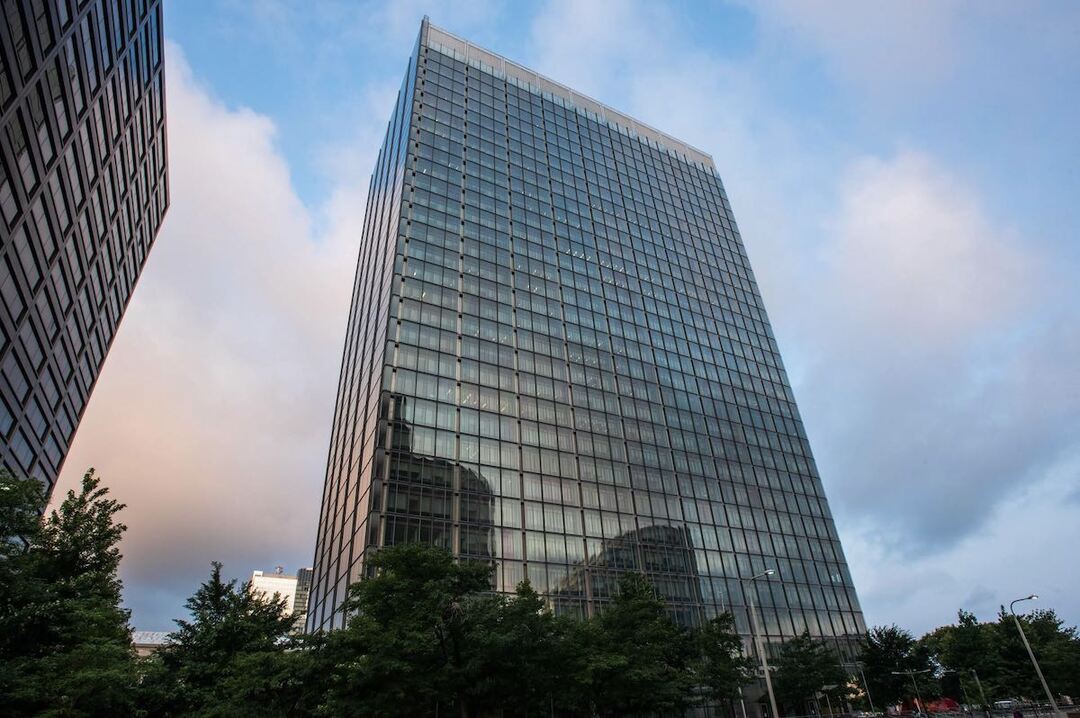
    <summary type="html"><![CDATA[<p><strong><em>When the federal government began planning its new building as part of the Erieview Plan, it departed from I. M. Pei’s original vision and chose a stunning new design that drew from the latest in Modernist thought. Forty years later, that building was showing its age and required a dramatic intervention. The solution was an innovative facade overclad system that changed the building’s appearance but maintained its original purpose and function.</em></strong></p><img src="https://clevelandhistorical.org/files/fullsize/08179223f0e96be7ec08765e524e5ec3.jpg" alt="The Anthony J. Celebrezze Federal Building" /><br/><p>The 1960s were a very active period for the construction of federal buildings in cities across the country, and Cleveland was no exception. As early as 1957, area members of Congress began pushing for the construction of a centrally located downtown federal office building that would consolidate federal services in the city. The site of the building was determined in 1960 as an integral part of the Erieview Urban Renewal Project in downtown Cleveland. This large scale, multi-phased urban planning project was led by renowned architecture firm I. M. Pei and Associates.</p><p>Pei’s 1960 master plan for the Erieview development included a mix of high- and low-rise commercial and residential buildings with more than fifty percent of the land left open for parks and malls. The plan was designed to be completed in two phases; a western area of 96 acres to be designated for primarily commercial use and an eastern area of 67 acres to be designated for residential buildings. The focal point, at the center of the development, was a forty-story office tower. Completed in 1964 and dubbed the Erieview Tower, this was the first part of the Erieview plan to be built. A new six-story federal building that was to occupy an entire city block was also a key part of Pei’s plan. In preparation for the Erieview redevelopment, more than 200 buildings were demolished, including the old Armory that was located on the site of the current Federal Building.</p><p>While I. M. Pei developed the master plan for the Erieview development, other architects were brought in to design the individual buildings, including the new federal building. The General Services Administration (GSA), established in 1949 to meet the needs of the growing federal government, selected three local architecture firms to work together on the design of the federal building: Outcalt, Guenther, Rode, Toguchi & Bonebrake; Schafer, Flynn & Associates; and Dalton & Dalton Associates. However, the GSA did not choose a lead designer for the project and left the three firms to resolve the issue. All three firms wanted to lead the project, so a compromise was reached that they would bring in an outside architect to be the lead designer. The firm principals originally thought about bringing in a famous architect to lead the project, but eventually decided to find an architect that worked for one of these significant architects. Peter van Dijk was working for Eero Saarinen and Associates in Bloomfield Hills, Michigan, at the time and was selected based on a suggestion by one of Calvin Dalton’s employees. Upon speaking with van Dijk, the principals at the three firms quickly decided he was the right person to lead the design of the Federal Building project.</p><p>The design process began in 1961 and continued through 1962. The architectural team was charged with designing a one million square foot federal office building with an “open, flexible, well-planned loft space for offices.” GSA also requested that a two-level parking garage, large cafeteria, and loading dock be included. According to van Dijk, the goal was “to produce a most elegant steel cage. A façade executed with strength and precision. A stressed skin smoothness with machine-like clarity. Good proportion, scale, detail and choice of appropriate materials and colors.”</p><p>After careful consideration and study of the site and GSA programmatic requirements, it was decided that the team would design a tall building, which was in direct contradiction to the concept design in Pei’s Erieview Master Plan. The designers’ decision to abandon the Pei design was based on their belief that a tall structure would relate to the existing Terminal Tower and the other buildings being designed in proximity at the time. In their opinion, the large donut-shaped plan did not conform with the “plans for open space and plazas.” They believed a tall building would provide for more space for outdoor plazas, as well as views of the downtown and lake from the upper floor offices. Following their conclusion, the team convinced Pei and GSA that “a tall, slim structure would be more in keeping” with the other high structures planned in the renewal area. </p><p>The building was designed as a simple rectangular shape and had the proportions of a golden rectangle. The design also contained a definite base, middle, and top and was intended to utilize simple materials (glass and stainless steel). Furthermore, according to van Dijk, the steel frame of the building became “the basis of the architectural expression of the façade.” The siting was also important to the designers. The building was purposely set back from East Ninth Street to provide room for a plaza at the main entrance and set back even farther on East Sixth Street to create a “garden plaza.”</p><p>The design was substantially completed by June 1962 when GSA issued an official press release regarding the new federal building in Cleveland. In the press release, GSA described the thirty-two story building as “an important element in the city’s Erieview Redevelopment Plan” that would “provide the lake-shore metropolis with an imposing landmark.” They also estimated that the building would cost $41.2 million to complete. </p><p>The Celebrezze Building was designed during a period of growing public acceptance of Modernist design. The Modernist movement in architecture, which had roots in Europe, began to flourish in the United States following World War II as architects like Walter Gropius and Mies van der Rohe expanded their influence. As the movement continued to thrive throughout the 1950s and into the 1960s, Modernism became the preferred style of architecture for office buildings across the country. Buildings such as the Seagram Building (1958) in New York City by Mies van der Rohe and Philip Johnson, as well as the Inland Steel Building (1957) in Chicago, Illinois by Bruce Graham and Walter Netsch of SOM, continued to push the envelope in Modernist design. Significant Modernist skyscrapers in Cleveland include the McDonald Investment Center (1968) by Charles Luckman; the Cleveland Trust Tower/Ameritrust Tower (1971) by Marcel Breuer; Earnest J. Bohn Housing Tower (1972) by William Dorsky Associates; the Diamond Building (1972) by SOM; the Holiday Inn Lakeside (1974) by William Bond; and the Sheraton City Centre Hotel (1975) – now the Crowne Plaza Hotel – by Bialosky and Manders.</p><p>The policies of the federal government also reflected the shift toward Modernist design. When John F. Kennedy assumed the presidency in 1961, he found many federal buildings to be lacking in efficient office space and inadequate for modern use. As a result, he requested that an Ad Hoc Committee on Federal Office Space be formed to develop solutions for short- and long-term space needs in federal buildings. In 1962 the committee issued its report, which included the “Guiding Principles for Federal Architecture.” In the “Guiding Principles” the committee recommended new mandates for “high quality architectural designs” for all new federal buildings across the country and developed a three-point system for federal architecture standards. They also encouraged modern principles of architecture through choice words within the standards, such as “contemporary,” “functional,” and “economical.” With the adoption of the new principles, the monotonous architecture of the previous decade gave way to new, innovative, quality design. Although the design of the Celebrezze Building was initiated before the Principles were published, it clearly exemplifies the Principles’ embrace of high-quality modern design.</p><p>The building’s expression of structure on the exterior façade follows the design principles of Mies van der Rohe, which can be seen in many of his works, including the Dirksen Federal Courthouse in Chicago completed in 1965. However, unlike Mies who used protruding mullions on his buildings, Peter van Dijk used only contrasting materials – stainless steel and glass – to emphasize the grid of columns and floor plates. According to van Dijk, the solid of the stainless steel and the void of the glass created a solid and void effect that clearly emphasized the building’s skeletal structure. The idea of an exterior skin with no protruding mullions was a concept van Dijk learned in the office of Eero Saarinen from projects such as the General Motors Technical Center in Warren, MI, and Bell Labs in Holmdel, NJ. It continued to be the subject of experimentation with other Saarinen followers, most notably Anthony Lumsden and Cesar Pelli. </p><p>In 1965, in the midst of the Civil Rights era, the construction of the new federal building in Cleveland became the subject of protests that received nationwide attention. Led by the National Association for the Advancement of Colored People (NAACP), picketers protested discriminatory hiring practices among the predominantly white trades unions involved in the construction of the building. The protest’s leadership also targeted the federal government “for its failure to enforce civil rights laws.” The Erieview plan, of which the federal building was a part, also appears to have strained community relations. Across the country at this time, many cities had undertaken similar projects that resulted in the displacement of their most vulnerable residents and the destruction of their homes, with disproportionate effects being felt by the African American population. In Cleveland, many poor Black residents perceived that the Erieview project, which was located in the heart of the downtown area and treated as a showpiece by politicians and government officials, was diverting badly needed resources from projects in critically underserved east side neighborhoods. This resentment, combined with myriad other factors, burst out into the open the following summer in the Hough Uprisings, an episode of violent unrest comparable to the riots that occurred in Harlem, Watts, and other urban areas during the 1960s. </p><p>The Cleveland Federal Building was substantially completed in the fall of 1966 at a cost of $31,968,000 (substantially less than the budgeted $41.2 million) and officially opened in early 1967. The new building housed more than fifty government agencies that had previously been spread out in buildings throughout the city. In 1973, the building was renamed in dedication of Anthony J. Celebrezze, former Mayor of Cleveland, Ohio Congressman, Secretary of Health, Education and Welfare in the Kennedy Administration, and U.S. Appeals Court Judge. As mayor, Celebrezze was an early proponent of the Erieview Urban Redevelopment Project and helped in the process of bringing the Federal Building project to realization. </p><p>Following its completion, the building underwent relatively few significant alterations until 2009, when GSA utilized funds available through the American Recovery and Reinvestment Act (ARRA) to begin a massive intervention addressing the condition of the curtain wall. Flaws in the original detailing and installation, water infiltration, the action of wind forces, and the harsh Cleveland winters had resulted in advanced deterioration on the façade’s various components. Additional assessments found the curtain wall to be strikingly deficient in terms of modern energy efficiency and security standards. Ultimately GSA decided to install a second skin on top of the existing façade, effectively overcladding the original building with an entirely new window wall system. </p><p>Pursuing this innovative approach allowed GSA to retain the existing building, thereby avoiding the expense and inefficiency of constructing an entirely new building and relocating the current building’s occupants. Additionally, it allowed the agency to preserve a historic asset. In 2011, the Celebrezze Building was determined eligible for listing in the National Register of Historic Places for its exceptional local historic and architectural significance. This determination rests on the Celebrezze Building’s distinguished modernist design and its role in the history of the Erieview plan and the development of the modern Cleveland skyline. It also recognizes Peter van Dijk as a master architect. Comparatively unknown at the time that he designed the Celebrezze Building, van Dijk went on to become one of the Cleveland area’s most celebrated designers. Following the Celebrezze Building, he designed the Blossom Music Center (1968) in Cuyahoga Falls. Subsequently, his firm developed a global reputation for expertise in the design of performance venues. A committed preservationist, van Dijk was also a driving force behind the plan to save Cleveland’s Playhouse Square theaters. Recognizing the need to address issues with the original design and construction of the Celebrezze Building, van Dijk supported and participated in the façade renewal project. Peter van Dijk passed away in 2019 at age 90.</p><p>Following the completion of the facade overcladding, the Celebrezze Building was identified as a contributor to the Erieview Historic District, which was listed in the National Register of Historic Places in 2021.</p><p><em><strong><a href="https://clevelandhistorical.org/items/show/1004">For more (including 13 images) view the original article</a></strong></em></p>]]></summary>
    <published>2023-06-10T14:32:46+00:00</published>
    <updated>2026-03-04T21:32:05+00:00</updated>
    <link rel="alternate" type="text/html" href="https://clevelandhistorical.org/items/show/1004"/>
    <id>https://clevelandhistorical.org/items/show/1004</id>
    <author>
      <name>Jorgen Cleemann</name>
    </author>
  </entry>
  <entry>
    <title type="html"><![CDATA[Shore Cultural Centre: A Public School Reimagined as a Community Hub]]></title>
    <summary type="html"><![CDATA[<img src="https://clevelandhistorical.org/files/fullsize/1a498c202ac3d28128ee6936109041cf.jpg" alt="Shore High School" /><br/><p>For nearly seven decades, the building that is now Shore Cultural Centre served as a public school. The Euclid Village School District built Shore High School in 1912-13 after it purchased land between Babbitt Road and East 222nd Street near where these roads converged at Lakeshore Boulevard in the heart of the suburban village. The three-story school was constructed at a cost of $42,500 and was paired with another new high school built near Euclid and Chardon Road, Central High School. Although Euclid remained a small village at that time, it stood on the cusp of significant growth as growing numbers of people moved to Cleveland’s first-ring suburbs. In its early years, Shore High School, like Central High, housed all grades. Only the top floor of Shore High School actually housed high school classrooms. Neither of the village’s high school buildings initially had an auditorium, necessitating the use of Euclid City Hall for graduation ceremonies. </p><p>By 1928, according to the Directory of Euclid, Euclid-Central and Euclid-Shore High Schools collectively served 615 pupils, a reflection of Euclid’s growth from about 2,000 to 12,000 people in the time since the schools opened. The directory also noted the strength of Shore High’s Musical Department, which staged many different productions, including “The Spring Maid” and “The Mikado.” The directory also claimed that Euclid had one of the largest village school systems in Ohio, a distinction that reflected the fact that Euclid was still two years away from being incorporated as a city. Shore High School’s continued growth led to the addition of eight new attachments to the original building over the next couple of decades. The school had known nothing but growth, so Euclid residents could only imagine more of the same. </p><p>Shore High School’s future became uncertain after World War II. With the suburb’s explosive growth, a new Euclid High School building opened for grades ten to twelve in 1949. As a result, both Shore and Central High Schools were converted into junior high school that housed grades seven to nine. The original Central High School building was demolished in 1968 following the construction of a newer building, while the original Shore High building continued to serve the district until Euclid began to experience population loss in the 1970s. With demand for classroom space receding, Shore Junior High School closed in 1982, leaving the 1913 building’s fate in question. </p><p>Thanks to the school building’s central location in the community, the city saw many offers over time by people who wanted to redevelop the land. However, the people of Euclid decided instead to recast the building as a community center. Shore Cultural Centre opened in 1985 and, following the school board’s sale of the building to the City of Euclid in 1989, it underwent a major renovation. Shore Cultural Centre reflected efforts by community leaders who had lived in Euclid for decades. One of them, Dolly Luskin, headed the effort to establish this center. Luskin had served on the school board for years in various leadership positions. She believed in the building’s potential as a place for teaching future generations about arts and culture while honoring a physical landmark from the city’s early years. Shore Cultural Centre preserves the memory of Shore High School as it provides cultural activities in the city. Its auditorium is the home of the Euclid Symphony Orchestra and serves other performing arts organizations, as well as some nonprofits and businesses. </p><p>Despite Shore Cultural Centre’s updated role in the community, it became the subject of debates about its utility. As early as 2007, some in the community argued that the building should be converted into some other use or sold to the highest bidder due to its land value. Ideas for what should be done with the building came from all angles, as seen in contentious local city council meetings. The problem, some argued, was that Euclid was pouring money into a facility that was losing more money than it made through renting its spaces. The city, which suffered a significant loss of its tax base after losing one-third of its population in the four decades after 1970, struggled in recent years to make needed repairs and improvements to the aging building. As a result, the city continued to troubleshoot the facility’s problems. By 2023, it had made some progress. Shore Cultural Centre received an earmark of federal funds to upgrade some of its infrastructure and was reportedly 93 percent occupied. </p><p>Shore Cultural Centre embodies the story of Euclid and, more broadly, of older suburbs. As a school, it rose from humble beginnings, grew with all the vigor of the suburb whose students it served. Then, as in many inner-ring suburbs, Euclid endured the deindustrialization and population flight to more outlying areas or even other states, leaving school facilities in excess of the need. The school’s reinvention was part of a wider effort to reinvest in the community, but like the city, Shore Cultural Centre continues to navigate toward the promise of a sustainable future for a historic asset.</p><p><em><strong><a href="https://clevelandhistorical.org/items/show/929">For more (including 9 images) view the original article</a></strong></em></p>]]></summary>
    <published>2020-12-13T22:25:05+00:00</published>
    <updated>2026-03-04T21:32:04+00:00</updated>
    <link rel="alternate" type="text/html" href="https://clevelandhistorical.org/items/show/929"/>
    <id>https://clevelandhistorical.org/items/show/929</id>
    <author>
      <name>Harrison McCreight</name>
    </author>
  </entry>
  <entry>
    <title type="html"><![CDATA[Historic Bedford: Preserving the Past in One of Cuyahoga County&#039;s Oldest Towns]]></title>
    <summary type="html"><![CDATA[<img src="https://clevelandhistorical.org/files/fullsize/4e61049230bbc72a5b899829d45f4949.jpg" alt="Town Hall" /><br/><p>Historic Bedford, located in downtown Bedford, Ohio, is a terrific example of the power of small-town preservation. Bedford, which has been around for more than 190 years, may be a small town, but it has connections to a big history. Indeed, much of the history of the United States unfolded in smaller towns such as Bedford. Historic Bedford’s preservation success owes much to the hard work of the Bedford Historical Society (BHS) in safeguarding the town's historic buildings. The historical society’s work uses the town’s landmarks, including the Hezekiah Dunham House and Old Town Hall, to tell Bedford’s story. The survival of small-town history begins with small-town preservation.</p><p>Historic Bedford is just a small strip along Broadway Avenue, but that small strip is filled with much rich history. The first settlers arrived in 1813 in what became Bedford, which was given the temporary name of Township 6. It wasn’t until 1823 that Township 6 finally became a village, which was soon named Bedford. One of the most famous houses in Historic Bedford was the Hezekiah Dunham House, which was built in 1832. Four years later, Hezekiah Dunham and wife Clarissa signed a document that gave grant of the land in Lot No. 46 to the trustees of the Township of Bedford. With the land deeded by the Dunhams, residents of Bedford began to build houses, churches, businesses, the Old Town Hall, the Wheeling & Lake Erie Railway depot. By the mid-19th century the village of Bedford quickly turned into a prosperous town where several illustrious historical events occurred.</p><p>Certainly, one of the most noteworthy moments in Bedford’s history was when President Abraham Lincoln stopped in the village on February 15, 1861, at the Wheeling & Lake Erie train depot. The newly elected president was on his way to Washington, D.C., for his inauguration and stopped in Bedford that day around 3:30 p.m. to greet the townspeople. According to an account by Bedford historian Dick Squire, “The train slowed as it neared the Bedford station. The tall figure of Mr. Lincoln emerged from the warmth of the coach and stood on the rear platform, acknowledging the cheering crowds.” Lincoln only spent a few minutes in town, but his presence turned those few minutes into a historic event.</p><p>In addition to Lincoln’s visit, the story of Julius Caesar Tibbs, the Strawberry Festival, and the Spirit of ’76 were other highlights in Bedford’s history. Julius Caesar Tibbs was born into slavery in Virginia in 1812. Tibbs escaped the plantation and was later found at the Burns Farm in Bedford. Bedford was known for its strong anti-slavery feelings, which is why the village became a stop along the Underground Railroad. There the Burns family gave Tibbs food and provided him with a place to stay on their farm. The Strawberry Festival is an annual festival, sponsored by the Bedford Historical Society. The festival was created in June of 1964 in hopes of raising funds for the Bedford Historical Society to use towards preserving historic buildings in Bedford. In another example, by 1976, as America celebrated its Bicentennial, the BHS made copies of the famous painting, “The Spirit of ‘76”, and even created items using the theme “Spirit of ‘76”. During this time many small towns were finding ways to contribute to the celebration of the Bicentennial. Historian M.J. Rymsza-Pawlowska states in her book <em>History Comes Alive</em> that, “…individual states were also preparing for 1976 and began to use their own regional histories to find relevance Bicentennial in ways that often diverged from the federal vision.” The Spirit of ’76 is an example of Bedford connecting to the nation’s history at one of the most important commemorative moments. </p><p>The importance of preserving small-town history begins with the small history that contributes to the town. Historic buildings are the physical markers of the town’s history, and these buildings become daily reminders of a place’s past. It is important to remember that preserving a town's historic building provides a sense of pride for the community. Although the businesses contributed to the growth of Bedford’s economy and history, the buildings that stood out the most must be the Hezekiah Dunham House and the Town Hall. Both buildings are listed in the National Register of Historic Places, but each contributes differently to the history of Historic Bedford. For example, in 1832 the Hezekiah Dunham House was built by one of Bedford’s earliest settlers, Hezekiah Dunham. While the Dunham House began to gain notoriety, the establishment and construction of the Town Hall started. By 1874, the Town Hall was finally complete and became the tallest structure among the local landmarks. The Town Hall was used for public meetings, speeches, lectures, and productions at the opera hall located inside of the Town Hall.</p><p>By the early 1970s, following the Historic Preservation Act of 1966, many small towns decided to preserve historic buildings. Bedford was no exception. The Dunham House became the first phase of a restoration project launched by the Bedford Historical Society. In order to accomplish restoration of the house, the Bedford Historical Society created a Restoration Fund Account (RFA) designated solely for preserving and restoring historic structures. With the RFA, the BHS fixed the Town Hall for $35,000 and turned the building into Town Hall Museum, which is filled with collections such as extensive forms of lighting, clothing and textiles, military uniforms, small arms, and assorted memorabilia. The museum also contains a library, archive, and became the home for the Bedford Historical Society. Along with the Town Hall the Dunham House was restored and used as a museum, which transport individuals to the mid-1800s with its period furniture and gorgeous stenciling. Although less commonly cited than Chagrin Falls and Hudson, Historic Bedford is a great example of a small town that used its small and big history to preserve building structures, and shine light on the importance of small-town preservation.</p><p><em><strong><a href="https://clevelandhistorical.org/items/show/885">For more (including 7 images) view the original article</a></strong></em></p>]]></summary>
    <published>2019-11-20T20:17:24+00:00</published>
    <updated>2026-03-04T21:31:58+00:00</updated>
    <link rel="alternate" type="text/html" href="https://clevelandhistorical.org/items/show/885"/>
    <id>https://clevelandhistorical.org/items/show/885</id>
    <author>
      <name>Jeri Baboryk</name>
    </author>
  </entry>
  <entry>
    <title type="html"><![CDATA[Wheeling and Lake Erie Railway Depot]]></title>
    <summary type="html"><![CDATA[<img src="https://clevelandhistorical.org/files/fullsize/9a1b7e6fc48cad9fb55dabd6457eb774.jpg" alt="Connotton Valley Railroad Train" /><br/><p>Did you know that Abraham Lincoln visited Bedford, Ohio, via train? In February of 1861, the president-elect journeyed through Bedford on the Cleveland and Pittsburgh Railroad (C&P) while on his way from Springfield, Illinois, his hometown, to Washington for his inauguration. The train carried Lincoln, his wife, and their three sons. As the train passed by the C&P depot, he waved from the platform of the train to welcoming residents. A few years later, in 1865, Lincoln made his way to his hometown from the Capitol, but this time he did not get out and wave. His funeral train made the 1,700-mile voyage back to Springfield, stopping in major cities like Baltimore and Cleveland for Americans to pay their respects to the fallen president.</p><p>The railroad industry brought many individuals to Bedford, including Abraham Lincoln, James A. Garfield, William McKinley, Warren G. Harding, and Herbert Hoover; these men and their families rode the C&P, which stopped in Bedford on the way to the developing city of Cleveland. Trains and railroads became an important industry, fueling the economic growth of many small suburbs, like Bedford, which is located about 12 miles southeast of Cleveland. </p><p>The Wheeling and Lake Erie Depot is the last standing historic railroad depot in Bedford. The Connotton Valley Railroad Company (bought by the Wheeling and Lake Erie Railway Company in 1899) built the depot in 1882 when it decided to expand its tracks through Bedford’s Public Square. The depot’s location in the Public Square, next to the 1874 Town Hall building was significant as it was at the center of the town’s economic activities. Throughout the years, this depot has fueled economic activity and development in Bedford.</p><p>The town began to adopt the role of a suburb during the time of “railroadization,” which was only reinforced with the 1882 opening of the Connotton Valley Railroad (CV) Depot. Trains and interurban streetcars, like the Akron, Bedford, and Cleveland (AB&C), created a direct route to Cleveland and areas of southern Ohio. Frequent schedules for passenger trains between Bedford and Cleveland were used to entice city dwellers to the suburbs. The Plain Dealer carried an advertisement for Bedford, claiming it to be the “most beautifully situated of all Cleveland’s suburbs—the healthiest town in Ohio to make a home—only twelve miles from the [Cleveland] Public Square, with the best of railroad facilities.” In addition to passengers, the railroads brought freight, including coal, to the town. The construction and subsequent use of this depot, as well as the C&P Depot, brought developers and new industries, like the Franklin Oil and Gas Co., to the developing area.</p><p>The depot is a characteristic late 19th century small town train station, transporting passengers and freight. Before being donated to the city, the depot had been used as storage space and offices from the train depot’s last use as a stop for passenger trains in July 16, 1938, to its donation in 1986. It furthermore embodies the evolution of railway companies. Built by the Connotton Valley Railroad, the Wheeling and Lake Erie Railway Company (WL&E), chartered to the Nickel Plate Road from December 1949 to 1964, and then served the Norfolk and Western Railway following yet another merger. In 1982, the Norfolk and Western became the Norfolk Southern Railway. The original lines of the WL&E were sold in June 1990 to a new railroad, which adopted the original name (WL&E)  and still runs today.</p><p>The Norfolk Southern Railway Company, which owned the depot after many mergers, donated the building, 104 years old at that time, to the city in 1986. The City of Bedford, along with the help of the Bedford Historical Society and many of Bedford’s residents, began the restoration of the railway depot in 1986, completing it in 1989. The historical society intended it to be an annex of the museum, displaying railroad mementos from years of the depot’s use. For this project, the historical society and city relied on $85,000 in state grants, including the State of Ohio’s historic preservation grant, $12,000 in federal funding, and donations. Unlike other historic preservation sites, this railway depot was not restored to its original 1882 style, but to the 1920s era passenger station. Bedford’s Wheeling and Lake Erie Railway Depot has been on the National Register of Historic Places since 2004. Work has been continually done on the square since the 1980s to preserve the city’s history with the intention of furthering memories of the city’s past and creating a central cultural feature in Bedford.</p><p><em><strong><a href="https://clevelandhistorical.org/items/show/820">For more (including 17 images) view the original article</a></strong></em></p>]]></summary>
    <published>2017-11-27T13:10:45+00:00</published>
    <updated>2026-03-04T21:32:03+00:00</updated>
    <link rel="alternate" type="text/html" href="https://clevelandhistorical.org/items/show/820"/>
    <id>https://clevelandhistorical.org/items/show/820</id>
    <author>
      <name>Jenna Langa</name>
    </author>
  </entry>
  <entry>
    <title type="html"><![CDATA[Colonial Hotel]]></title>
    <summary type="html"><![CDATA[<img src="https://clevelandhistorical.org/files/fullsize/45aede22394e0d51e961ccfb60c9bd60.jpg" alt="Colonial Hotel Cleveland" /><br/><p>The Colonial Hotel, now called the Residence Inn, is located on Prospect Avenue next to Cleveland’s historic East 4th Street. The hotel was built in 1898 in combination with the Colonial Arcade by designer George H. Smith, who was also the architect of “The Arcade,” Cleveland’s more famous shopping street under glass which was built in 1890. The Colonial Hotel opened on October 21, 1898, with an informal ceremony, which was attributed to the fact that it opened a day earlier than scheduled. The Colonial Arcade, however, was not fully complete until 1911, when John F. Rust hired architect Franz Warner. Warner was able to design an adjacent arcade that would link the William and Rodgers buildings on Euclid Avenue (one block to the north) with the Colonial Hotel, thus creating the Euclid Arcade. Today the interconnected Colonial and Euclid Arcades are known together as the <a href="https://clevelandhistorical.org/items/show/236">5th Street Arcades</a>.</p><p>Within a year after opening, the hotel was already being improved with the addition of a 100-room wing on the Prospect Avenue side and parallel to the Colonial Arcade. Another expansion occurred in 1901, adding nearly one hundred rooms and expanding the hotel’s restaurant. The hotel during this period occupied a considerable amount of property on the Euclid side of the street, but the side facing Prospect Avenue was shallow in comparison. With this enlargement, the Colonial Hotel would be one of the largest hotels in the city. This renovation was started so the Colonial could keep up with the accommodations and luxuries that other hotels in the city were offering. In fact, it was speculated that the Colonial only decided to attempt this expansion to keep pace with the Hollenden Hotel, which, at this period, was one of the most luxurious hotels in the city. </p><p>In the 1930s, however, during the Great Depression, Cleveland’s unemployment rate rose to encompass nearly a third of its population, which impacted the hotel industry drastically. The Colonial dealt with this problem rather well, and in fact, some of their only concerns were simply competing with other hotels in Cleveland and attempting to attract more patrons with fresh new ideas and amenities.</p><p>Though the Colonial had survived the worst economic period in the nation’s history, the hotel eventually began to decline in later years as Cleveland took a turn for the worse. This occurred in the 1970s and the 1980s, a time when Cleveland lost close to twenty-five percent of its entire population. By 1975, Cleveland stood in the nation’s highest quintile among cities in terms of poverty, unemployment, poor housing, violent crime, and municipal debt. The Colonial Hotel also felt this pressure, first by changing ownership to the Milner Hotel Company, which was based in Detroit, Michigan. This transfer was all the Colonial could do to keep alive during this tough economic time. After this exchange, things seemingly got worse for the Colonial. The Colonial kept getting devastatingly bad luck, which reflected in the <em>Plain Dealer</em>, most notable being two deaths that occurred within five years of each other. The first death being Dan Duffy, a popular lawyer in Cleveland and a beloved patron to the Colonial Hotel. The second death was a John B. Caduff, whom tragically died in a fire, caused by Caduff carelessly smoking. Finally, however, to finish off these hard economic times, the Colonial Hotel closed in 1978. </p><p>This was not the end of the Colonial Hotel, however. Twenty years after the hotel's closing, an idea to re-open the hotel came into the minds of businessmen as part of broader attempts to preserve and revitalize Cleveland’s historic downtown area. This project finally got underway in 1998, when investors partnered with Marriott, a thriving hotel company, and wanted to open a Residence Inn in the former Colonial Hotel. The project would not only put a new hotel in the heart of downtown, it would also revitalize the Cleveland arcades. This eventually led to a $30 million project to renovate the space into extended stay lodging with 144 rooms of a Marriott Residence Inn and nearly 60,000 square feet of shopping. This hotel eventually opened in 2000 and would thrive amid a reemerging entertainment district.</p><p><em><strong><a href="https://clevelandhistorical.org/items/show/819">For more (including 8 images) view the original article</a></strong></em></p>]]></summary>
    <published>2017-11-26T15:38:17+00:00</published>
    <updated>2026-03-04T21:32:03+00:00</updated>
    <link rel="alternate" type="text/html" href="https://clevelandhistorical.org/items/show/819"/>
    <id>https://clevelandhistorical.org/items/show/819</id>
    <author>
      <name>Keanu Hallowell</name>
    </author>
  </entry>
  <entry>
    <title type="html"><![CDATA[Charles F. Schweinfurth Residence: The Unostentatious Home of the Man that Molded Beauty  ]]></title>
    <summary type="html"><![CDATA[<p><strong><em>"So you may know my life has been a happy and busy one, if at times, architecturally lonesome." – Charles F. Schweinfurth</em></strong></p><img src="https://clevelandhistorical.org/files/fullsize/3c1c1eb54472a74b8b786aba07c8bbc1.jpg" alt="Front of Schweinfurth Residence" /><br/><p>As you look around Cleveland – attuned to the city's built landscape – you may not know it, but you are looking at many structures designed by the renowned architect Charles Frederick Schweinfurth. He envisioned the most expensive private residence, Mather Mansion, built on the acclaimed Millionaires' Row and erected his masterpiece Trinity Episcopal Cathedral. Schweinfurth's "sound mentality and intellectual discipline of a high order, supplemented by a thorough mastery of technical knowledge" sounded through in the design of the Union Club, and the stone bridges that accent the Cultural Gardens. Not only did Schweinfurth design these beautiful architectural works of art, he lived and thrived in the urban landscape that he was charged with making so aesthetically pleasing. During his successful tenure as one of Cleveland's master architects, Schweinfurth also conceived his own private residence on East 75th Street, formerly known as Ingleside Avenue. </p><p>What became the Schweinfurth residence was originally proposed for one of his clients W.K. Vanderbilt. In his book <em>Cleveland Architecture 1876-1976</em>, Eric Johannesen notes that "Vanderbilt was chairman of the Lake Shore & Michigan Southern Railroad" and a member of the famed robber baron family. Nevertheless, these plans fell through for unknown reasons and Schweinfurth took control of the property and set forth to design a home that truly expressed his own stylistic flare. In 1894, Schweinfurth's Romanesque Revival unostentatious home was completed. Schweinfurth occupied the home from 1894 until his death in 1919. In 1915 he "enlarged the original house … to provide [for an] additional dining area and space for servants and guests, as well as [a]…small conservatory." Over time, the lots down E. 75th Street were procured and the wealth of Euclid Avenue flowed off of the main artery onto the side streets. But then the area took an unimagined turn. </p><p>White flight to the suburbs changed the character of the neighborhood. The mansions and other grand homes were either boarded up, torn down, or chopped up by slum landlords eager to make a quick buck at the expense of the new predominantly African American clientele. The Schweinfurth home, no longer a private residence, continued after 1930 as the William L. Wagner & Son Funeral Home. The City of Cleveland turned away from the Midtown Corridor, leaving the people and structures to splinter into vermin riddled streets. A resident of E. 75th recalled looking out his "'window at the neighbor's house and watch[ing] the ground under the garbage cans writhe with rats.'" The Hough Riots of 1966, which were in no small way a response to the lack of investment in the area, did not propel the City of Cleveland or private investors to revive the area that "when Cleveland was a boom town… was the neighborhood in which to live." Banks only perpetuated the problem. Local banks redlined the neighborhood because it was overwhelmingly "occupied by persons at the bottom of the economic heap." It was not until 1970—when R. Van Petten and his partner Dale H. Smith purchased the former Schweinfurth property after convincing an African American bank to sign a loan agreement—that a twinkling of resurgence gleamed on the horizon. </p><p>Van Petten and Smith labored away, restoring the residence to its original simple elegance, while the rest of the street continued to suffer from urban decay. The new owners hoped that their personal investment in the area would encourage others to follow, but the home for decades remained an "oasis-in-the-desert." In the 1970s, Van Petten and Smith started a preservation movement in the Midtown Corridor that never quite caught. Once investment and economic recovery acts were implemented in the Midtown Corridor, new construction became the answer. Today the winding roads of infrastructure and the expanding Cleveland Clinic campus has architecturally sterilized much of the neighborhood. The former Schweinfurth residence remains an "architecturally lonesome" part of the Ingleside Historic District.</p><p><em><strong><a href="https://clevelandhistorical.org/items/show/810">For more (including 8 images) view the original article</a></strong></em></p>]]></summary>
    <published>2017-08-23T18:02:06+00:00</published>
    <updated>2026-03-04T21:32:03+00:00</updated>
    <link rel="alternate" type="text/html" href="https://clevelandhistorical.org/items/show/810"/>
    <id>https://clevelandhistorical.org/items/show/810</id>
    <author>
      <name>Sarah Nemeth</name>
    </author>
  </entry>
  <entry>
    <title type="html"><![CDATA[Fairmont Creamery]]></title>
    <summary type="html"><![CDATA[<img src="https://clevelandhistorical.org/files/fullsize/596e8347012cdf776c9e159500b94900.jpg" alt="Fairmont Creamery Delivery Drivers, 1941" /><br/><p>Fairmont Creamery Company was founded in Fairmont, Nebraska, near Omaha, in 1884—an early “national dairy” with operations stretching from the Dakotas to Buffalo, New York. Fairmont was a pioneer in milk can pickup and one of the first creameries to provide farmers with their own hand-operated cream separators. In 1948 the company was re-branded as Fairmont Foods. It also became a Fortune 500 company and was granted a seat on the New York Stock Exchange in 1959.</p><p>Fairmont Creamery’s Cleveland operation opened in 1930 in a five-story building at 2306 West 17th Street, directly across Willey Avenue from what is now the Animal Protective League. Designed with two floors of manufacturing space and room for 75 delivery trucks, the facility also could accommodate railcar delivery input and output through its lower floor receiving room. For decades, a variety of dairy products were processed and distributed at the Cleveland facility. Local residents bought ice cream cones at a retail window. Employees from Tremont and Ohio City enjoyed short walks to work. </p><p>In the early 1980s all of Fairmont Foods’ properties and subsidiaries were either sold or closed, including the Cleveland operation. The West 17th Street building stayed largely empty for roughly 30 years, save for a small nickel-chrome-plating business that worked out of the basement. Dust, debris and an occasional squatter were all that occupied the remaining spaces.</p><p>In 2013, a trio of aggressive young developers—recent graduates of Oberlin College—stepped in and brought new life to the old building. Ben Ezinga, Josh Rosen and Naomi Sabe, founders of Sustainable Community Architects, purchased the building for $450,000. Comprising federal New Markets Tax Credits; state and federal historic preservation tax credits; a JobsOhio grant; city vacant property initiative funds; private equity investment; and a Goldman Sachs construction loan, $15 million was poured into a residential/commercial renovation, which was completed in 2015. The repurposed creamery includes 30 apartments and several ground-floor businesses. </p><p>Sustainable Community Architects worked to retain and celebrate the building’s history. Walk-in coolers were transformed into bedrooms and gym locker rooms. Huge concrete columns and beams, along with brick interior walls (originally glazed for food safety) became interior highlights. Windows, doors and signs were rebuilt in the 1930s style. According to Josh Rosen “the building is a reminder that people make stuff in this city; we wanted to expose the building’s original features rather than hide them.” </p><p>At the same time, the property also incorporates the best of the new. Natural light permeates living spaces. Each apartment has a unique design and layout. A 3,500-square-foot rooftop deck offers a place to lounge, garden, picnic and enjoy panoramic views of downtown Cleveland. However, the best juxtaposition of old and new may be that Fairmont Creamery is concurrently a Cleveland Landmark and a site on the National Register of Historic Places, and conforms to modern eco-friendly standards such as Leadership in Energy and Environmental Design (LEED) and Enterprise Green Communities. </p><p><em><strong><a href="https://clevelandhistorical.org/items/show/751">For more (including 5 images) view the original article</a></strong></em></p>]]></summary>
    <published>2015-12-10T07:42:17+00:00</published>
    <updated>2026-03-04T21:32:03+00:00</updated>
    <link rel="alternate" type="text/html" href="https://clevelandhistorical.org/items/show/751"/>
    <id>https://clevelandhistorical.org/items/show/751</id>
    <author>
      <name>Chris Roy</name>
    </author>
  </entry>
  <entry>
    <title type="html"><![CDATA[The House That Brass Built: The Farnan Family Builds One of Detroit Shoreway&#039;s Treasures]]></title>
    <summary type="html"><![CDATA[<img src="https://clevelandhistorical.org/files/fullsize/3f6c070bd717c2c46e9668d86a978117.jpg" alt="The House that Brass Built" /><br/><p>The yellow pastel colored, Italianate style house on the corner of W. 73rd Street and Herman Avenue, which in recent years has been restored to its nineteenth century grandeur, was built by a member of the family that pioneered Cleveland's brass industry.
Cleveland's first brass foundry was built in 1852 on Center Street (located in the East Bank of the Flats) by Irish immigrant Walter Farnan. The business quickly flourished as brass was a important metal alloy used in many products manufactured in the nineteenth century. It was especially critical in the construction of municipal water works systems, and thus Farnan Brass Works became an early supplier in the 1850s to the Cleveland waterworks system.
In 1860, Walter Farnan's oldest son James, now active in the family business, purchased 12 acres of farmland on Detroit Avenue in what was then northern Brooklyn Township. Today it is part of the Detroit Shoreway neighborhood of the west side of Cleveland. According to county tax records, James Farnan, who became owner of Farnan Brass Works upon the death of his father in 1866, built the house which is the subject of this story in 1870. Unfortunately, James did not live long enough to enjoy his grand house. He died from cancer in 1875 at age 44. Mary Farnan, his widow, not only completed the task of raising the couple's four surviving children but, in addition, took over the reins of Farnan Brass Works, running the company for 36 years until her own death in 1911. She was so successful as a business woman that, in 1894, she was able to hire noted local architect W. D. Benes to design an extensive remodeling of her home.
The house that brass built was originally located on what is now the northeast corner of W. 70th Street and Detroit Avenue. Several years after Mary Farnan's death, the house was purchased by Thomas "Coal Oil" Masterson, an Irish immigrant, political activist and local entrepreneur, who, in 1917, moved the house to <a href="https://clevelandhistorical.org/items/show/288">Kilbane Town</a>. Masterson and his family lived in the house on the corner of W. 73rd and Herman for nearly 50 years. It was sold by the family in 1968 shortly after the death of Thomas Masterson's widow, Ida.
In the late 1970s and early 1980s, efforts began to be undertaken by concerned citizens to revitalize Cleveland's historic Detroit Shoreway neighborhood, including rehabilitating and restoring many of the historic houses in the neighborhood. Tim and Mimi Elliott, two suburbanites, moved into the neighborhood and began restoring a number of those historic houses.  One of them was the Farnan's Italianate mansion that Coal Oil Masterson had moved to the corner of W. 73rd and Herman. The restoration of that house by the Elliotts took years of patience, hard work and quality craftsmanship.  Today, as a result of their labors, the house that brass built is once again a neighborhood jewel.</p><p><em><strong><a href="https://clevelandhistorical.org/items/show/524">For more (including 8 images) view the original article</a></strong></em></p>]]></summary>
    <published>2012-07-17T09:55:55+00:00</published>
    <updated>2026-03-04T21:32:00+00:00</updated>
    <link rel="alternate" type="text/html" href="https://clevelandhistorical.org/items/show/524"/>
    <id>https://clevelandhistorical.org/items/show/524</id>
    <author>
      <name>Jim Dubelko</name>
    </author>
  </entry>
</feed>