<?xml version="1.0" encoding="UTF-8"?>
<feed xmlns="http://www.w3.org/2005/Atom">
  <title type="text">Cleveland Historical</title>
  <updated>2026-05-10T00:03:33+00:00</updated>
  <generator uri="http://framework.zend.com" version="1.12.20">Zend_Feed_Writer</generator>
  <link rel="alternate" type="text/html" href="https://clevelandhistorical.org/"/>
  <link rel="self" type="application/atom+xml" href="https://clevelandhistorical.org/items/browse?output=rss2"/>
  <id>https://clevelandhistorical.org/</id>
  <author>
    <name>Cleveland Historical</name>
    <uri>https://clevelandhistorical.org</uri>
  </author>
  <link rel="hub" href="http://pubsubhubbub.appspot.com/"/>
  <entry>
    <title type="html"><![CDATA[Adele&#039;s Lounge Bar: A Home for Beatniks, Bikers, Co-eds, and Hippies]]></title>
    <summary type="html"><![CDATA[<p><strong><em>For a short time, a small and humble lounge served as a home for a diverse assortment of people to enjoy each other's company, write poetry, organize activism, and sometimes seek a higher level of consciousness. But surrounding institutions did all in their power to close it down.</em></strong></p><img src="https://clevelandhistorical.org/files/fullsize/17b684014c408712aa2b75d489c25474.jpg" alt="Martin Prengler Serving Patrons" /><br/><p>Travel back in time to the sixties, and the epicenter of Cleveland’s counterculture scene may well have been 11605 Euclid Avenue, where a small and humble bar was nestled in an ordinary storefront built in front of a turreted Victorian rooming house on the north side of the street between East 115th and 116th Streets. There, one could find an inclusive atmosphere that hosted patrons of many backgrounds and worldviews, a place where Marty and Sam would welcome their patrons with a pint of beer. This little gathering place was Adele’s Lounge Bar, which opened in 1954 in a commercial building that also housed L. Schwartz Antique Shop next door.</p><p>One faithful patron, Paul Hilcoff, recalls, “It was a long, fairly narrow space. When you entered from the street, the bar was along the wall on the right. An aisle ran behind the bar and the remaining space was filled with wooden tables. I'm fairly sure there were no booths…. By evening on most days, it was crowded, and there was a perceptible buzz in the air. On weekend nights you'd be lucky to squeeze in there at all, let alone get a table. Lighting was typical barroom-dim, but adequate to pick out faces at the other end of the room… just the usual stale-beer-and-cigarette-smoke background radiation that always permeated well-attended bars.” Yet there was something more important than appearances at Adele’s—the atmosphere and culture it created.</p><p>Adele’s is remembered for its diverse clientele, as it was home to bikers, college kids, poets, artists, musicians, hippies, members of the LGBTQ community, interracial couples, and the not-so-occasional high schooler. Hilcoff describes what made Adele’s important to its former patrons: “One of the chief attractions of Adele's, at least from my perspective, was that it was a place where outsiders and misfits could feel comfortable. This atmosphere had already been established by the time I started going there.” But by being home to so many diverse patrons, Adele's caught the attention of University Circle institutional leaders and the Cleveland and Circle police forces, who increasingly disliked the unpredictability and sometimes disorder along Euclid Avenue.</p><p>Adele’s peaceful bliss and coexistence within its own community would soon come to end. In the years after its formation in 1957, the University Circle Development Foundation (UCDF) set its sights on de-urbanizing the Circle as well as discouraging establishments and crowds that it believed would be undesirable for the community. Unfortunately, in its view, Adele's Lounge Bar and other popular hangouts along Euclid Avenue fit this description. </p><p>As a home to countercultural ideas, Adele’s saw a lot of activism being conducted underneath its roof. Adele’s was also known as one of the few inclusive bars that were friendly toward LGBTQ people, which troubled a lot of traditionalists. In addition, Adele’s was home to underground activist and post-Beat poet d. a. levy, who infamously ran multiple periodicals such as <em>Buddhist Third Class Junkmail Oracle</em> and <em>Marrahwanna Quarterly</em>. Institutional leaders had no room for places like Adele’s in their new plans for the Circle.</p><p>Adele’s had a darker side that made it easier for its antagonizers to prey upon it. The culture of Adele's was not so different from the counterculture sweeping the rest of the country. Adele’s, neatly located near Case Tech and Western Reserve University, attracted hordes of young people, many of them from nearby colleges or the Heights suburbs, and some of them engaged in illicit drug use or consumed alcohol under age. By 1966 the use of marijuana, LSD, and other drugs started to catch the attention of the community and law enforcement. Some accounts suggest that dealers sold drugs to adolescents not only outside of the lounge but in it as well. There were also multiple accounts of alcohol being served to minors in the establishment. With violations of this nature, Adele’s soon found itself in the court systems.</p><p>The way to permanently shut down Adele’s Lounge Bar seemed to be through inflicting harsh punishments for liquor violations. Throughout its remaining years, Adele’s would spend a great amount of time temporarily closed or operating without a liquor license. Tragically, on February 3, 1969, a fire broke out in the early morning hours, leaving Adele’s completely destroyed and condemned by the city. Authorities blamed an arsonist for the fire, but the destruction of the business would go unpunished. Finally, then, fire accomplished what heavy policing and litigation could not—forcing Adele’s to close for good.</p><p>Though some in the media derided it as a haven for “alcoholics and LSD freaks,” Adele’s and similar establishments nearby served as oases for poets, musicians, and activists. And, as one article stated, Adele’s had been “perhaps the only place where an interracial couple wouldn’t feel watched, or where people could talk about socialism or the Bomb without being harassed.” Despite the backlash that Adele’s stirred, its community seemed to look back fondly on the decade of peace, love, and drugs when Adele’s was the heart of countercultural Cleveland.</p><p><em><strong><a href="https://clevelandhistorical.org/items/show/984">For more (including 10 images) view the original article</a></strong></em></p>]]></summary>
    <published>2022-11-24T16:40:03+00:00</published>
    <updated>2026-04-17T19:17:42+00:00</updated>
    <link rel="alternate" type="text/html" href="https://clevelandhistorical.org/items/show/984"/>
    <id>https://clevelandhistorical.org/items/show/984</id>
    <author>
      <name>Savannah Shaver</name>
    </author>
  </entry>
  <entry>
    <title type="html"><![CDATA[Little Ted&#039;s Restaurant and Bar: The Lost Little Hole in the Wall]]></title>
    <summary type="html"><![CDATA[<p><strong><em>It’s Saturday night, and you’re looking for somewhere to cruise. You don’t want to head to Mac and Jerry’s; the last time that you were there you went for a tall drink of water who didn’t quite swing your way. But he did plenty of swinging once you dared to speak to him. You can’t go back to the Cadillac Lounge; you broke Gloria’s “twelve-inch rule” with a quick kiss and got yourself banned last week. The other places that sprang up after the war have dwindled, and you can never be sure what other "safe" bar is open this month. Well, there’s always Little Ted’s…</em></strong></p><img src="https://clevelandhistorical.org/files/fullsize/f81dc06857949879f0899dfc5c0c9993.jpg" alt="Little Ted&#039;s Restaurant and Bar" /><br/><p>Little Ted’s Restaurant and Bar was nestled in a dense business block catty-corner from Superior Avenue and East 3rd Street, right across from the Cleveland Public Library, and was owned and operated by restaurateur Ted Miclau. From 1944 to 1955, people would have been able to see the neon signs and walk in for some chicken paprikash or steak and greens, while enjoying the novelty of air-conditioning on a hot summer’s day and televisions showing live broadcasts throughout the day. The restaurant was popular, with regular advertisements in local papers touting well-cooked meals for a decent price, as well as musical acts for the bar downstairs. Little Ted’s also regularly appeared in papers as the venue for various events: A luncheon for the local American Civil Liberties Union, where the national head spoke to the assembled about new legislation and what it meant for labor rights. A dinner for the Yugoslavian University Club, where college students could mingle and listen to talks about conditions abroad from the <em>Plain Dealer's</em> foreign affairs editor. And, on December 31st, a big blowout party where guests would be able to enjoy live music, party favors, hats, and noisemakers to ring in the New Year included with their purchase of dinner.
By all accounts, Little Ted’s was a cornerstone of the community, and Ted Miclau was a pillar that rested on it. Born in Romania, Theodore Miclau was later apprenticed to a beautician, for whom he worked until he moved to Chicago, Illinois in 1926, where he built up a chain of five beauty shops and parlors. While there, he earned the nickname “Little Ted” due to his short stature and gentle speaking voice. With the repeal of the Prohibition Act, he purchased and renovated an old building and opened up one of the first legal nightclubs in the city, “Little Ted’s Garden.” Unfortunately, the Chicago Mafia had a vested interest in ensuring the bars of the city did not compete with their own now-legal speakeasies. Not without paying for protection, at least. “...one night, gangsters kidnapped me from my night club… They stuck a gun in my ear, beat me up, and threatened my family unless I bought their protection.” </p><p>The Chicago Mafia’s scare tactics did not end with this incident, and Miclau was forced to flee back to Romania in 1937. He would not return to the United States until 1943, and chose to re-settle in Cleveland, where he attempted to renovate an old nightclub called “the Showboat.” The project wound up falling through, and Miclau purchased a property at 304 Superior Avenue Northeast, renovated it, and named it “Little Ted’s Restaurant and Bar,” which would become quite an upstanding establishment and the start of a chain of “Little Ted’s” businesses. These included Little Ted’s Black Angus Restaurant, Little Ted’s Loop Cafe, Little Ted’s Latin Lounge, Little Ted’s Towne Casino, and Little Ted’s Pearl Motel. However, Little Ted’s had a secret. It was not just a family restaurant that hosted police balls and big meetings and wedding receptions… its basement was also a safe space for gay men to socialize and cruise.
Pre-Stonewall Cleveland had few options for members of the queer community to get together safely. Civil rights groups like the Mattachine Society and <a href="https://clevelandhistorical.org/items/show/880">G.E.A.R.</a>, the Gay Educational and Awareness Resources foundation, would not come to the city for decades. And openly queer bars and nightclubs like Snickers or the Five-Cent-Decision were even further off. In his very directly titled essay, “The Cleveland Bar Scene in the Forties,” John Kelsey described a world of uncertainty and shifting safe spaces. Gay men had no option to be open due to Ohio’s existing anti-gay laws, and had to make do with bars owned and operated by straight people for straight people, hoping that they would be willing to tolerate gay patrons. This created a boom-and-bust cycle as gay men spread information via word-of-mouth—printed guidebooks like <em>Bob Damron's Address Book</em> would not exist until 1964— about a new bar that was willing to accept their business, only to become disenchanted and leave or find the bar failing, at which point they would jump ship to a new place. Some bars and clubs had staying power, like the upscale Cadillac Lounge at East 9th and Euclid, with its fine decorations, live music, and beautiful murals. However, the Cadillac had a strict dress code and a “twelve-inch rule” for male patrons that was enforced by its owner, Gloria Lenihan, with all of the fierceness of a prom chaperone at a Catholic school. This rule prevented any male customers from making physical contact, or getting closer than a foot apart from each other, while on the premises.
Little Ted’s, by contrast, had no dress code and there seems to have been nothing to prevent two men from shaking hands or getting chummy at the bar. However, these more lax standards carried a special danger. As John Kelsey wrote, “Here things were more informal; almost anyone was let into this large, dark room, and there was no dress code. Yet you had to watch yourself there; sometimes rather shady characters, such as shakedown artists, would turn up in the weekend crowd.” An event just like what Kelsey described did occur on May 26, 1952, where a 48-year-old veteran named Walter Koppitch bonded with a younger patron via stories of their mutual times in the military, and invited him home… only to be robbed. The younger man stole Walter’s wallet, containing $14, and his watch. The thief was later apprehended. Now, whether Walter was a gay man, or if he was just a kindhearted veteran looking to help a fellow out, his experience was not the first nor the last shakedown a Little Ted’s patron received.
In the end, however, this is all that ties Little Ted’s to the queer community of Cleveland in the early twentieth century, a handful of lines in an essay, a few crimes and "crimes" between men, and the occasional whisper. The restaurant is gone, abandoned in 1955 when Little Ted’s moved locations, and Ted Miclau died in 1991. With him, died the only man that could give a definitive reason for why he opened his restaurant to the queer community during a time when queer people were forced into hiding. The building that hosted the business was torn down to make room for the expansion of other businesses and even the numbering system has changed. Little Ted’s, like many other pieces of Cleveland’s history, is now dead and buried with the man that built it.</p><p><em><strong><a href="https://clevelandhistorical.org/items/show/979">For more (including 6 images) view the original article</a></strong></em></p>]]></summary>
    <published>2022-11-21T22:22:09+00:00</published>
    <updated>2026-04-17T19:17:42+00:00</updated>
    <link rel="alternate" type="text/html" href="https://clevelandhistorical.org/items/show/979"/>
    <id>https://clevelandhistorical.org/items/show/979</id>
    <author>
      <name>Madison Matuszak</name>
    </author>
  </entry>
  <entry>
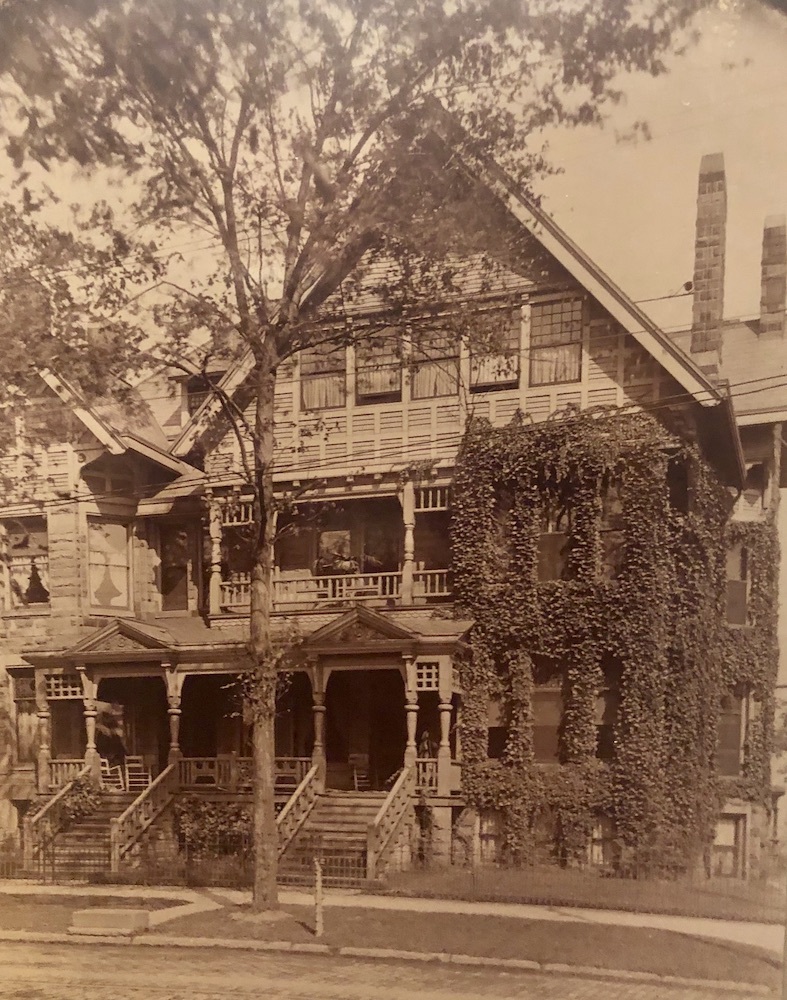
    <title type="html"><![CDATA[Sarah Bousfield House: Also known as &quot;Stone Gables&quot;]]></title>
    <summary type="html"><![CDATA[<p><strong><em>Wealth generated from John Bousfield's wooden ware business enabled the Bousfield family to move into their first house on Franklin Avenue in 1863.  After the business failed and they lost that house, the resilient Bousfields found a way to return to the west side's "Euclid Avenue" in 1883,  building the mammoth stone house that today still stands at Franklin Boulevard and West 38th Street.</em></strong></p><img src="https://clevelandhistorical.org/files/fullsize/7e94cfc54af23bff938538bc0ad44092.jpg" alt="The Sarah Bousfield House" /><br/><p>The large stone house on the northwest corner of Franklin Boulevard and West 38th Street was built in 1883-1884 for John and Sarah Bousfield. It was designed by the prominent nineteenth century architectural firm of Coburn and Barnum, the same firm that designed the Spitzer-Dempsey House at 2830 Franklin Boulevard.  The house, which today has the address of 3804-3806 Franklin, was designed to be  a two-family home with the Bousfields occupying the larger east side, which was advertised as having 17 rooms, and a renter occupying the west side which was said to have 13 rooms.  The house is two and one half stories tall and has more than 12,000 square feet of living space.  It also has a full basement with ground level access from the back yard.  The house was designed in the Queen Anne style, with characteristic asymmetrical massing, half-timbered gables, and what local architectural historian Craig Bobby referred to as "robust" spindlework.  Bobby also opined that the design of the house is closer to the English example of this style of house and less "Americanized" than other Queen Anne style houses built in Cleveland in the late nineteenth century.  </p><p>John Bousfield and Sarah Featherstone, the house's original owners, were English immigrants who came to America  in the early 1840s.  They met in Kirtland, Ohio, and married there in 1845.  After having little success in trying his hand at farming, John purchased a small wooden ware business and began manufacturing  wooden pails, first in Kirtland and then in nearby Fairport (today, Fairport Harbor).  Looking for a better location for his business, he moved his family to Cleveland in 1855.  His early years working and residing in the city  were filled with a mixture of small successes and  several business reverses, the latter often caused by fires that appear to have been altogether too common in the nineteenth century wooden ware manufacturing industry.  However, by the early 1860s, he and his business partner J. B. Hervey had established a large and successful business, known as Cleveland Wooden Ware Manufacturing Company, in Cleveland Centre, near the intersection of Leonard and Voltaire Streets.   After Hervey retired from the business in 1866, Bousfield and his new partner John Poole had even greater success initially, growing the business into what several contemporary sources stated was the largest wooden ware business in the country.  By this time, the company was manufacturing not only wooden pails, but also many other wooden products used in that era, including churns, half-tubs, washboards, clothes pins, dressed lumber, shingles, mouldings, and matches.</p><p>Befitting John Bousfield's business success, the Bousfield family in 1863 moved from a house on Pearl (West 25th) Street into their first house on Franklin Avenue (Boulevard), a grand mansion built in the Italianate style and located on the southeast corner of Franklin and Duane (West 32nd) Street.  To their east lived William Castle, former mayor of Cleveland, and to the west their house was just a stone's throw away from the Kentucky Street Reservoir and its legendary promenade walk.  (Diagonally across Franklin on the corner of State Street they may have noticed the little girl who tended to her flower garden and often played with Mayor Castle's daughter.  She would grow up to become Ella Grant Wilson, one of Cleveland's pioneer feminists.)  Living on Franklin Avenue, the Bousfields interacted socially with many of the west side's wealthiest families, including those of Daniel Rhodes, John Sargent, Nelson Sanford, Belden Seymour, Thomas Axworthy,  Judge James Coffinberry and his son Henry, and George Warmington, just to name  a few.  One such interaction, which was described in an article that appeared in the Cleveland Plain Dealer on January 8, 1870, was the party the Bousfields threw for their 25th wedding anniversary, where their "spacious mansion . . .on Franklin Street . . . was thronged with guests."  Interactions like these were not only "social," but often also presented opportunities for neighbors on the west side's "Euclid Avenue" to form new or cement old business relationships with each other.   John Bousfield was involved in several such business relationships with his neighbors.  In 1866, he and neighbors Daniel Rhodes, Nelson Sanford, John Sargent, James Coffinberry, and others, had founded the People's Gas Light Company, which Bousfield later headed as president.  Three years later, in 1869, he participated in the formation of the People's Saving and Loan Association, serving for the next six years as one of the bank's two vice presidents under president Daniel Rhodes.  Despite all of his neighborhood social and business successes, however, the economic depression in the United States that followed the Panic of 1873 may have been too much to overcome. John Bousfield's  wooden ware business in Cleveland Centre collapsed in 1875 and he was left bankrupt, losing not only his business assets  to creditors but, in 1880, his grand house on Franklin Avenue too.</p><p>After his business failed in 1875 and he lost his house on Franklin Boulevard, John Bousfield started a new wooden ware manufacturing business at a different location on the west side with help from his adult children, including his daughter Charlotte who lived with him and Sarah, but it was plagued by fire, lawsuits and other problems.  By 1881 it had closed and its business operations had been transferred to his adult sons' wooden ware manufacturing facility in Bay City, Michigan.  Between 1880 and 1883, the Bousfields rented a house on nearby Clinton Avenue--literally within sight of their former mansion--while they strove to satisfy creditors and plan their return to Franklin Avenue.  While there, they purchased another house on the northwest corner of Franklin and Kentucky (West 38th) Street in 1881.  They rented that house out until 1883, when they either razed it or moved it to make room for the large stone mansion designed by Coburn and Barnum that was subsequently built on the corner.  In the same year that the stone house was completed, the Bousfields began renting out rooms in a second house on the property that fronted Kentucky Street.  (This house may have been all or part of the house that formerly sat on the corner of Franklin and Kentucky; it may have been new construction; or it may have been a house that was moved from another location.) With two houses on their lot, the Bousfields were not only able to generate rental income from the west side of the stone mansion, but also from the second house too.  While there exists little evidence of the financial status of John and Sarah Bousfield during this period, the rental income from these properties may well have been critical to their survival in what were the later years of their lives.  John Bousfield died at the house in 1888; his wife Sarah died there six years later in 1894.</p><p>Following their deaths, Horace Hannum who lived up the street and who married Charlotte Bousfield  just months after her mother's death, took over the management of the Sarah Bousfield House as well as the other house on the property.  Hannum maintained the west side of the Sarah Bousfield House as a single-family unit, moving into it with Charlotte in 1898 and living there until his death in 1908.  The larger east side of the house, however, was by 1900 operating as a rooming house.  Shortly after Horace's death, Charlotte and the other heirs of Sarah Bousfield sold the property in 1910 to Juno Robeson, a social worker who had moved to Cleveland ten years earlier from Paducah, Kentucky.  Robeson converted the entire stone mansion into a rooming house for businesswomen.  It may have been during her ownership (1910-1923) that physical alterations were made to the house to provide access from one side of the house to the other.  Robeson's Business Inn for Women does not appear to have survived for more than a couple of years.  Thereafter the stone mansion, as well as the other house on the property, like many other large houses on Franklin Boulevard in the twentieth century, became rooming houses, first managed during Robeson's ownership, and then later directly owned, by Frank and Clara Bennett.  By 1925, the stone mansion was being advertised for lease as a rooming house with 38 rooms.  Both houses on the property remained rooming houses for much of the rest of the twentieth century.  In 1945, the lot upon which the two houses sat was split and the houses were thereafter under different ownership.  While it is unclear exactly when, at some point in time after 1966 the other house was razed.  The resulting vacant lot afterwards became property of the city of Cleveland which, in 1983, sold it to the  Franklin Boulevard Nursing Home, located across West 38th Street from the Sarah Bousfield House.</p><p>And thus the stone mansion continued to sit on the corner of Franklin Boulevard and West 38th Street, continued to be used as a rooming house, and continued to deteriorate until 1994,  when  James Hauer and Richard Turnbull purchased it at a sheriff's sale. The two men had since 1988 owned and lived in a house up the street at 3901 Franklin Boulevard.  Turnbull, an art historian, wanted to restore and renovate the house, redividing it into its original two-family configuration, with four apartment suites on the east side of the house and a five-room bed-and-breakfast on the west side.  After hiring Cleveland architect John Rakauskas,  obtaining city approval for their plan, and providing financial incentive for their roomers to vacate the house, Hauer and Turnbull began restoring and renovating it in 1999.  (That same year, they also purchased the vacant lot owned by the nursing home in order to provide parking for tenants and guests.)  Turnbull conducted extensive research in the restoration effort.  He located a 1905 photo of the house to guide his restoration of its exterior.  Decades of paint were hand-scraped off the house to get down to the original colors.  The front porch was restored with its original columns carefully replicated.  In the interior of the house, walls that had been put up to create the rooming house were removed, and the original rooms, to the greatest extent possible, were restored, even down to moldings and picture rails.  (During the renovation, Turnbull was able to debunk a legend told to him by a former roomer that in the 1950s money from a bank robbery had been hidden somewhere in the house under a floorboard.  Roomers believing the legend had cut through many of the house's floorboards, sometimes even switching rooms to cut through more.  If the money had ever been in the house, it was long gone before Trumbull did his extensive renovation.)  The total cost of the renovations and restoration was $650,000. The majority of the work was completed in 2001, when Stone Gables, a bed-and-breakfast that was advertised as a safe place for gay visitors to stay in Cleveland, opened.  Remaining work on the house continued for two more years before the renovation and restoration was complete.  Hauer and Turnbull operated the bed-and-breakfast and rented out the apartments in the house until 2017, when they sold the house.  As of 2021, its new owners continue to operate the Sarah Bousfield House--still also known as Stone Gables--as Hauer and Trumbull had.</p><p><em><strong><a href="https://clevelandhistorical.org/items/show/938">For more (including 18 images) view the original article</a></strong></em></p>]]></summary>
    <published>2021-02-06T15:26:30+00:00</published>
    <updated>2026-04-17T19:17:42+00:00</updated>
    <link rel="alternate" type="text/html" href="https://clevelandhistorical.org/items/show/938"/>
    <id>https://clevelandhistorical.org/items/show/938</id>
    <author>
      <name>Jim Dubelko</name>
    </author>
  </entry>
  <entry>
    <title type="html"><![CDATA[GEAR Foundation: For the Benefit of Cleveland&#039;s Gay and Lesbian Community]]></title>
    <summary type="html"><![CDATA[<img src="https://clevelandhistorical.org/files/fullsize/c93bcbc747863196184c74365ad76b98.jpg" alt="Bernard Furniture Building, 1969" /><br/><p>In the summer of 1975, Art MacDonald was 25. He had been kicked out of the Navy a few years before for his orientation. He had since partnered, and founded and continued to lead a Metropolitan Community Church (MCC) congregation in spite of death threats aimed at him, serious harassment and assaults on his congregation, and his lack of theological education. He had also founded <em>High Gear</em> the year before and continued to write for it, and he co-founded the Gay Educational and Awareness Resources (GEAR) Foundation earlier that year and continued to lead it. </p><p>GEAR intended to provide activities and services in hopes of uniting the lesbian and gay community. One of GEAR’s main purposes was furnishing information, through <em>High Gear</em> and a hotline, and another was providing social space, through the Gay Community Center. <em>High Gear</em> covered a wide variety of topics but mainly focused on political news affecting the gay and lesbian community and on lesbian and gay events in northeast Ohio. The hotline was staffed by volunteers and answered evening and weekend calls. Some callers were simply going out of their way to harass the community, but the majority of calls were actually from gay and lesbian people with a variety of concerns: those considering suicide, individuals looking for nonjudgmental healthcare for STIs, folks wanting information about the bars and baths, and people who were just coming out. GEAR was concerned about gay and lesbian youth, but ambivalent or uncertain about how to interact with them or allow them space without reinforcing negative public perceptions of lesbian and gay people. In the early 1980s, the organization focused on helping youth through the hotline.</p><p>GEAR’s founders and board members were against gender and racial discrimination, at least in principle, but active inclusion was more difficult to achieve. The composition of GEAR’s board of trustees shifted from all men to nearly half women and back again from the late 1970s to the mid-1980s, while that of the foundation membership remained fairly steady at approximately one-third women. Bisexuals, transgender people, crossdressers, and people involved in the drag scene were seen as less a part of the community, and very few of these individuals were involved with GEAR. Participation by straight allies was also uncommon in the 1970s and 1980s, with most of the few around being parents in Parents of Gays (now PFLAG). GEAR did host groups for black and Asian gay men, but participation of people of color in GEAR was limited.</p><p>With the discriminatory social climate and limited financial resources, GEAR was frequently looking for suitable space to host Cleveland’s lesbian and gay community. Before opening the Gay Community Center, GEAR initially met at MacDonald’s home, but he moved to Chicago early in 1976 to attend seminary. Starting around November 1975, GEAR had its office and the hotline at 2999 W. 25th Street, in a shared space with the offices of the Cleveland Gay Federation and the Cleveland MCC congregation. On March 27, 1977, the Gay Community Center had its first open house in GEAR’s new location, a few rooms in the CoventrYard building, a mini-mall at the corner of Euclid Heights Boulevard and Coventry Road in Cleveland Heights. Eleven months later, CoventrYard was destroyed in a fire. GEAR moved into a basement room at New Dimensions, a club downtown at 1012 Sumner Court, across from Erie Street Cemetery. The room was cold and small, holding only fifteen to thirty people at most, and quite loud when the club was operating. GEAR began to look for another location but didn’t find a suitable place until 1980.</p><p>In February 1980, GEAR’s board made its initial decision to buy the former Bernard Furniture Building on the northeast corner of West 14th Street and Auburn Avenue in Tremont. The wooden building was approximately 80 years old and needed substantial work, but GEAR’s trustees assumed they could gain enough rental income from the upper floor to make the finances work, and moved forward with the purchase. After GEAR made the down payment early in March, a few neighborhood organizations got wind of the planned move and disapproved of it. GEAR became concerned over safety and attempted to back out of buying the building, but the organization couldn’t find a way to without losing its down payment. The board initially planned to resell, but renovations progressed slowly, and with no immediate incident of significant prejudice GEAR moved in to save money. However, the problems of owning a building – particularly issues with tenants and the physical state of the Bernard building – quickly exacerbated GEAR’s money woes. By September 1982, the building had failed a city inspection, almost all its utilities were past due, and some had been disconnected. The next month, all the trustees resigned and the mortgage was foreclosed. A meeting of the foundation membership was held in November, electing new trustees who began to turn the situation around, and GEAR continued to use the Bernard building into the fall of 1983 before moving to a board member’s home at 2100 Fulton Road by December 1983.</p><p>The Gay Community Center continued despite GEAR’s decline, and became the stable foundation of Cleveland’s LGBT community over the next thirty years. It moved only three additional times over that period, and with a few name changes continues to exist as the LGBT Center of Greater Cleveland.</p><p><em><strong><a href="https://clevelandhistorical.org/items/show/880">For more (including 6 images) view the original article</a></strong></em></p>]]></summary>
    <published>2019-11-20T20:07:46+00:00</published>
    <updated>2026-04-17T19:17:38+00:00</updated>
    <link rel="alternate" type="text/html" href="https://clevelandhistorical.org/items/show/880"/>
    <id>https://clevelandhistorical.org/items/show/880</id>
    <author>
      <name>Katie Cummings</name>
    </author>
  </entry>
  <entry>
    <title type="html"><![CDATA[The Conversion of Saint Paul Shrine: &quot;A Church Without Boundaries&quot;]]></title>
    <summary type="html"><![CDATA[<p><strong><em>In 1876, St. Paul Episcopal was a preferred place of worship for Cleveland's political and economic elite. In 1932, as Millionaire's Row was fading away, the campus became a home to cloistered Catholic nuns. From 1949 to 2008, it served as a Catholic parish, under the care of  Capuchin Franciscan friars beginning in 1978. Through its many conversions, the Shrine has continued to respond to its environment and reinvent its service to the larger community.</em></strong></p><img src="https://clevelandhistorical.org/files/fullsize/5806ae27cd68559dacd6f893086eaf40.jpg" alt="St. Paul&#039;s Episcopal Church, ca. 1915" /><br/><p>The Episcopal congregation of St. Paul's in Cleveland made its third stop on its eastbound journey at the southeast corner of Case Avenue (East 40th Street) and Euclid Avenue in 1876. Founded in 1846 at the American House Hotel at Superior Avenue and West 6th Street, St. Paul's held services  in rented rooms until it completed a frame church at Sheriff (East 4th Street) and Euclid Avenue. In 1851 St. Paul's built a brick Gothic church on the same site that served the congregation until 1876, when prominent members convinced church officials to build on the site further east on Euclid Avenue in the middle of Millionaires' Row. </p><p>The new Victorian Gothic structure was designed by architect Gordon Lloyd of Detroit and built by Andrew Dall of Cleveland. Berea sandstone was used to complete the cruciform plan with a 120-foot bell tower complete with exaggerated turrets and pinnacles. The interior features decorative wood trusses in an inverted ship's keel style and Tiffany stained-glass windows. Neighbors' homes at the intersection included John D. Rockefeller on the southwest corner and Jeptha H. Wade and Sylvester T. Everett on the north side of Euclid. </p><p>The first service in the new St. Paul's was held on Christmas Eve, 1876, where the city's aristocracy would come to worship. Notable socially prominent patron services were routine at St. Paul's including weddings and the funeral of Marcus Hanna attended by President Theodore Roosevelt. St. Paul's tower bell tolled to summon Cleveland's nabobs to services but the sound proved too much for some neighbors. "Some arrangement was made," wrote reporter S. J. Kelly of the Plain Dealer, in which an annual $100 contribution to the church would silence the bell for more than 15 years. In 1902, an enthusiastic bridegroom handed the janitor five dollars and the bell pealed thereafter! </p><p>The church served the congregation for 52 years until it moved again eastward to Cleveland Heights. St. Paul's sold its magnificent building to the Cleveland Catholic Diocese which re-dedicated it as the Shrine of the Conversion of St. Paul on October 2, 1931. In 1932 a convent was built on the grounds and Cleveland Bishop Joseph Schrembs invited the Franciscan Order of the Poor Clare nuns, a group that had come to Cleveland about a decade before from Austria, to establish the devotion of Perpetual Adoration and to "pray for the needs of the city" at St. Paul, a devotion which continues today. The millionaire neighborhood dissolved in the 1930s and St. Paul Shrine assumed various ministries during its ensuing 85 years as a Catholic institution. </p><p>The neighborhood surrounding the former Millionaires' Row was heavily populated during and after World War II, and the Shrine drew many worshipers to its services. In 1949, the Diocese declared St. Paul a parish to serve the community north and south of Euclid Avenue. In the early 1950s, many Puerto Rican migrants arriving in Cleveland were drawn to St. Paul's by Fr. Thomas Sebian, a Spanish-speaking priest in residence there. Along with Our Lady of Fatima Parish in Hough, St. Paul Shrine contributed to the expansion of the Puerto Rican community on the East Side before many Puerto Ricans re-centered on the Near West Side in the 1960s. The St. Paul Shrine congregation peaked in 1978 with more than 700 members, who represented a diversity of people. Continued change in the neighborhood brought varied worshipers while St Paul's maintained its vibrancy as a "way station for shorter term parishioners" and a place for those struggling with addictions or homelessness. St. Paul's welcomed the gay community and other marginalized communities to its services, leading one close observer to liken it to the "Island of Misfit Toys." </p><p>The Shrine of the Conversion of St. Paul was decommissioned as a parish in 2008 yet remains a Shrine for Perpetual Adoration of the Blessed Sacrament and a destination for faithful from around the city and the world. In fact, some of its nuns, trained through St. Paul's missions to India, are now cloistered at St. Paul's. The Shrine of the Conversion of St. Paul remains an anchor on Euclid Avenue drawing worshipers from millionaires to the homeless.</p><p><em><strong><a href="https://clevelandhistorical.org/items/show/758">For more (including 9 images&#32;&amp;&#32;4 audio files) view the original article</a></strong></em></p>]]></summary>
    <published>2016-02-16T11:36:02+00:00</published>
    <updated>2026-04-17T19:17:41+00:00</updated>
    <link rel="alternate" type="text/html" href="https://clevelandhistorical.org/items/show/758"/>
    <id>https://clevelandhistorical.org/items/show/758</id>
    <author>
      <name>Jim Lanese</name>
    </author>
  </entry>
  <entry>
    <title type="html"><![CDATA[The Gay 90s: "Sometimes Serious, Sometimes Humorous, But Never <em>Straight</em> Talk"]]></title>
    <summary type="html"><![CDATA[<img src="https://clevelandhistorical.org/files/fullsize/cdc6260daf3cd8ffbd0e3523064e54a1.jpg" alt="Cleveland Gay Pride Parade, ca. 1995 " /><br/><p>The nation’s first gay and lesbian talk radio show, <em>The Gay 90s</em>, aired from downtown Cleveland, Ohio and started off with a bang. Not literally, but given the bomb threat called in before the show’s premier broadcast on WHK 1420 AM it was a possibility. Despite the potential danger, <em>The Gay 90s</em> aired as scheduled on March 26, 1993, and became the country’s first commercial live, “call in” radio program by, for, and about the gay and lesbian community. Given Cleveland’s history of settling disputes with explosives, coupled with the homophobic atmosphere surrounding lesbians and gay men at the time, the threat was taken seriously. Not willing to risk the consequences of ignoring the threat, the Cleveland Police Department provided the show’s staff with personal escorts to and from the radio station for the next two weeks. The police attention and protection was motivated, in part, by the station’s location: Cleveland’s iconic Tower City Center. Thankfully, no bomb exploded at Tower City that night or any of the following nights during <em>The Gay 90s</em> six-year run. It was, instead, the radio show itself that blew down barriers, shattered myths and united Cleveland’s gay, straight and “in between” communities in a remarkably peaceful way. </p><p>Looking back, it’s not surprising that the nation’s first gay and lesbian talk show was hosted by Cleveland native Buck Harris, a man at ease being the “first” in a number of public roles. In 1984, Governor Richard Celeste appointed Harris as the Ohio Department of Health’s gay health consultant, the first state in the nation to create such a position in response to the growing AIDS crisis. Shortly after his appointment, <em>The Plain Dealer</em> asked Harris for an interview regarding the crisis, insisting on referring to him as a “homosexual” (as opposed to gay) consultant, as was the newspaper’s policy at the time. Harris told the paper if they did not use his proper title, there would be no interview. The paper relented and, in 1985, for the first time used the word “gay” instead of the inflammatory alternative. A few short months later Harris made the P.D.’s 1986 “Happy New Year” list, the first openly gay person to make the cut. Later that year, Cleveland Magazine named Harris one of the 86 most interesting Clevelanders – again, a first for any openly gay Clevelander. And the bomb threat that greeted Harris and his staff that first radio broadcast? Not a first. As an outspoken and unapologetic AIDS activist, Harris was accustomed getting death threats. Escorted by police and armed with his brave “chin up” attitude, Harris and his crew aired the live broadcast as scheduled. </p><p>Bomb threat notwithstanding, <em>The Gay 90s</em> aired during a time of national crisis for the LGBTQ community, as the AIDS epidemic was nearing its worst. In 1993, tennis star Arthur Ashe died (six weeks before the first show’s first broadcast); President Clinton established the White House Office of National AIDS Policy; Tom Hanks starred in <em>Philadelphia</em>, Hollywood’s first major film on AIDS; and the play <em>Angels in America</em> won both the Tony and the Pulitzer Prize. There was a lot to talk about. Regardless of the topic, which ranged from local politics to the art scene and everything in between, Harris maintains that “a good slice of gay culture” was served, often with a side of humor. The first half of the weekly two-hour program involved guest interviews, and there were notable ones including, in Harris’s words, “movers, shakers and founders of the gay civil rights movement.” Among them were U.S. Congressman Barney Frank; gay rights activist Frank Kameny; two-time Grammy Award winning singer/songwriter Janis Ian, and four-time Tony award winning playwright Harvey Fierstein. Arbitron, the radio ratings agency, estimated that 20,000 listeners tuned in to <em>The Gay 90s</em> on a typical night – perhaps more on a clear night when the AM signal strength was strong enough to reach listeners as far away as Akron or Canton, maybe even the “boondocks,” Harris quips. Some listeners, he believed, were petrified to actually call in – fearing that someone might recognize their voice. Some took the chance, but changed their name. Not all, of course, but the fear of being identified as queer was strong enough to paralyze some listeners, preventing them from calling – and for good reason. Jobs, homes, families – even lives were at risk. One fourteen-year-old gay listener, however, summoned the courage to call in one night. The young man told Harris that he was thinking of suicide but changed his mind after listening to the show. Listening to <em>The Gay 90s</em>, the young man realized there was a “world waiting for him,” where he fit in – brought to him from a radio station in downtown Cleveland. </p><p>After two and a half years broadcasting from WHK on Friday nights and getting preempted for sports broadcasting on more than one occasion, Harris moved to another station, WERE 1300 AM. From there, The Gay 90s aired on Sunday evenings – a time slot Harris preferred, believing that his target audience was more likely to be home (and tuned in), not partying in one of Cleveland’s many gay bars. Harris once commented, “Our entrée into the gay community was through the doors of gay bars”. Not that he was opposed to gay bars – after all, he was a former bartender at the locally famous gay bar, Twiggy’s, and knew the bar’s value as a community anchor. But Harris also knew Cleveland’s gay community needed an alternative to the bar scene, and needed, literally, a voice. Seeing the opportunity and the need, Harris offered his voice as he opened the every show with this greeting: “Good evening Cleveland… Welcome to <em>The Gay 90s</em>, the voice of Northeast Ohio’s gay and lesbian community. It is the intent of this show to provide programming that represents the diversity of our gay and lesbian community and reveal the deep cultural and historical contributions that for too long have gone unrecognized. The opinions expressed are those of the host and guest and not necessarily of WERE or its management – as a matter of fact, probably not. If you are a member of our community, a friend, or just a curious listener we certainly welcome you and please give us a call this evening at 578-1300. If you’re not a friend, don’t tune in, don’t call and find some other way to torture yourself. And a word about our advertisers: unless otherwise stated, you can assume their sexual orientation to be either bi or gay or straight.“</p><p>If the show started with a (figurative) bang, according to Harris, it “went out with a whimper.” He compared the show’s finale on July 11, 1999, to the last episode of the Mary Tyler Moore television show in 1977 when Moore simply turned off the lights and left the building – sad and anticlimactic. The legacy of the radio program, however, is anything but. In the show’s six-and-a-half-year run, thousands of Clevelanders of every flavor listened, learned, and participated in the nation’s first live gay talk show, bringing together gay, lesbian, transgendered, bisexual, and, importantly, straight listeners. Bringing these diverse groups together to listen and learn from each other bridged, at least to some degree, a very large gap, and along with the work of many, many others, helped lay the foundation for the LGBTQ civil rights momentum we witness today. </p><p>When asked if he would consider doing it again, Harris, although flattered by the question, declines to entertain the idea of hosting another gay and lesbian-exclusive radio program. “The world has changed, and I’m not sure we need that today.” Perhaps he’s right.</p><p>In an interview several years after the show last broadcast, Harris reflected on how far things have come since the show first aired in 1993. He says, “It’s exciting in this day and age to see organizations like the lesbian and gay service center that are strong, vibrant, and in storefronts. Before…. you would never have the rainbow flag hanging out in front of the Center… it would have been dangerous to do so… I can rest comfortably knowing I had some impact on helping those organizations grow.”</p><p><em><strong><a href="https://clevelandhistorical.org/items/show/710">For more (including 8 images) view the original article</a></strong></em></p>]]></summary>
    <published>2015-05-23T19:31:56+00:00</published>
    <updated>2026-04-17T19:17:40+00:00</updated>
    <link rel="alternate" type="text/html" href="https://clevelandhistorical.org/items/show/710"/>
    <id>https://clevelandhistorical.org/items/show/710</id>
    <author>
      <name>Leda Carol Drake</name>
    </author>
  </entry>
</feed>
