<?xml version="1.0" encoding="UTF-8"?>
<feed xmlns="http://www.w3.org/2005/Atom">
  <title type="text">Cleveland Historical</title>
  <updated>2026-05-10T00:16:47+00:00</updated>
  <generator uri="http://framework.zend.com" version="1.12.20">Zend_Feed_Writer</generator>
  <link rel="alternate" type="text/html" href="https://clevelandhistorical.org/"/>
  <link rel="self" type="application/atom+xml" href="https://clevelandhistorical.org/items/browse?output=rss2"/>
  <id>https://clevelandhistorical.org/</id>
  <author>
    <name>Cleveland Historical</name>
    <uri>https://clevelandhistorical.org</uri>
  </author>
  <link rel="hub" href="http://pubsubhubbub.appspot.com/"/>
  <entry>
    <title type="html"><![CDATA[Jefferson Park: A Beloved Central Gathering Spot on Cleveland’s Far West Side]]></title>
    <summary type="html"><![CDATA[<img src="https://clevelandhistorical.org/files/fullsize/4d2572d48d5f1425916f26383a87824d.jpg" alt="Jefferson Park Plan" /><br/><p>Early nineteenth-century maps show the land now known as Jefferson Park was part of land surveyed and owned by Leonard Case, a well-known agent for the Connecticut Land Bank and local businessman who served at one point as president of the village of Cleveland. The park site was originally part of Rockport Township, one of the original 19 townships in Cuyahoga County. Rockport Township eventually split into several smaller hamlets, and the area of Jefferson Park became part of the short-lived West Park Township, then West Park village, and finally the city of West Park. West Park was absorbed into Cleveland in 1923 after a decisive vote by residents of West Park on November 7, 1922.</p><p>The earliest known article, written by the <em>Plain Dealer</em> on February 10, 1912, mentions that Jefferson Park was originally planned to be a cemetery and owned by the city’s hospital and infirmary department. However, the land was ultimately deemed unfit “because of the character of the ground.” Park plans were developed by Superintendent Harris R. Cooley, who was Director of Charities under Cleveland Mayor Tom L. Johnson. Accordingly, the street on the south end of Jefferson Park was named Cooley Avenue around this time period. The <em>Cleveland Leader</em> references the opening of the park as May 13, 1912. The history behind the name “Jefferson” is not known entirely, but the same article mentions Cleveland Councilman Harry L. French, who served from 1908 to 1914, as the one who introduced Resolution 25154 to name it Jefferson Park. One can infer that it is named after Founding Father Thomas Jefferson. As such, the surrounding neighborhood also bears the name “Jefferson” but is officially recognized as a sub-neighborhood of West Park, along with Bellaire-Puritas, <a href="https://clevelandhistorical.org/items/show/935">Kamm’s Corners</a>, and Hopkins (formerly Riverside). </p><p>The 8.5-acre park has a pleasing layout that is inspired by the twentieth-century City Beautiful movement in the United States. Around the same time that Jefferson Park was in the planning stages, construction was underway to execute the iconic <a href="https://clevelandhistorical.org/items/show/56">Group Plan</a> of 1903, led by architect and planner Daniel Burnham, founder of the City Beautiful movement. According to a 1912 <em>Plain Dealer</em> article, “Supt. Cooley is planning a park 400 feet wide and 1,800 feet long… and a plat is being developed showing a double row of lots around the park.” Everything from the paths to the placement of trees was done in a thoughtful manner that resembles Frederick Law Olmsted’s pastoral style of park design. It is possible that Jefferson Park was designed this way to offer a moment of respite and peace from the busy and often noisy Lorain Avenue. Fortunately, many of the original trees planted during the construction of the park still remain today. Homes around the park were mainly built in the 1920s in the Colonial, Tudor, and Craftsman styles. </p><p>The park, though meticulously laid out in its origination, was little more than walking paths and trees. However, it evolved over time to meet the needs of the neighborhood, and renovations throughout the 20th century included the addition of playing fields, a playground, tennis courts, basketball courts, and a shelter house. Many longtime residents of the neighborhood fondly recall that the Cleveland Fire Department would hose down the playing fields in the winter to create an ice skating rink at the park, before the creation of a neighborhood rink at nearby Halloran Park. In 1937, conceptual plans were developed by the City of Cleveland to add a new recreation center, swimming pool, and game fields. The drawings for the recreation center were based on the 1932-built Portland-Outhwaite Recreation Center (now Lonnie Burten Recreation Center) on East 46th Street in the Central neighborhood. These plans never became reality, as a nearby recreation center was operated at John Marshall High School on West 140th Street. When John Marshall’s original building was demolished and rebuilt from 2012 to 2015, the stone owls that adorned the facade were saved and placed in Jefferson Park along with stone benches as a welcoming entrance to the park from Lorain Avenue. In 2024, the City of Cleveland made improvements to the park, including the addition of pickleball courts, renovated tennis courts, a new playground, and new benches and tables throughout the park. </p><p>While some planned expansions were never realized, Jefferson Park remains a cherished community space, continually evolving with recent upgrades, and serves as a vibrant venue for public events and recreation, preserving its legacy as a peaceful urban retreat.</p><p><em><strong><a href="https://clevelandhistorical.org/items/show/1051">For more (including 13 images) view the original article</a></strong></em></p>]]></summary>
    <published>2025-01-03T00:04:28+00:00</published>
    <updated>2026-04-17T19:17:43+00:00</updated>
    <link rel="alternate" type="text/html" href="https://clevelandhistorical.org/items/show/1051"/>
    <id>https://clevelandhistorical.org/items/show/1051</id>
    <author>
      <name>Nate J. Lull</name>
    </author>
  </entry>
  <entry>
    <title type="html"><![CDATA[The 1953 Tornado]]></title>
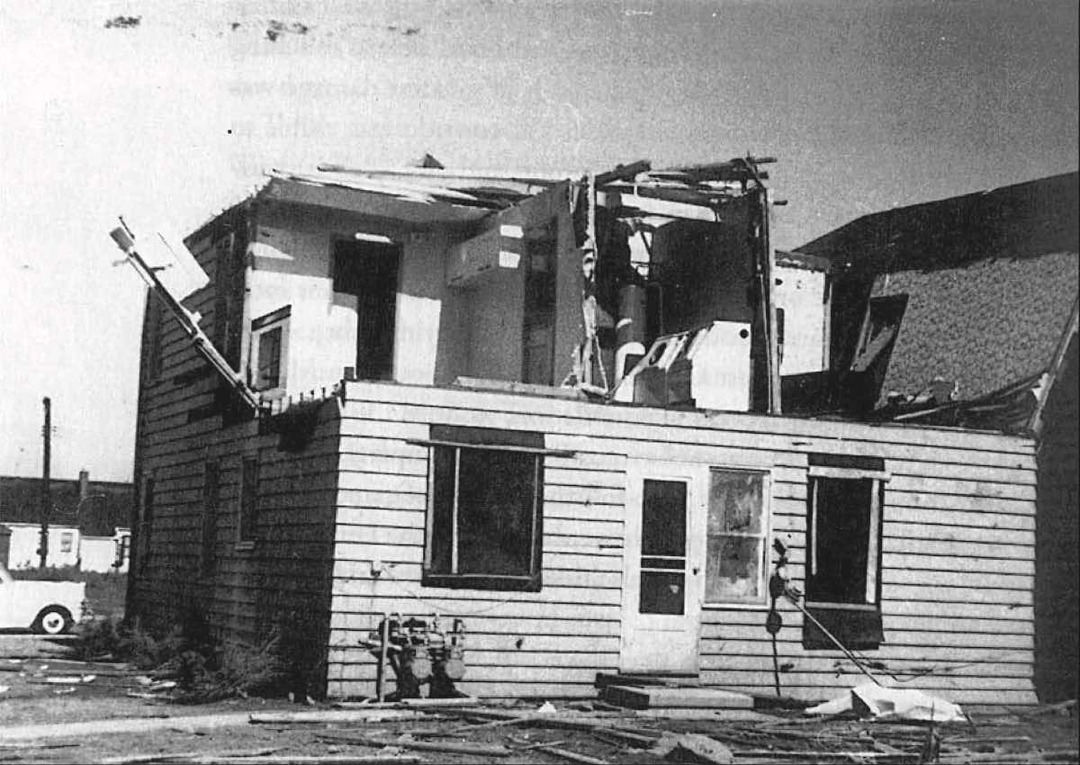
    <summary type="html"><![CDATA[<p><strong><em>On June 8, 1953, the west side of Cleveland was struck by a large F4 tornado that ripped through the city, causing mass destruction. The stormfront that produced this tornado had originated in Michigan, where it struck Flint, killing 116 people and injuring 844 before working its way south into Ohio. The long-track tornado that eventually hit Cleveland first touched down around the village of Deshler (midway between Toledo and Lima). The storm made its way east-northeast, hitting Cygnet, where it reportedly killed eight people and injured a further forty-eight. By evening, Cleveland was in harm's way.</em></strong></p><img src="https://clevelandhistorical.org/files/fullsize/8530814b9e733f2858e84d64e1d921bb.jpg" alt="Damaged House" /><br/><p>At 8:23 p.m. the rain began to fall, and at 8:50 the thunder started. Five minutes later the Cleveland Weather Bureau issued a tornado warning. The thunderstorm grew in strength with high winds and heavy rain, and at 9:45 the tornado was observed on the ground at the north edge of the Cleveland-Hopkins Airport. Not long after, a second funnel was spotted just north of the Solon Airport as well. </p><p>The primary tornado then traveled northeast through the city's west side, running roughly parallel to Lorain Avenue. The worst-hit areas were between West 117th and West 130th Streets south of Lorain where an untold number of houses were utterly destroyed. Similarly hard-hit was the area around Franklin Circle. Crossing the river, the tornado plowed through downtown, where the <em>Plain Dealer</em> reported that "Euclid Avenue was strewn with broken glass from shattered doors and store fronts." The tornado then dissipated over Lake Erie. The all-clear signal was finally issued at 11:45.</p><p>The city and its people responded immediately by setting up emergency shelters and aid stations as the hospital filled to capacity. With no electricity, nurses and doctors had to work by flashlight and candlelight, administering what care they could. The National Guard was called up to assist and emergency sessions of the local and state governments were convened. All told, there were 17 dead, including a 13-month-old baby and five others found in the debris of a house on West 28th Street. In addition, there were over 400 wounded, as well as hundreds more who were left homeless. The tornado had caused an estimated fifty-million dollars in damage. </p><p>The outbreak that spawned the Cleveland tornado killed a combined total of 139 people in Michigan and Ohio. On June 9, a series of large tornadoes, likely from from the same stormfront as Cleveland’s, hit Massachusetts. These tornadoes resulted in 94 people dead and nearly 1,300 hurt.</p><p><em><strong><a href="https://clevelandhistorical.org/items/show/1026">For more (including 5 images&#32;&amp;&#32;1 audio file) view the original article</a></strong></em></p>]]></summary>
    <published>2024-05-16T16:26:27+00:00</published>
    <updated>2026-04-17T19:17:43+00:00</updated>
    <link rel="alternate" type="text/html" href="https://clevelandhistorical.org/items/show/1026"/>
    <id>https://clevelandhistorical.org/items/show/1026</id>
    <author>
      <name>Matthew Steenbergh</name>
    </author>
  </entry>
</feed>