<?xml version="1.0" encoding="UTF-8"?>
<feed xmlns="http://www.w3.org/2005/Atom">
  <title type="text">Cleveland Historical</title>
  <updated>2026-05-10T00:35:27+00:00</updated>
  <generator uri="http://framework.zend.com" version="1.12.20">Zend_Feed_Writer</generator>
  <link rel="alternate" type="text/html" href="https://clevelandhistorical.org/"/>
  <link rel="self" type="application/atom+xml" href="https://clevelandhistorical.org/items/browse?output=rss2"/>
  <id>https://clevelandhistorical.org/</id>
  <author>
    <name>Cleveland Historical</name>
    <uri>https://clevelandhistorical.org</uri>
  </author>
  <link rel="hub" href="http://pubsubhubbub.appspot.com/"/>
  <entry>
    <title type="html"><![CDATA[Cleveland Thermal Energy: District Heating in the City]]></title>
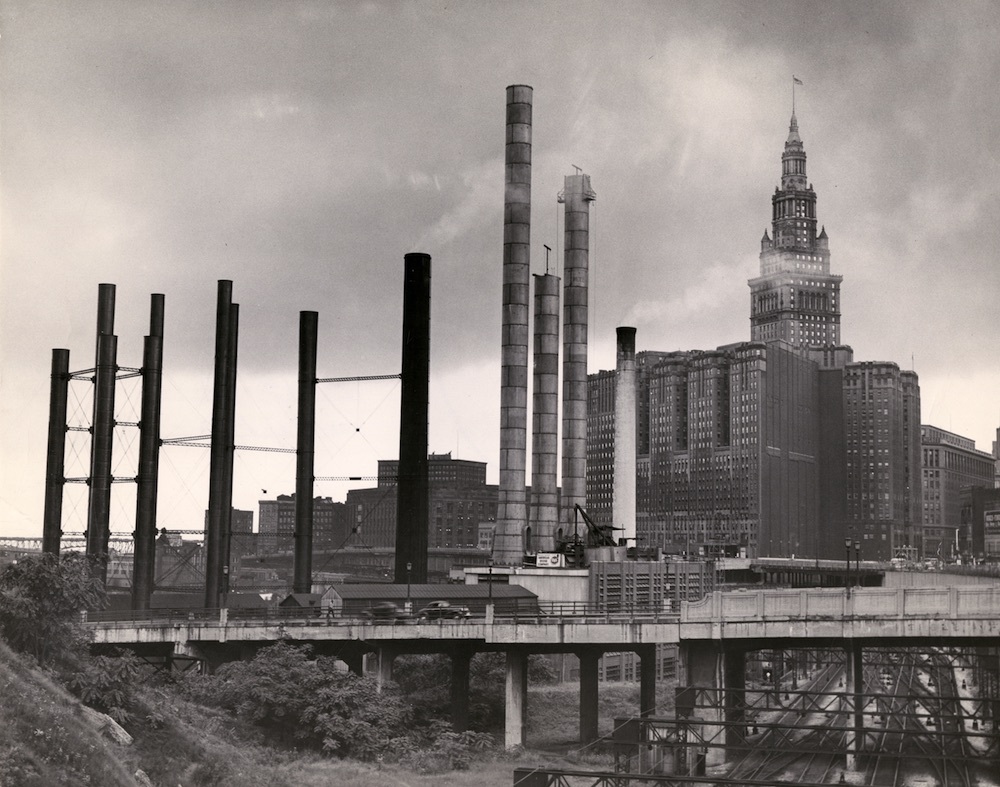
    <summary type="html"><![CDATA[<p><strong><em>A product of electricity generation and innovative engineering at the turn of the century, Cleveland's extensive network of underground pipes supplies steam heat and chilled water to make several downtown facilities comfortable in all seasons.</em></strong></p><img src="https://clevelandhistorical.org/files/fullsize/cd87a92dac07b445b8891ce19d8b42e0.jpg" alt="&quot;A Giant Trio of New Stacks&quot;" /><br/><p>District heating and cooling denotes the network of delivery of thermal energy to a group of proximate buildings or structures from a central source. The concept was first recorded with the use of Roman hypocausts, a hot air furnace, designed to warm a close group of buildings. The design evolved during the Renaissance to tap hot springs’ heat and energy to channel warmth to nearby buildings, inspiring further architectural development to incorporate thermal energy into urban development. By the 17th century, several countries in Europe, England, and Scandinavia relied upon hot water and steam to centrally heat neighboring buildings, both factories and residences. The efficiency of these systems attracted awareness across the Atlantic, and as technology evolved during the 19th century the Exhibition of 1851 marked the heating of several exhibits including the Crystal Palace via a separate boiler. During the next 25 years, European and American cities, including London, New York, Philadelphia, and Springfield, Illinois, boasted district heating. Later in the century, the cooling of structures was added to the district energy distribution concept. More cities throughout the United States incorporated heating and cooling systems into urban developments.</p><p>District heating in Cleveland evolved as part of the pioneering electric generation industry spawned by Charles Brush’s street lamps on the city’s Public Square. During the 1890s Brush Electric joined Cleveland Electric light to form General Electric Light Company which evolved into Cleveland Electric Illuminating Company by 1894 to respond to the increasing demand for electric service throughout the city. Between 1895 and 1906, the design and development of CEI’s Canal Road generation plant attracted worldwide attention via the advanced engineering used to generate electricity and steam at the site. Located on the east bank of the Cuyahoga River, clean water access was available but not ideal as upstream mills and factories polluted the resource as CEI looked to develop the byproduct of coal-fired electricity generation into a district heating business. By 1910, the Canal Road plant switched to city water to generate steam and expand its reach into the downtown area. </p><p>During the second decade of the 20th century, CEI continued to respond to the demand for increased regional electric and local steam power with progress on the infrastructure to deliver the energy. Competition for customers also grew during this period. Other local steam plants arose to supply power to proximate factories and institutions as the area developed. Among these competitors were Bradley, Cleveland, and Cuyahoga Light and Power Companies.   </p><p>A new generation plant was built at East 20th Street and Hamilton Avenue in 1924 to complement Canal Road production of both electricity and steam. The Canal Road plant was re-engineered, demolished, and rebuilt in 1928. Over the next twenty years CEI expanded its steam business to serve more than 660 customers bounded by Prospect Avenue north to Lake Erie and the Cuyahoga River east to East 24th Street. CEI continued to be recognized as a leader in the district heating technology and business, setting a national example. In 1946, the Canal Road plant ceased electric power production and turned to steam only. Two years later, CEI constructed three 235-foot colossal smokestacks at the Canal Road plant to provide greater draft for new boilers at the plant. The stacks were 12 feet inside diameter and 13 feet outside diameter steel and brick construction. During construction, workers ascended and descended the inside of the stacks while standing on a crane ball. The three tall stacks replaced ten smaller stacks and became a ‘landmark’ sight along Ontario Avenue visible from Public Square looking south. Only one remains today.</p><p>CEI continued to operate the steam generation and heating business throughout the next four decades amid legal and political disputes during an era of deregulation of public utilities, fierce competition with Cleveland Public Power (the city owned power company serving local customers), and corporate mergers and acquisitions. In 1982, several steam buildings left CEI for cheaper heat from natural gas sources. By the mid 1980s, Cuyahoga County's downtown facilities were CEI’s number one steam customer and Cleveland State University was second among downtown customers. One notable eight-year dispute between Cleveland State University and CEI over rates was ultimately settled in 1987 when CEI sold both plants and the steam operation to Youngstown’s Catalyst Thermal to operate as Cleveland Thermal Energy Corporation (CleTEC).</p><p>CleTEC operated the steam heating and expanded chilling operations for the next 28 years. During that time, corporate control of CleTEC changed hands twice until it was bought by the Canadian firm Corix in 2015. Corix moved to phase out the less eficient Canal Road plant in favor of the upgraded Hamilton Avenue plant with high-efficiency steam production using clean-burning natural gas. The Canal Road Plant closed in 2017.</p><p>Today, "Cleveland Thermal’s pipeline spans more than 30 million square feet throughout the Downtown Cleveland footprint. This pipeline delivers district steam and chilled water 24 hours a day, 365 days a year to downtown customers."</p><p><em><strong><a href="https://clevelandhistorical.org/items/show/953">For more (including 12 images) view the original article</a></strong></em></p>]]></summary>
    <published>2021-11-15T17:09:31+00:00</published>
    <updated>2026-04-17T19:17:42+00:00</updated>
    <link rel="alternate" type="text/html" href="https://clevelandhistorical.org/items/show/953"/>
    <id>https://clevelandhistorical.org/items/show/953</id>
    <author>
      <name>Jim Lanese</name>
    </author>
  </entry>
  <entry>
    <title type="html"><![CDATA[Avon Lake Power Plant]]></title>
    <summary type="html"><![CDATA[<img src="https://clevelandhistorical.org/files/fullsize/8f3bc520e6bae4f9eb5318e396d87074.jpg" alt="Rotor Installation" /><br/><p>With regard to Cleveland's west side, the addition of the Avon Lake Power Plant on Lake Road in 1926 is arguably the most significant project taken on by Cleveland Electric Illuminating Company (CEI).  Situated 23 miles west of CEI's Public Square headquarters, the plant added another massive range of power and opened "a new industrial area in which electrical power will be available in abundance." Announced in 1924, the Avon Lake plant was built from March 1925 to July 1926 at a cost of approximately $30,000,000.  The plant was constructed in Avon Beach Park in order to make use of the uniquely large, cool source of water in the Great Lakes. Cool water was necessary to condense steam as it left the turbines, and five-hundred tons of water were required for every ton of coal burned by the plant. To put this in perspective, so much water was needed for the Avon Lake plant that it had to pump twice the amount of water that the city water works did. When it opened, the Avon Lake plant became the largest of its kind in the world, capable of producing a magnificent 400,000 horsepower.</p><p>The Avon Lake plant's dependence on water led to an extraordinary dilemma on February 21, 1953. That day, "great masses of gizzard shad" collapsed the plant's water intake screens and caused each of the plan'ts seven generators to instantly shut down. This resulted in a significant power-outage throughout the entire Greater Cleveland area. After hours of scooping out the dead fish with a large crane, it took the work of another 50 men, including welders and divers, to fix the broken water intake screens located 35 feet below the surface. The Ohio Division of Wildlife determined that a sudden and significant drop in temperature had killed the fish, which subsequently created a large aggregation of dead fish on the surface near the plant's intake channel.</p><p>In addition to cool water, the plant also depended on a substantial amount of coal.  In 1950, the Avon Lake plant reportedly processed 4,000 tons of coal a day.  Despite a late-fifties effort by CEI to beautify the immediate area surrounding the Avon Lake power plant, significant backlash over the plant's environmental impact eventually led to its demise. In November of 2011, Ohio Representative Dennis Kucinich publicly addressed the Ohio Environmental Protection Agency, (EPA). Kucinich urged the EPA to take action against the plant, now controlled by GenOn, and limit its toxic air pollution.  Kucinich cited that the "power plant in Avon Lake had released more than two million [tons] of toxic chemicals in 2010."  The EPA determined that the Avon Lake power plant was guilty of excessive ozone emissions, and cited GenOn.  In order to become compliant under stricter EPA regulations, the power plant would have to undergo an overhaul costing hundreds of millions of dollars. This pressured GenOn to announce plans to close the Avon Lake power plant in 2015, but instead the plant changed hands and continued to operate for six more years before finally shutting down in 2021. It was mostly demolished over the next two years as part of a lakefront redevelopment plan.</p><p><em><strong><a href="https://clevelandhistorical.org/items/show/458">For more (including 8 images) view the original article</a></strong></em></p>]]></summary>
    <published>2012-05-15T23:16:03+00:00</published>
    <updated>2026-04-17T19:17:39+00:00</updated>
    <link rel="alternate" type="text/html" href="https://clevelandhistorical.org/items/show/458"/>
    <id>https://clevelandhistorical.org/items/show/458</id>
    <author>
      <name>Matthew Sisson</name>
    </author>
  </entry>
</feed>
