<?xml version="1.0" encoding="UTF-8"?>
<feed xmlns="http://www.w3.org/2005/Atom">
  <title type="text">Cleveland Historical</title>
  <updated>2026-04-17T14:57:08+00:00</updated>
  <generator uri="http://framework.zend.com" version="1.12.20">Zend_Feed_Writer</generator>
  <link rel="alternate" type="text/html" href="https://clevelandhistorical.org/"/>
  <link rel="self" type="application/atom+xml" href="https://clevelandhistorical.org/items/browse?output=rss2"/>
  <id>https://clevelandhistorical.org/</id>
  <author>
    <name>Cleveland Historical</name>
    <uri>https://clevelandhistorical.org</uri>
  </author>
  <link rel="hub" href="http://pubsubhubbub.appspot.com/"/>
  <entry>
    <title type="html"><![CDATA[The Jones Home and School for Friendless Children: A Story of Transformation ]]></title>
    <summary type="html"><![CDATA[<p><strong><em>On the opening day of the Jones Home and School for Friendless Children, the weather was “dark and stormy,” but even so, “a large number of interested visitors found the house at 1633 Pearl St.,” which was a “half day’s drive by carriage or wagon” from Cleveland. Since that day in 1887, the Home has endeavored to improve the lives of children and families while adapting to more than a century of change. </em></strong></p><img src="https://clevelandhistorical.org/files/fullsize/1757ef1c1c3a34dde1248a7bd97f30f2.jpg" alt="The Jones Home" /><br/><p>The Jones Home was founded on December 15, 1887, by Carlos and Mary B. Jones, who intended for it to provide mainly short-term housing for children who still had one or two parents, but who were currently unable to care for them. The Joneses began a policy of accepting only white, Protestant children for foster care that lasted for several decades. The farmhouse was situated on six acres and, in November 1889, housed about twenty children between four and ten years old. In 1890 the Home was reportedly “in a prosperous condition,” with extensions made to the main house and a new $1,300 building that enabled the Home to take in an additional thirty children.</p><p>Whenever possible, the Jones Home’s administrators wanted families to be reunited. Orphanages understood that they could never hope to replicate traditional home life but did their best. The First Annual Report noted: “One little fellow was readmitted after an absence of several weeks, and ran about wild with delight, poking his curly head into all his beloved play-places. 'Oh, is my little bed here yet?' was the first thing he said when the door opened to readmit him.”</p><p>If after staying at the Home for a time the children were unable to return to their parents, they would be apprenticed to a family when “age and acquirements justify” and given a Bible. The families were required to be “regular attendants of some Protestant church.” This preoccupation with religion was not unusual for the time. </p><p>During the annual harvest day festival in October 1895, Mr. Jones shared his vision to build a new three-story brick building near the original farmhouse, “at the corner of Pearl street and Daisy avenue.” The cornerstone of the new building, designed by Sidney R. Badgley, was laid in late November 1902. Dedicated in October 1903, the building was a “buff brick, with red stone trimmings” and cost $33,703.24. The first  floor included an entrance hall, reception room, dining room, kitchen, girl’s cloakroom, reading room, library, and the matron’s private rooms. The second floor contained four dormitories, bedrooms for attendants, and bathrooms. The third floor held a meeting hall, sewing room, and five sleeping rooms with bathrooms that the executive director later lived in with his family. The basement had a receiving room and bathroom for newly admitted children, boy’s coat room, coal room, and storage space. </p><p>At the turn of the century, the Jones Home had a bright future ahead of it. In 1908, a two-story playhouse was built for $5,500, allowing the children to play in bad weather. In 1910, the third floor of the main building was converted into sick rooms and additional dormitories, creating space for twenty more children. In 1921, a vegetable garden was being “maintained bountifully.” Unfortunately, this prosperity would only continue for a few more years.</p><p>The Jones Home struggled during the Great Depression; while in the past it had usually received “hundreds of dollars a month” from donations, in 1933 “less than $50 a month comes in” because of extremely high unemployment in Cleveland. The closure of banks caused its endowment to become inaccessible. Despite these troubles, fifty-eight children were living at the Home – with space for ten more but but no means to support them – and was described as “old-fashioned but comfortable.” The Home scraped by, however, with what limited funding the community could provide, and in 1937 year it partnered with Community Chest – later renamed United Way Services – which brought in additional funding.</p><p>When the Home celebrated its seventy-fifth anniversary in 1962, the “long-ago stipulation” that the children be Protestant had been “abandoned.” In late 1966, the Jones Home merged with Children’s Services, allowing it to provide psychologists and case workers for the children for the first time. A $400,000 renovation in 1971 was largely funded by selling land to the state to build I-71. Despite the encroaching city, it was a “quiet oasis” for “neglected children of any race or religion,” surrounded by eighty-year-old sycamore trees planted by Mr. Jones. The goal of the Home was to house children for “a few months to a year or two” while they and their parents received counseling.</p><p>The Jones Home continued to adapt to the community’s needs by expanding its ability to help children with mental health–related issues. In 1990, the Home was kept running with a 10 percent allocation from United Way, an endowment and trust fund, government funds, and donations. By this time the Home had three programs for children according to their needs: “a residential treatment program for children who are victims of sexual, physical and psychological abuse” and who were wards of Cuyahoga County’s Department of Human Services; “two classrooms funded by the Cleveland Board of Education for severely, behaviorally handicapped children”; and “court-designated programs providing temporary shelter and short-term, intensive residential treatment.”  In 1997, the Jones Home merged with Guidance Centers, a psychiatric clinic founded seventy years before, to form Applewood Centers.</p><p>The Cleveland City Planning Commission named the Home a Cleveland landmark in 1984, and it was listed in the National Register of Historic Places in 2012 as part of the Jones Home Historic District. Flats Construction completed a three-year long restoration in 2021, ensuring the Home will continue to serve the needs of Greater Cleveland's youth for many years to come.</p><p><em><strong><a href="https://clevelandhistorical.org/items/show/1044">For more (including 4 images) view the original article</a></strong></em></p>]]></summary>
    <published>2024-11-27T00:40:52+00:00</published>
    <updated>2026-03-04T21:32:05+00:00</updated>
    <link rel="alternate" type="text/html" href="https://clevelandhistorical.org/items/show/1044"/>
    <id>https://clevelandhistorical.org/items/show/1044</id>
    <author>
      <name>Aidan Sellman</name>
    </author>
  </entry>
  <entry>
    <title type="html"><![CDATA[Union Trust Building: Built to Send a Message to the Banking World]]></title>
    <summary type="html"><![CDATA[<p><strong><em>It wasn't by accident that Union Trust Bank erected a building on the northeast corner of East Ninth Street and Euclid Avenue that, when completed in 1924, was reputedly the second or third largest office building in the world with the largest bank lobby in the world.</em></strong></p><img src="https://clevelandhistorical.org/files/fullsize/d46fb24a771a1becc3c70fe6208e3169.jpg" alt="The Union Trust Building" /><br/><p>You might say that the mammoth Union Trust Building on the northeast corner of East Ninth Street and Euclid Avenue--which over the years has also been known as the Union Commerce Building, the Huntington Bank Building, the 925 Building and, since 2018, the Centennial--was built as the result of an Act of Congress.  When Congress passed the Act of November 7, 1918, which created a simplified process for national and state bank mergers, it instituted an era of bank mergers in the United States that did not end until the Great Depression.  In Cleveland, the Act produced two significant mergers in 1919--one between Union Commerce National Bank (founded in 1884 by Marcus A. Hanna) and Citizens Savings and Trust Co. (founded in 1868 by Jeptha H. Wade) and the other between First National Bank (founded in 1863 by George Worthington) and the more recently founded First Trust and Savings Co.  Then, just one year later, came the announcement that these two pairs of merged financial institutions had decided to merge again, this time with each other.  In December 1920, they formed the Union Trust Co., which immediately became the  largest bank in Ohio, and one of the largest in the United States.  And the first order of business for this new financial behemoth?  It was to erect a suitably large and grand edifice on the northeast corner of East Ninth Street and Euclid Avenue for its banking needs.</p><p>Even before Union Trust Bank was formed in 1920, two of its component banks--Union Commerce National, whose offices were in the Union National Bank building on the corner of Euclid Avenue and East 3rd Street, and Citizens Savings and Trust, whose offices were in the Citizens Building next door to the Schofield Building--had turned their eyes in 1919 to the northeast corner of Euclid Avenue and East Ninth Street as the future site for their new bank building.  Toward that end, in April 1920 they had purchased from the Lennox Company three large adjoining lots on or near that corner, including the lot upon which the historic Lennox Building sat.  With the creation of Union Trust that same year, the scope of their anticipated building project on that corner simply increased in size.  The following year, Union Trust selected the Chicago architectural firm of Graham, Anderson, Probst and White to design a building  large enough and grand enough to meet the bank's present needs as well as its anticipated future growth. It was a good choice.  Graham, Anderson, Probst and White, had ties to Daniel Burnham who two decades earlier had been the lead architect for Cleveland's Group Plan.  The firm itself more recently had completed design work for the new Cleveland Hotel (today, the Renaissance Cleveland Hotel) on Public Square.  And, in just a few short years it would begin designing Cleveland's most iconic building of all, the Terminal Tower.  </p><p>The Union Trust Building was erected on the northeast corner of Euclid and East Ninth during the period 1922-1924.  It displaced the Lennox Building, the Euclid Theater and a number of other smaller commercial buildings. Twenty-one stories tall (including the rooftop penthouse), the building has 146 feet of frontage on Euclid Avenue, 258 feet on East Ninth Street and 513 feet on Chester Avenue, and has more than one million square feet of office space.  Its four-story L-shaped bank lobby--at the time the largest in the world-- is fifty feet wide and extends 224 feet parallel to East 9th Street and then 304 feet parallel to Chester Avenue.  The lobby has Corinthian columns, vaulted ceilings, skylights, and murals by  Jules Guerin, a famous twentieth-century artist noted for the murals he created for the Lincoln Memorial in Washington, D.C.  The huge building transformed the intersection of East Ninth and Euclid Avenue, making it the center of the city's financial district and one of the more important commercial addresses in the United States.  It opened to the public, during a week of gala events, in May 1924.</p><p>The building had other notable features when it opened, including a retail arcade on the first floor near Chester Avenue, a section of which became known as "Steamship Row," because of the travel agencies that located there and placed in their windows pictures of enticing overseas destinations.  The penthouse became home to the Midday Club, a private men's club with a grand dining room and smaller meeting rooms for members. (After the Midday Club closed in 1990, the penthouse a few years later became home to Sammy's Metropolitan Ballroom and Restaurant.)  Outside the penthouse on the roof of the building near East Ninth Street were two 125-foot towers between which was stretched an antenna wire.  The towers and antenna were part of radio station WJAX which broadcast financial news from the 20th floor of the buildng.  There was a legend that the roof was also designed for a dirigible docking station, but the rooftop plans prepared by Graham, Anderson, Probst and White show no such station planned for the building, and no contemporary news articles or other primary sources have been discovered that prove the existence of, or plans for, either the station itself or any accessory buildings on the rooftop.</p><p>The Union Trust Building at 925 Euclid Avenue quickly became one of the most desirable business locations in Cleveland.  Among other prominent tenants, it was home to two of the city's largest and most recognizable law firms, Squires, Sanders and Dempsey, and Baker and Hostetler.  Squires occupied the entire 18th floor of the building from 1924, when it opened, until 1992 when the firm left, taking its 400-plus employees to Key Tower.  Another long-time tenant in the building was Rickey C. Tanno Jewelers, which moved into the Arcade in 1949 and was the last retail tenant to leave in late 2018.  While these and other tenants occupied space in the building for decades, Union Trust Bank itself had a much shorter stay in the building.  After operating there for less than ten years, it failed in 1933, during the Great Depression.  Its collapse was reportedly fueled by a run on its deposits caused by the disclosure that bank officials with ties to the Van Sweringen real estate empire had lied about a $10 million sale of government bonds by Van Sweringen to the bank.  Two Union Trust bank officials--Joseph R. Nutt, chairman of the board, and Wilbur Baldwin, its president--were indicted along with Oris P. Van Sweringen in Cuyahoga County Common Pleas Court for creating false bank records. While the state charges were eventually dismissed after the three were found innocent in a related federal court proceeding, Union Trust Bank never recovered.   It underwent a liquidation process that lasted for several years before a reorganization plan was approved that created new Union Commerce Bank in 1938.  That same year, the Union Trust Building became the Union Commerce Building.</p><p>For many older Clevelanders, the Union Commerce Building was the only name of the building they ever knew while growing up.  The building carried that bank's name for 45 years until 1983 when the bank was purchased by Huntington Bank.  During the years that it was owned by Union Commerce, the grand bank lobby underwent several restorations, including most notably the one architect Peter van Dijk led in 1975.  Van Dijk literally saved the bank lobby from what would have been a disastrous remodelling.  Additionally, in 1968 as part of the Erieview project, Union Commerce erected a five-story parking garage on the north side of Chester Avenue that is connected to the building's arcade by a tunnel  under Chester Avenue.  </p><p>Following the  purchase of the building by Huntington Bank in 1983, it  became the Huntington Building, once again taking the name of the bank that occupied its grand lobby.  That tradition ended in 2011 after Huntington Bank sold the building and  moved to the BP Building on Public Square.  Following Huntington's departure, the building became known as the 925 Building.  According to a July 31, 2015, article in the Cleveland Jewish News, it was at the time that Huntington Bank left that the building began to "hemorrhage" tenants, but it likely had been losing tenants for years before that to the newer Cleveland skyscrapers built in the last decades of the twentieth century.  In 2015, a new owner acquired the 925 Building with plans to redevelop it with apartments, a hotel, and retail, banquet and office space.  However, that developer's plans never materialized and, in 2017, it sold the building to Millennia Cos., a local developer which had already successfully redeveloped several other historic buildings in downtown Cleveland, including the Statler and Garfield Buildings.  As of the Fall of 2019, Millennia has plans to redevelop the originally-named Union Trust Building with apartments, retail stores and possibly some office space.  And, as for the new name it decided to give the building--The Centennial?  Well, it's not a bad one for a grand edifice nearing its 100th birthday.  </p><p><em><strong><a href="https://clevelandhistorical.org/items/show/876">For more (including 13 images&#32;&amp;&#32;4 audio files) view the original article</a></strong></em></p>]]></summary>
    <published>2019-10-15T20:05:08+00:00</published>
    <updated>2026-03-04T21:32:01+00:00</updated>
    <link rel="alternate" type="text/html" href="https://clevelandhistorical.org/items/show/876"/>
    <id>https://clevelandhistorical.org/items/show/876</id>
    <author>
      <name>Jim Dubelko</name>
    </author>
  </entry>
  <entry>
    <title type="html"><![CDATA[Civilian Conservation Corps: The Dedication of Euclid Creek Reservation]]></title>
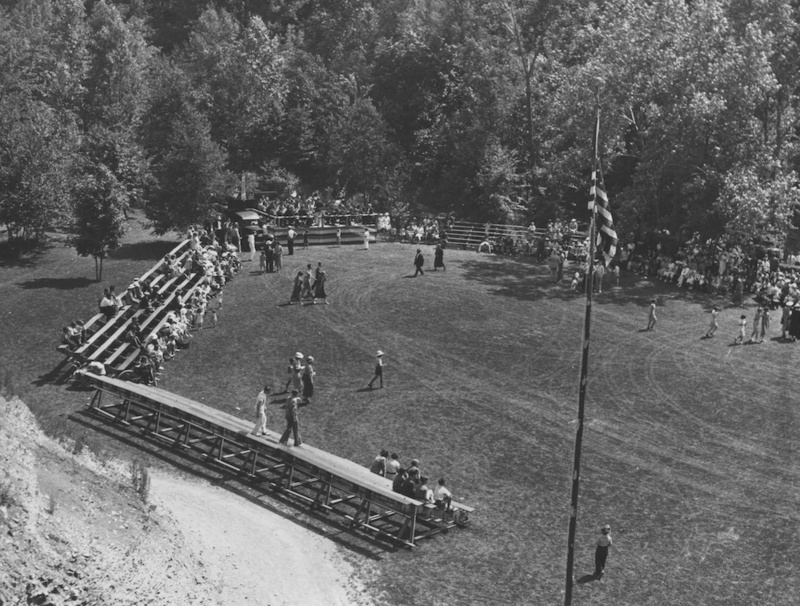
    <summary type="html"><![CDATA[<p><strong><em>At the height of the Great Depression, battalions of young men stationed at Euclid Creek Reservation worked tirelessly making Cleveland's Metropolitan Park System accessible to the public.  It wasn't just the park system that benefited from their labors, however.</em></strong></p><img src="https://clevelandhistorical.org/files/fullsize/59843295e9d50875ee47d69213170802.jpg" alt="Euclid Creek Dedication, 1936" /><br/><p>Ushered in by parade and sounds of the WPA Band, the Metropolitan Park Board and representatives of the Village of South Euclid formally dedicated Euclid Creek Reservation on June 24, 1936. The day marked the first public dedication of any unit in the Metropolitan Park System.  Despite being in the midst of an economic depression, the South Euclid Kiwanis Club threw caution to the wind in planning the celebration. An array of scheduled activities offered a little something for everyone. Ceremonial undertakings were supplemented throughout the afternoon with children's races, games, a Works Progress Administration-sponsored vaudeville act, and appearance by professional strongman Arthur Santell.   Once adequate numbers of steel bars had been refashioned into pretzels, a guard mount of the Civilian Conservation Corps lowered the American flag to conclude the evening. </p><p>The day had been made possible by the labors of these enlisted conservationists.   Since November 21, 1933, a junior CCC company was stationed at a barracks within Euclid Creek Reservation on Highland Road. The division spent their days digging, planting trees, landscaping, trimming deadwood, and lugging around stones.   Thanks to the work of  "Camp Euclid," the grounds were sculpted with scenic roads, parking lots, trails and picnic areas.  The once primitive lands of Euclid Creek Reservation had been transformed into an accessible public park within a few short years.</p><p>While the Great Depression was far from over at the time of Euclid Creek Reservation's dedication, the new park and its youthful laborers offered a visual representation of the strides made in the country toward achieving social and economic stability.   It hadn't been long since the U.S. economy bottomed out and the Great Depression reached its peak.  Amid this mess, Franklin D. Roosevelt was inaugurated as President of the United States on the fourth of March.   The first actions of his famous "Hundred Days" aimed to stabilize the economy; a bank holiday was called and the Economy Act drafted and quickly passed by both houses of government.   By his second week, Roosevelt began efforts to assist the unemployed with government relief and the development of labor creating programs.  The first work program submitted to both congress and the public was the Civilian Conservation Corps.  The bill authorized the government to enlist young men for work on conservation projects. Its hefty goal was to revitalize both the natural environment and the spirit of America's young, disaffected populace.   By month's end, the bill passed and efforts were underway to mobilize a work force of America's unemployed youth.</p><p>The CCC admitted its first enrollee on April 7, 1933. A battalion of Cleveland men were relocated to a U.S. Army reconditioning camp at Fort Knox, Kentucky by the middle of May.   Joining the ranks of over 250,000 men initially recruited for Roosevelt's reforestation army, these young Clevelanders were generally shipped out west or placed in one of the plus 40 companies founded in Ohio state parks that year.   Following much planning and filing of paperwork by the Metropolitan Park Board, a CCC camp was secured for Euclid Creek Reservation.  State Park 15, Company 595 was established in November to perform manual work in Euclid Creek and North Chagrin Reservations.  Under the supervision of engineers and landscape architects, the young men began the labor-intensive process of park building.   Work started immediately.   Among their many accomplishments, stone quarries were filled, dams and retaining walls built, foot and bridle trails blazed, a lake excavated, and land graded for drainage and construction.</p><p>The symbolic opening of Euclid Creek Reservation in 1936 honored more than the park improvements made by CCC crews; the Village of South Euclid had much to celebrate.   In addition to offering employment to young men and promoting the conservation of local natural resources, Civilian Conservation Corp camps throughout the United States provided an economic boost to their surrounding communities. Each of the nearly 200 CCC recruits at Camp Euclid pocketed between five and eight of their 30-dollar monthly earnings; with the remainder sent to an appointed family member on relief, the young men often used this allowance for recreational activities at local establishments such as pool halls, bars, movie theaters and restaurants.</p><p>Camp construction, maintenance, and the purchase of operational supplies also supported regional employment and businesses.  A CCC camp cost around $20,000 to build. At the time Camp Euclid was founded, both local labor and materials were used for construction of the barracks.   Once built, the cost of running a CCC camp reached upwards of $5,000 a month for food, supplies and maintenance.   Additionally, CCC camps hired "local experienced men" to dissuade any possible resentment felt by jobless members of the community.   These men, who were generally selected by the Metropolitan Park Board at Camp Euclid, lived within the immediate vicinity of projects and had experience in the work at hand.   Since WPA funds were also generously expended for park improvements in Euclid Creek Reservation, many unemployed residents of South Euclid with experience in the building trade found temporary work during trying times.</p><p>While the CCC camp benefited the surrounding community, East Cleveland and South Euclid residents also did their part in making the work relief program a success. Spurred on by public enthusiasm for the CCC, concern for the well being of enlistees, and a healthy dose of fear over the possibilities of 200 young men with money consistently being set loose on the town, the Welfare Council for Co. 595 formed to assist in the creation of programs at the camp.  Representatives of local religious, civic and educational groups composed the board. Although the barracks already supplied its residents a government sponsored emergency school, it lacked critical resources like books and sporting equipment.  The Welfare Council raised money to fund recreational and educational activities. By 1934, Camp Euclid offered classes in aviation principles, English, commercial art, public speaking, ethics, radio engineering, woodworking, music and banking.  Recreational activities such as wrestling, boxing and calisthenics were also offered in the evening.  The Cleveland Y.M.C.A oversaw the initial organization of these programs.  Camp Euclid staff estimated that 96% of the company took part in one or more of the weekly activities. </p><p>The combined labors of the surrounding community, CCC employees and recruits, government officials, and the Metropolitan Park Board culminated in the dedication of Euclid Creek Reservation.  By the time the barracks at Camp Euclid was demolished in 1944, wartime production had brought an end to the nation's fiscal crisis. Work relief programs such as the CCC were dismantled; their legacy, however, was imprinted within the radically altered landscape of the Cleveland Metroparks. Grounds that sat dormant during the 1920s while the Metropolitan Park Board acquired property were reshaped as an accessible public park system.  The young men who helped create these parks with shovels, picks and axes were also rebuilt. The CCC provided residents of Camp Euclid a temporary reprieve from the hardships of the outside world, and offered them a chance to resume a life that had been impeded by the Great Depression.</p><p><em><strong><a href="https://clevelandhistorical.org/items/show/690">For more (including 15 images&#32;&amp;&#32;2 audio files) view the original article</a></strong></em></p>]]></summary>
    <published>2015-01-05T07:39:48+00:00</published>
    <updated>2026-03-04T21:32:02+00:00</updated>
    <link rel="alternate" type="text/html" href="https://clevelandhistorical.org/items/show/690"/>
    <id>https://clevelandhistorical.org/items/show/690</id>
    <author>
      <name>Richard Raponi</name>
    </author>
  </entry>
  <entry>
    <title type="html"><![CDATA[Harold H. Burton Memorial Bridge]]></title>
    <summary type="html"><![CDATA[<img src="https://clevelandhistorical.org/files/fullsize/a2eab890089139545a5ab048039ac422.jpg" alt="Main Avenue Bridge Construction, 1939" /><br/><p>Republican Justice Harold Hitz Burton served as Cleveland's 45th mayor from 1936 to 1940, U.S. Senator from Ohio from 1941 to 1945, and U.S. Supreme Court Associate Justice from 1945 until his retirement in 1958 due to failing health. Burton was born in Jamaica Plain, Massachusetts, in 1888, and graduated from Bowdoin College and Harvard Law School. Law was Harold Burton's calling, and in his various practices he sought to uphold it as dispassionately as possible. Upon the United States' entry into World War I, he sought commission as an officer in the 361st Infantry of the 91st Division and achieved the rank of Captain by fall 1918. In his service he fought in Verdun during the Meuse-Argonne Offensive, was  awarded the Belgian Croix de Guerre "for extraordinary heroism and gallantry in action," and was recognized by General John J. Pershing "for exceptionally meritorious and conspicuous services during the Argonne Offensive."</p><p>Following the resigning of his commission in 1919, Burton moved to Cleveland with his wife to practice corporate law in a local firm before forming his own firms: Cull, Burton & Laughlin and Andrews, Hadden & Burton. After a brief stint as Cuyahoga County Commander of the American Legion he was persuaded to join the world of politics by local Republican Party leader Maurice Maschke. In 1921, Cleveland constituents voted to create the position of City Manager, an individual to work closely with the city government to oversee city development and governance with the  goal of  eliminating party politics in the interest of the city's progress. Burton initially served under City Manager William R. Hopkins as City Law Director from 1930 to 1931, though some of his time in office was as interim City Director following the removal of Hopkins by the city council. The position of City Manager was  eliminated in November 1931, thereby restoring the mayoralty. Burton later ran for the recreated position of Mayor in 1935 as an independent Republican seeking to oust the corrupt Harry L. Davis. By 1936 Cleveland had become rife with corruption in the form of gambling, racketeering, and protection rackets. Burton's desire to eliminate corruption led him to hire Eliot Ness as City Safety Director, tasking Ness with cleaning up the city.</p><p>As a mayor during the Great Depression, Burton benefited from a number of New Deal programs designed to put people back to work and rebuild the aging infrastructure of the city. One of the most successful and influential of these was the Works Progress Administration (WPA), a federal program that provided economic aid to workers and cities through construction projects and infrastructure renovations that often could not be afforded by the cities themselves. Cleveland's Memorial Shoreway, now a segment of Ohio State Route 2, was originally constructed to provide transit to the Great Lakes Exposition of 1936. This roadway was expanded using WPA funding to provide access to downtown Cleveland from the West Side as one of the nation's first limited-access expressways, with the majority of it completed in 1939. Mayor Burton worked closely with the WPA and its administrators to increase the funding given to Cleveland for its development. Under Burton and with federal assistance, Cleveland's unemployment declined from 125,000 persons to 75,000 using the almost $1.5 million that the WPA provided in relief funding to the city government each month. Following Burton's death, the Main Avenue Bridge, a segment of Memorial Shoreway, was later renamed the Harold H. Burton Memorial Bridge in his memory.</p><p>Harold Burton served as Mayor of Cleveland for only four years before pursuing election to the U.S. Senate, and he was ultimately appointed into the Supreme Court by Harry S. Truman in 1945. As an Associate Justice he later voted in favor of and helped produce unanimity in the landmark <em>Brown v. Board of Education</em> case, which can be considered the highlight of his career on the court.</p><p>Harold Burton served as a model soldier, Republican Mayor, and Associate Justice throughout his life, seeking only to do what he considered to be righteous and just. It is because of this that he left a very noncontroversial legacy, and as such has been somewhat ignored by history which remembers great and controversial figures alike.</p><p><em><strong><a href="https://clevelandhistorical.org/items/show/688">For more (including 7 images) view the original article</a></strong></em></p>]]></summary>
    <published>2014-12-19T21:42:37+00:00</published>
    <updated>2026-03-04T21:32:02+00:00</updated>
    <link rel="alternate" type="text/html" href="https://clevelandhistorical.org/items/show/688"/>
    <id>https://clevelandhistorical.org/items/show/688</id>
    <author>
      <name>Steven Nickels</name>
    </author>
  </entry>
  <entry>
    <title type="html"><![CDATA[The Great Depression and the Zoo: Infrastructure and Insecurity]]></title>
    <summary type="html"><![CDATA[<p><strong><em>Cleveland's Brookside Zoo faced a crisis at the onset of the Great Depression.  With Clevelanders going hungry, the city government was faced with the decision of whether to spend its limited resources caring for and feeding zoo animals.</em></strong></p><img src="https://clevelandhistorical.org/files/fullsize/179c4df538a371bbc6b80e9fcfbd6236.jpg" alt="WPA Rebuilds Brookside Park, ca. 1938" /><br/><p>The Great Depression was a trying time in the City of Cleveland. As early as 1931, nearly one third of the city's work force was unemployed, and things would only get worse. With an already growing economic divide between suburban communities and inner city residents, the depression hit those living in Cleveland the hardest; the tax base that financed local government all but dried up, leading to a financial crisis. Public funding for institutions such as parks and libraries were heavily cut, requiring that they operate on a shoestring budget. Brookside Zoo found itself in a predicament. While maintenance of park grounds could be delayed, animals in the zoo needed food and care. The economically conservative city government was unable to provide relief within its budget; as people were waiting in food lines, the decision to provide care for animals at the zoo raised a few eyebrows. The animal population dwindled, and existing structures and exhibits deteriorated.</p><p>Despite these setbacks, the depression era marked a period of incredible expansion and growth for both the Cleveland Metropolitan Park System and the City of Cleveland's Zoo. The Brookside Zoo offered free recreation, and droves of cash-strapped city residents visited its remains.  Aiding in its revitalization, federal work relief programs provided the labor needed to completely overhaul Brookside Park and Zoo. The latter would emerge the economic crisis with both a new skeleton of an infrastructure and a foundation of public support, paving the way for a period of expansion in the 1940s.</p><p>A comment by Captain Curley Wilson in 1934 concerning the shape of the public zoo summed up the depression-era state of affairs: "Sixth city-and 25th zoo -- but what are you going to do when you haven't got any money?"  Beginning his work as superintendent of the zoo in 1931,  plans for development of the grounds had already been stilted by a lack of available city funding.  All the while, attendance and usage of the free park increased due to both the newly found free time of the unemployed as well as the cautious spending habits of those with work.</p><p>Coming into his new job, Captain Wilson was initially charged with building the zoo to be on par with established zoological gardens in the United States. Efforts to remodel a bird preserve were undertaken, but plans for new structures were soon bypassed to meet the more immediate need of feeding animals. The new superintendent was instantly confronted with the staff's inability to afford adequate security at the zoo; a seal was killed at the hands of a bottle wielding vandal, birds were shot after-hours, and four locals executed a not-so-daring break-in to retrieve a pet monkey placed in the zoo's care by local police.  </p><p>Providing a bit of salt for an open wound, the shrinking zoo needed to deny donations of new animals due to the cost of their upkeep. Even when zoo advocate Laura Mae Corrigan offered a donation in 1933 of 28 animals acquired on safari in Africa, the city was initially forced to refuse the gift. While it was known that the exotic animals would be an incredible boon to the zoological garden's validity as an institution, there was no available money to cover the cost of caring for the animals. Eventually, the widow of steel magnate James W. Corrigan padded her donation with a $5000 check to provide four years worth of food for the zoo's new inhabitants. The gift from Africa would act as the highlight of Brookside's collection during the Depression era.   </p><p>Beyond Corrigan's generous gift, the zoo's infrastructure expanded greatly during the Depression era.  A hefty list of construction projects was undertaken at the zoo and Brookside Park, utilizing work relief programs.  Under the umbrella of the WPA, the zoo was provided two new exhibits - a Sea Lion pool and Monkey Island; runs for prairie dogs, guinea pigs and woodchucks were also constructed, and the bear pits were reconditioned.  The grounds were rehabilitated with new roads, a lake, animal shelters, picnic grounds, and parking lots.  All in all, Brookside Park and Zoo received much in the way of attention and resources from work relief programs.  </p><p>A decade of depleted funding during the Great Depression also had its adverse effects.  A 1940 inspection of the grounds found that nearly every building at the zoo leaked, and needed roofing and spouting.  Most structures required painting and new plumbing, fencing throughout the zoo needed repaired or replaced, and the heating plant was due for a complete overhaul. The deteriorating remnants of Cleveland's early zoo structures littered the grounds which were redeveloped by work relief laborers.  As the zoo emerged from the Great Depression, this contrast in the physical landscape aptly reflected the state of the institution; pushed forward by a resurgence in popularity and the evident possibilities for further expansion, the zoo's growth was restrained by its ties with Cleveland's Department of Recreation as just one of many public spaces in the city's vast park system.  </p><p><em><strong><a href="https://clevelandhistorical.org/items/show/615">For more (including 12 images) view the original article</a></strong></em></p>]]></summary>
    <published>2013-06-19T10:14:47+00:00</published>
    <updated>2026-03-04T21:32:01+00:00</updated>
    <link rel="alternate" type="text/html" href="https://clevelandhistorical.org/items/show/615"/>
    <id>https://clevelandhistorical.org/items/show/615</id>
    <author>
      <name>Richard Raponi</name>
    </author>
  </entry>
  <entry>
    <title type="html"><![CDATA[Virginia Kendall Park]]></title>
    <summary type="html"><![CDATA[<img src="https://clevelandhistorical.org/files/fullsize/b42bef9a40e05a989bba75ec808f9181.jpg" alt="Scenic Overlook" /><br/><p>For thousands of years, the land that encompasses Virginia Kendall Park has been a place of nature, recreation, and history --  from its prehistoric formation to its housing of some of the area's first inhabitants. Once the site of a public works project during the Great Depression and now a modern-day urban oasis, visitors have always appreciated the variety the park has to offer.</p><p>Now a part of the greater Cuyahoga Valley National Park, this multi-purpose land unit was the first property in the area perpetually designated for park purposes. Upon his death in the late 1920s, Cleveland businessman Hayward Kendall donated 430 acres of land around the Ritchie Ledges to the Akron Metropolitan Park District, calling it Virginia Kendall to honor his mother. Long before Kendall owned the land, Native Americans lived among the rock outcroppings there, getting food and water from nearby woods and streams. A favorite place for Indians to store things back then was between the crevaces of the rocks, like that of the famed Ice Box Cave, which provided a natural form of refrigeration.</p><p>In the 1930s, the Civilian Conservation Corps (CCC) built shelters and trails as a part of the New Deal's public works programs. Young men ages 18-25, who were jobless due to the Great Depression, were recruited to cut locally quarried sandstones to build steps among the natural rock outcroppings. CCC workers also built shelters from wormy chestnut trees found in local forests. The Happy Days lodge they built there was named after the song, "Happy Days are Here Again," featured prominently in Franklin Roosevelt's 1932 Presidential campaign. The unique shape of the octagon shelter is a good example of how architects incorporated their designs into the natural landscape.</p><p>Today, the park contains four primary trails, four secondary trails, four shelters, a lake, sledding hills, open spaces, rock outcroppings, an old cemetery, and various flora and fauna.  The Cuyahoga Valley National Park makes available Questing pamphlets and Self-Guided Nature guides at most trailheads, allowing visitors to more easily explore Virginia Kendall's many treasures. </p><p><em><strong><a href="https://clevelandhistorical.org/items/show/276">For more (including 10 images) view the original article</a></strong></em></p>]]></summary>
    <published>2011-07-22T11:04:53+00:00</published>
    <updated>2026-03-04T21:31:59+00:00</updated>
    <link rel="alternate" type="text/html" href="https://clevelandhistorical.org/items/show/276"/>
    <id>https://clevelandhistorical.org/items/show/276</id>
    <author>
      <name>Andreas Johansson</name>
    </author>
  </entry>
  <entry>
    <title type="html"><![CDATA[Cain Park: From Wooded Ravine to Home of the Arts]]></title>
    <summary type="html"><![CDATA[<img src="https://clevelandhistorical.org/files/fullsize/8469841c79ab79bf0ab9bceeb6e1c8ef.jpg" alt="Covering Dugway Brook, ca. 1937" /><br/><p>Before it became Cain Park, the ravine between Taylor and Lee roads was merely a wet, overgrown gully visited by only the most adventurous of hikers.  In 1914,  the Central Improvement Association of Cleveland Heights (then still a village) formed a committee to look into the possibility of turning the Dugway Brook ravine into a more formal public park.  It was not until the 1930s, however, that Cain Park began to take shape.  </p><p>Much of the credit for the development of Cain Park in the 1930s can be given to Dr. Dina Rees Evans, who taught drama and English at Cleveland Heights High School. In 1932 "Doc" Evans became the first person in the United States to receive a Ph.D. in theater. She was an adamant believer in the ability of drama education to have a positive effect on students.  In the summer of 1934, the drama club she ran at Heights High, called the Heights Players, collaborated with the Civic Theater of Allied Arts (the city's adult stage group) to put on a production of Shakespeare's "A Midsummer Night's Dream." The show took place on a hastily assembled wooden stage at the foot of the sledding hill, along which spectators gathered.  The production proved to be wildly successful and spurred the further development of Cain Park.  </p><p>Frank Cain, for whom the park is named, served as Mayor of Cleveland Heights from 1914 to 1946. After witnessing the success of the 1934 production, Cain threw his support fully behind the construction of a 3,000-seat amphitheater in the park. Besides constructing the amphitheater, workers from the Great Depression-era Works Progress Administration (WPA) also helped drain the ravine which Cain Park is situated in, covering up and culverting the creek that ran through its center. Attractive landscaping, tennis courts, ball fields, and walking paths completed the transformation of the former "wild" land into a public park.  </p><p>The amphitheater had its grand opening in August 1938 with the staging of "A Midsummer Night's Dream."  Plays, operas, concerts, and other cultural events have been held at Cain Park ever since.  Evans, meanwhile, continued to serve as managing director of Cain Park Theater until 1950. She attracted top-flight young talent to the theater company, including music director Jack Lee, producer Ross Hunter, and actors Hal Holbrook, Dom DeLuise, Carol Kane, Jack Weston and Pernell Roberts.  Evans retired from teaching in 1958. The amphitheater was renamed in her honor in 1989. </p><p><em><strong><a href="https://clevelandhistorical.org/items/show/193">For more (including 9 images, 3 audio files,&#32;&amp;&#32;1 video) view the original article</a></strong></em></p>]]></summary>
    <published>2011-04-21T14:08:21+00:00</published>
    <updated>2026-03-04T21:31:58+00:00</updated>
    <link rel="alternate" type="text/html" href="https://clevelandhistorical.org/items/show/193"/>
    <id>https://clevelandhistorical.org/items/show/193</id>
    <author>
      <name>Michael Rotman</name>
    </author>
  </entry>
  <entry>
    <title type="html"><![CDATA[Lincoln Park Baths]]></title>
    <summary type="html"><![CDATA[<img src="https://clevelandhistorical.org/files/fullsize/cphdh-lincolnparkbaths2009_15488ea325.jpg" alt="Lincoln Park Baths, 2009" /><br/><p>The construction of city-run public bathhouses in Cleveland began around the turn of the twentieth-century as municipal leaders became concerned about health and sanitation in the city’s teeming immigrant neighborhoods. Many of Cleveland’s poorest residents at this time did not have bathtubs in their residences. According to an 1899 survey, only one bathtub existed for every 600 Cleveland homes. Even those who did have tubs could not always afford to heat bath water and thus used their tubs for storage instead of bathing. Aside from improving sanitation, the proponents of public baths believed that public bathhouses would help teach middle-class American values to the city’s newly-arrived European immigrants. Personal cleanliness, they argued, would instill self-respect and improve moral character, making better American citizens out of immigrants.</p><p>The city opened its first bathhouse in 1904 at 1609 Orange Avenue and initially charged $.02 for a bath or shower. New bathhouses soon opened in other immigrant neighborhoods, including the Lincoln Park Baths in Tremont in 1921. Between 1904 and 1921, ten public bathhouses were opened and run by the City of Cleveland, the Lincoln Park facility being the last. Interestingly, the term “bathhouse” is a misnomer since few (and eventually, none) of the houses contained bathtubs. They did, however, have dozens of showers—generally separate stalls on the main floor for men and women, and open children’s shower rooms in the basement, separated by gender.</p><p>A 1920 Cleveland Foundation survey marveled at the fact that 482,000 baths and showers had been taken at the four bathhouses that had been built by 1918. The report rhetorically (and clumsily) asked, “May we not assume that these 482,000 baths were by all odds better baths, by reason of having been taken under public showers, than they would have been if taken under the multifariously improvised arrangements that have to be resorted to in the many homes, in the more congested districts, that lack bath tubs?”</p><p>However, Cleveland bathhouses (Lincoln Park included) provided more than bathing services. Many contained gymnasiums, swimming pools, playgrounds, meeting spaces, and community clinics. In this way, the bathhouses took on the role of community centers, where neighborhood residents could interact with one another and participate in enriching activities outside of their home, school or workplace. </p><p>Despite the fact that bathers paid a fee to use the baths, the bathhouses always cost the city money to operate. In 1918, for example, Cleveland’s four bathhouses took in $17,000 while expenditures came to around $56,000. And although bathhouses in Cleveland went through a period of expanded use and importance during the Great Depression, actual bathing declined in the years following World War II as indoor plumbing and private, in-home bathrooms proliferated. Declining revenues and high operational costs in the aging facilities eventually led all of the city’s bathhouses to close by 1954.</p><p>Like many government buildings built in the early 20th Century, elegance, style and a sense of power, durability and stability were central. For example, Lincoln Park Baths’ terra cotta tile roof and round-arched clerestory (an upper portion of a wall containing windows for supplying natural light to a building) clearly were meant to emulate an elite Roman bathhouse. The building’s surface is raised/textured stucco, framed by Doric columns and ornamented with three carved, raised fish murals: one on either side of the door and one over it. Other ornamental touches include smaller, sculpted, nautilus shell murals; “egg and dart” molding below the roofline; and a highly inviting central walkway connecting the front and back.</p><p>Recast in the 1930s as Lincoln Park Recreation Center, the facility remained open as Tremont, and many other inner-city neighborhoods, fell further into poverty, neglect, and disrepair. Shower facilities remained in the building’s basement, but plumbing was removed from the upper floors and replaced by open space for meetings, ping pong, pocket billiards, basketball, boxing, medical dispensaries, boy scout meetings, dances, drama and orchestra rehearsals.</p><p>By the early 1980s, the Lincoln Park Recreation Center’s condition was such that an estimated $600,000 was required for plumbing, wiring, masonry and window replacement, and to reduce hazards of asbestos insulation and repair a leaking roof. Unable to swallow these costs, the facility closed its doors in March 1984. </p><p>Only two years later, Westlake-based Zaremba Company bought the building with intentions to make it the anchor of an imaginative and aggressive plan that also included “six free-standing townhouses and a duplex.” The structure’s reincarnation was underway. In 1996, redevelopment was complete and the Lincoln Park Baths/Recreation Center was now the Lincoln Park Condominiums. Three floors consisting of four units were available: two three-story units totaling 2065 square feet and two single-story units of 1094 square feet each. Four years later, one of the larger units sold for $269,000—roughly ten times the median price of a typical Tremont residence, and precisely ten times as much as the entire appraised value of the facility prior to its renovation.</p><p><em><strong><a href="https://clevelandhistorical.org/items/show/154">For more (including 6 images&#32;&amp;&#32;1 audio file) view the original article</a></strong></em></p>]]></summary>
    <published>2011-03-08T08:26:34+00:00</published>
    <updated>2026-03-04T21:31:58+00:00</updated>
    <link rel="alternate" type="text/html" href="https://clevelandhistorical.org/items/show/154"/>
    <id>https://clevelandhistorical.org/items/show/154</id>
    <author>
      <name>Michael Rotman&amp;#32;&amp;amp;&amp;#32;Chris Roy</name>
    </author>
  </entry>
  <entry>
    <title type="html"><![CDATA[The Great Lakes Exposition: Two Summers of Excitement]]></title>
    <summary type="html"><![CDATA[<img src="https://clevelandhistorical.org/files/fullsize/greatlakesexpo-csu-speccoll-clevepress-greatlakesexpo-night_8a1fdacc0d.jpg" alt="Expo at Night" /><br/><p>During the summers of 1936 and 1937, Cleveland's civic and business leaders sponsored the Great Lakes Exposition.  Held along the lakefront on a reclaimed refuse dump, the Expo was intended to foster civic and regional pride, attract visitors and businesses to Cleveland, and provide an entertaining diversion in the midst of the Great Depression.  </p><p>Local businesses and industries from the region sponsored exhibits designed to celebrate American progress and promote their own products. Standard Oil of Ohio produced souvenir maps to the city, while the Higbee Company hosted a branch store on the expo's grounds, housed in an impressive tower. Visitors learned about regional industries at exhibits such as "The Romance of Steel", and watched patriotic pageants.</p><p>Municipal Stadium acted as the western anchor of the grounds, which stretched to East 24th Street. The main grounds extended to East Ninth Street, where the Midway began. The main area featured imposing, albeit temporary, structures and pageantry, while the Midway "Streets of the World" area provided carnival style entertainment with an international theme. Controversy over appropriate entertainment on the Midway swirled around the expo. Originally, nudity and "exotic" dancers were banned, but in 1936 several venues featured scantily clad females and striptease dancers.  In 1937 the nudity rule was again enforced.</p><p>The Expo garnered some international attention but was never a full blown world's fair. Attendance was not as large as hoped for, and plans to construct more permanent lakeside recreation facilities never came to fruition. Even so, the Great Lakes Exposition provided two summers of excitement and entertainment for many Cleveland residents and out of town guests at a time when spirits needed a lift.</p><p><em><strong><a href="https://clevelandhistorical.org/items/show/71">For more (including 12 images) view the original article</a></strong></em></p>]]></summary>
    <published>2010-09-23T11:50:54+00:00</published>
    <updated>2026-03-04T21:31:58+00:00</updated>
    <link rel="alternate" type="text/html" href="https://clevelandhistorical.org/items/show/71"/>
    <id>https://clevelandhistorical.org/items/show/71</id>
    <author>
      <name>Judy MacKeigan</name>
    </author>
  </entry>
  <entry>
    <title type="html"><![CDATA[Lakeview Terrace]]></title>
    <summary type="html"><![CDATA[<img src="https://clevelandhistorical.org/files/fullsize/lakeviewterrace-press-35aerialpreviousconditions_8766fee69b.jpg" alt="Before Demolition, 1935" /><br/><p>The population of Cleveland rose dramatically during the first two decades of the twentieth century as European immigrants, African Americans, and others came to find work in the city's burgeoning industries. As in other American industrial cities around this time, these impoverished new arrivals and their families often lived in slums and tenements since quality housing was scarce and unaffordable. This concerned reformers, who feared the effects that unhealthy and potentially immoral living conditions were having on the poor.</p><p>The energetic and pioneering efforts of city councilman and housing reformer Ernest J. Bohn, who served as head of the Cleveland Metropolitan Housing Authority from its inception in 1933 until the 1960s, ensured that Cleveland would be a leader in public housing projects. Even before the city secured millions of dollars of federal money in the mid-1930s to build three of the first public housing projects in the nation, Bohn and other reformers conducted studies of housing conditions and sought ways - with only mixed success -  to form public-private partnerships to encourage new home construction.  </p><p>Depression-era federal programs spurred the development of public housing in Cleveland, providing the money needed to turn reformers' ideas into reality. The Public Works Administration (PWA) made Cleveland the site of the first federally funded projects in the mid-1930s when it authorized the construction of Lakeview Terrace, Cedar-Central, and the Outhwaite Homes. The city celebrated the completion of the projects  in 1937 with festive ceremonies. First Lady Eleanor Roosevelt was in attendance for the dedication of Lakeview Terrace.</p><p>Built into a sloping hillside overlooking Lake Erie and the industry lining the old mouth of the Cuyahoga River, Lakeview Terrace was designed to be an ideal environment for struggling, though not necessarily destitute, families unable to find affordable housing elsewhere in the city. A multi-purpose community center, playgrounds, plenty of green space, and several murals heightened its attractiveness.</p><p>Reformers intended Lakeview and the other projects to be temporary stopping off points for upwardly mobile families. In direct opposition to the unhealthy, vice-filled slums, they would engender positive American values and strong, healthy children.  Indeed, at their inception, the prospect of moving to public housing was a source of excitement, optimism, and relief. This was the promise of public housing at a time when home ownership had yet to become a realistic option for most working-class Americans.  </p><p><em><strong><a href="https://clevelandhistorical.org/items/show/62">For more (including 7 images&#32;&amp;&#32;1 video) view the original article</a></strong></em></p>]]></summary>
    <published>2010-09-22T13:30:03+00:00</published>
    <updated>2026-03-04T21:31:58+00:00</updated>
    <link rel="alternate" type="text/html" href="https://clevelandhistorical.org/items/show/62"/>
    <id>https://clevelandhistorical.org/items/show/62</id>
    <author>
      <name>Michael Rotman</name>
    </author>
  </entry>
</feed>