<?xml version="1.0" encoding="UTF-8"?>
<feed xmlns="http://www.w3.org/2005/Atom">
  <title type="text">Cleveland Historical</title>
  <updated>2026-05-10T00:17:07+00:00</updated>
  <generator uri="http://framework.zend.com" version="1.12.20">Zend_Feed_Writer</generator>
  <link rel="alternate" type="text/html" href="https://clevelandhistorical.org/"/>
  <link rel="self" type="application/atom+xml" href="https://clevelandhistorical.org/items/browse?output=rss2"/>
  <id>https://clevelandhistorical.org/</id>
  <author>
    <name>Cleveland Historical</name>
    <uri>https://clevelandhistorical.org</uri>
  </author>
  <link rel="hub" href="http://pubsubhubbub.appspot.com/"/>
  <entry>
    <title type="html"><![CDATA[Fairhill Road Village: A Unique Planned Community ]]></title>
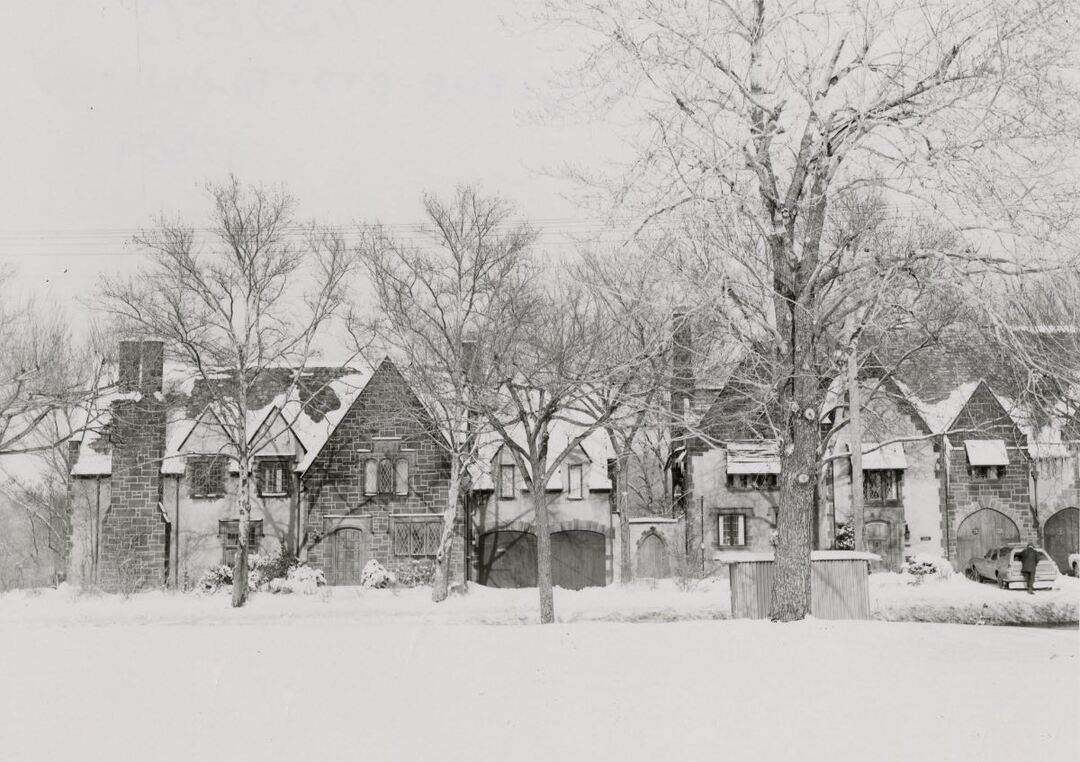
    <summary type="html"><![CDATA[<p><strong><em>"It is seldom that an entire neighborhood packs its trunks and moves in a body," wrote <em>The Architectural Exhibitor</em> in April of 1929 about a group of neighbors living around Hessler Road. The enclave of creative professionals planned to move into a community of their design, giving way to a historic development that bridges Cleveland and Cleveland Heights and urban and suburban living.</em></strong></p><img src="https://clevelandhistorical.org/files/fullsize/9caad50fe9b6e3d9b87b5fbdb316811b.jpg" alt="Fairhill Road Village" /><br/><p>Locally known as Belgian Village, Fairhill Road Village was listed on the National Register of Historic Places in 1990. Originally called Fairmount Place before the change of the development’s frontage road's name from Fairmount Road to Fairhill Road, the single-family homes combine detached and semi-detached dwellings. Today, thirteen homes comprise the Fairhill Road Village Historic District; five two-family semi-detached units built over the winter between 1929 and 1930 and three detached homes built intermittently in 1930, 1933, and 1971.
Fairhill recalls other planned communities built around the same time, notably Mayfair Lane in Buffalo, Sessions Village in Columbus, and the French Village in Philadelphia. All share the use of uniform architecture in a historic-revival style and semi-detached layout. Fairhill’s use of an unusually natural setting so close to an urban center allows it to be an exemplary model of this mode of building.</p><p>Standing on the abandoned debris created in the 1915 construction of the Fairmount Reservoir, Fairhill literally straddles the divide between urban and suburban by being built over the municipal boundary between Cleveland and Cleveland Heights. Architecturally Fairhill blends into its neighboring communities through historical revival architecture that evokes a common European heritage, a facet of suburban living. The development utilizes a style reflective of the Cotswold Hills District of England. The homes favor white varied stone and stucco with multiple gables and various recesses in the façade, creating the overall effect of an English hamlet appearing out of the forest.</p><p>The combination of shared and private space is central to Fairhill’s makeup. Originally planned as seventeen semi-detached homes by architect Antonio DiNardo, the eleven houses share a single drive with the dwellings facing a private park directly off Fairhill Road for shared use of the residents. The semi-detached units connect via their respective garages while service rooms above allow a more insular living space that looks onto private terraced gardens built at the edge of a ravine running through Ambler Park.</p><p>Landscape architect A. Donald Gray drove Fairhill’s development from conception to completion. Before moving to Cleveland, in 1920, Gray worked for The Olmsted Brothers landscape architecture firm under Frederick Law Olmsted Jr. Gray’s profession and his connections to the lauded firm show throughout Fairhill’s design.</p><p>The use of gardening to accentuate a site’s beauty and create natural boundaries was a key principle in Olmsted’s work and reflects in Fairhill’s balanced relationship between architecture and landscape. Each private terrace uses flower beds sparingly in order not to distract attention from the natural landscape. Decorative pools mirror the Doan Brook at the bottom of the ravine while simultaneously attracting birds into the garden. The additional planting of trees and shrubs at the front of the development creates a natural boundary between the homes and the roadway leading to the city.</p><p>The construction of Fairhill Road Village coincided with a culmination of development in suburban Cleveland before the Great Depression. By the end of the 1920s, Cleveland’s population had reached 900,000. The completion of the Union Terminal complex would mark Cleveland as a great American industrial center, with one of the tallest buildings in the country serving as a grand focal point for commuters going to and from their rapidly expanding suburban neighborhoods. Between 1919 and 1929 an average of 300 new homes were built annually in Shaker Heights. Literature and pamphlets were used like propaganda championing the single-family house on a large site and demonizing living close to vestiges of the city like factories, apartments, and minorities.</p><p>Nearby, John D. Rockefeller Jr. was developing the site of his family’s former country estate, <a href="https://clevelandhistorical.org/items/show/83">Forest Hill</a>, into another residential community. To promote his development, he mounted a large-scale advertising campaign in local papers that played on his bucolic childhood and promised to “revolutionize American standards of home construction” and ensure that “your neighbors are inevitably people of tastes in common with yours.”</p><p>In contrast to these commercial enterprises, Fairhill Road Village echoes the communal aspects of the Garden City Movement. Spearheaded by urban theorist Ebenezer Howard’s <em>Garden Cities of To-Morrow</em>, the Garden City attempted to alleviate the congestion of urban life by creating small, self-contained, and interconnected communities that would give residents access to the benefits of both urban and rural living while also making them stakeholders through communal ownership. Unlike Shaker Heights and Forest Hill, profit was not Fairhill’s concern. It started as a collaboration between creative professionals living on <a href="https://clevelandhistorical.org/items/show/829">Hessler Road</a> who wanted to move away from the frenzy of Cleveland towards the tranquility of Cleveland Heights while maintaining the cultural sophistication of urban life. Fairhill incorporated many of the ideas championed by the Garden City Movement through shared ownership, green space, and limited size.</p><p>The Fairmount Development Group, comprised of future residents of Fairhill, was formed to purchase and subdivide the property into individual lots. The company’s mission statement clearly outlined its objective “to get a group of interesting people to build semi-detached houses in the same style of architecture, to build these houses on small areas of land…” Through a co-op model, the residents of Fairhill pooled resources to procure the land on which to build their homes. This communal approach was unusual as shown by A. Donald Gray’s letter to architect H. O. Fullerton that showed the committee in charge of securing the loan at Cleveland Trust for the development of Fairhill was “skeptical” because the proposition “was a new idea to them.”</p><p>Inadequate finances and a lack of interested parties created an obstacle to the construction of Fairhill. To fill the appropriate number of building plots, the Fairmount Development Group members were enlisted to find interested people within their network. One Fairhill planner, J. T. Seavers, told Gray, “I’m putting it up to every family to get one more pronto, and we will not only be done but have a waiting list.”</p><p>A sense of urgency pervaded the building of Fairhill that correlated with the beginning of the Great Depression. <em>Cleveland Plain Dealer </em>business columnist, and original resident, John W. Love wrote on October 24, 1929, about his unease in Cleveland’s labor conditions amid a large building project. Love cited labor’s stable relationship with “the Vans” (<a href="https://clevelandhistorical.org/items/show/66">Van Sweringen brothers</a>) during the five-year construction of the Terminal complex as long as they didn’t “rock the canoe,” but that those agreements would end in the spring, and he urged the building to be completed before March 31 to avoid a potential strike. A week later, on Black Tuesday, he used the urgency of the telegram to communicate what must have been a growing sense of dread, writing, “Financial conditions [are] so extremely ominous that I doubt we ought to proceed with construction except with best possible guarantees of money and stability of contractor.” By April 1930, ten of the seventeen planned homes were completed in the spirit of DiNardo’s original plans if not in size.</p><p>The Great Depression crippled neighboring developments like Shaker Heights and Forest Hill. Donald Gray saw Fairhill’s innovative collaboration amongst its residents as a potential benefit in residential development during the Depression. In a letter to <em>The Ladies Home Journal, </em>Gray wrote of how the residents were able to lower the cost of building by sharing building materials because of Fairhill’s uniform style as well as sharing the expense of an architect. In a letter to <em>House Beautiful Magazine, </em>Gray stressed Fairhill’s merits, writing, “It seems to me that in these days of economy that the scheme has a great deal of interest to the general reader.” The letters show Gray’s belief in Fairhill’s social and economic benefits while demonstrating its adaptability to changing times.</p><p>The planned community allowed refuge for Cleveland’s white population to create enclaves amongst themselves. Fairhill’s co-op model and design reflected the intention to innovate in habitation, but not immune to the self-selective nativist sentiments prevalent in the 1920s. Fairhill’s formation of The Fairmount Road Association allowed members of the community to retain the social control that <em>The Architectural Exhibitor </em>alluded to in writing, “In every community, there are certain sections and sometimes individual streets to which people of kindred tastes and habits naturally gravitate.” To live, build, or sell in the development required the approval of three-fourths of the Association's trustees—a trustee was either the owner of a home or their spouse—allowing the residents to foster a social homogeneity in line with its times. Fairhill never fulfilled its objective as outlined in <em>The Architectural Exhibitor </em>of moving the original group of Hessler Road residents into a community of their design. Nevertheless, Fairhill proved to be the cross-section of creative, cultured, and professional people reflective of its origination on Hessler Road including Russell and Rowena Jelliffe, founders of Karamu House, retired movie star May Alison, and aforementioned John Love and A. Donald Gray.</p><p><em><strong><a href="https://clevelandhistorical.org/items/show/987">For more (including 10 images) view the original article</a></strong></em></p>]]></summary>
    <published>2022-11-28T20:14:38+00:00</published>
    <updated>2026-04-17T19:17:42+00:00</updated>
    <link rel="alternate" type="text/html" href="https://clevelandhistorical.org/items/show/987"/>
    <id>https://clevelandhistorical.org/items/show/987</id>
    <author>
      <name>Robert Vroman</name>
    </author>
  </entry>
  <entry>
    <title type="html"><![CDATA[Shaker Village Historic District]]></title>
    <summary type="html"><![CDATA[<img src="https://clevelandhistorical.org/files/fullsize/7740803f41c224c7830e3660a6a23fa9.jpg" alt="Historic District, 1994" /><br/><p>Added to the U.S. National Register of Historic Places on May 31, 1984, the Shaker Village Historic District was created to recognize Shaker Heights' significance as a Garden City–influenced planned suburban community. The designation of Shaker Heights as a historic district helped to redefine the community's identity and reaffirm its intrinsic values.  Roughly bounded by Fairmount and Lomond Boulevards, Green, Warrensville Center, Becket, and Coventry Roads, nearly 80 percent of Shaker is currently located within the district.   While shaped to incorporate a handful of early Warrensville Township sites and structures, the historical significance of the area can be attributed to the Van Sweringen Co.'s success in creating a planned community that integrated architectural standards, landscaping, and public transportation. By developing an exclusive, highly regulated community, the real estate developers made good on their promise to those who invested in property - the enduring value of a home located within Shaker Village.   </p><p>Dramatic changes to both cultural norms and the physical landscape characterized postwar American society. These changes challenged the foundation from which Shaker Heights grew to prominence as an elite community.  Suburbanization and new routes of transportation redefined the role of both the suburb and the city.  The diverse population of Cleveland increasingly began to settle away from the city's core. This postwar suburban growth encroached upon Shaker Heights' borders. Shaker Heights remained prosperous throughout this process, but the class and racial segregation that defined its early years became untenable in the context of the social upheaval of the 1960s.  A shift in popular conceptions of class and race soon after visited the cosmopolitan community.  While integration was initially met with strong resistance, Shaker Heights eventually earned its reputation as a bastion of progressive and socially liberal thinking.  Within this new environment, the exclusivity that had both characterized Shaker Heights and helped reinforce its perceived value needed to be redefined.</p><p>The inclusion of Shaker Heights on the National Register reflected one strain of efforts to recreate a new community identity for the changing suburb.  Since the 1960s, citizen groups had designated various historic landmarks throughout the suburb to affirm and preserve a unique Shaker Heights identity.  Cemeteries, colonial homes, Shaker Square, and sites previously inhabited by the religious order of Shakers had become sites of public commemoration.  These displays were a reflection of a larger movement in American society to use preservation as a tool of beautification, promote the development of an American identity, and help create order within the new urban landscape.  An offshoot of Lyndon Johnson's Great Society programs, the National Register of Historic Places aimed to identify and protect historic sites in the United States. The designation of a district regularly enhanced property values, and was meant to foster a sense of community that encouraged the preservation of housing stock.  When sites such as Shaker Heights were designated historic districts, they received federal tax incentives that encouraged rehabilitation.  At the time of its inclusion on the National Register, nearly 5,000 well-preserved residences, churches, schools community buildings, and commercial structures built in the style of early 20th century colonial and revival architecture were located within the historic district.   The district was a means to redevelop a foundation from which the community could both reaffirm a sense of and physically maintain its exclusive character, thereby helping to ensure the value of the structures and their surrounds.  </p><p><em><strong><a href="https://clevelandhistorical.org/items/show/384">For more (including 7 images) view the original article</a></strong></em></p>]]></summary>
    <published>2012-01-02T18:30:13+00:00</published>
    <updated>2026-04-17T19:17:38+00:00</updated>
    <link rel="alternate" type="text/html" href="https://clevelandhistorical.org/items/show/384"/>
    <id>https://clevelandhistorical.org/items/show/384</id>
    <author>
      <name>Richard Raponi</name>
    </author>
  </entry>
  <entry>
    <title type="html"><![CDATA[Forest Hill: John D. Rockefeller&#039;s Summer Estate]]></title>
    <summary type="html"><![CDATA[<img src="https://clevelandhistorical.org/files/fullsize/foresthill3_c7c86d4dd9.jpg" alt="Entrance to Forest Hill" /><br/><p>Forest Hill was once the sweeping estate of oil baron John D. Rockefeller. Originally from a small town near the Finger Lakes in upstate New York, Rockefeller purchased the land along Euclid Avenue as a commercial venture in 1873, opening (along with other investors) a "water cure resort" centered around a Victorian mansion built on a hilltop overlooking Cleveland and Lake Erie. After the resort quickly went out of business, the mansion became the Rockefeller family's summer home, often referred to as "the homestead." The Rockefellers split time between here and their home on Euclid Avenue's Millionaires' Row until the family moved to New York City in 1884, after which point they returned to Forest Hill each summer. After his wife died in 1915, however, John D. Rockefeller seldom returned to Cleveland and Forest Hill. The summer home burned down under mysterious circumstances in 1917. </p><p>Rockefeller sold Forest Hill to his son John Rockefeller Jr. in 1923 for $2.8 million. In 1939, Rockefeller Jr. donated 235 acres of the Forest Hill acreage to the cities of Cleveland Heights and East Cleveland with the express stipulation that they be used for public recreation. This land included the site of the old Rockefeller house (now used as a sledding hill), and was developed into a public park by the landscape architect and Cleveland Heights native A. D. Taylor. The park opened in 1942, allowing members of the public to at last savor the cool lake breezes previously enjoyed by the richest man in the world. Picnic areas, walking trails, ballfields, and a swimming pool were some of the amenities added to the park over the years. </p><p>On the land east of Lee Boulevard, Rockefeller Jr. commissioned Andrew J. Thomas of New York to design a Garden City-influenced residential and commercial development. The resulting Forest Hill subdivision included 81 French Norman–style houses situated with common back yards that formed greenswards, as well as the gateway business block now known as the <a href="https://clevelandhistorical.org/items/show/206">Heights Rockefeller Building</a>, before the Great Depression prevented a fuller expression of the Rockefeller-Thomas vision. After prolonged difficulty in developing the remainder of the Forest Hill residential allotment, Rockefeller Jr. sold the land in 1948 to a Toledo-based syndicate that in turn sold lots to individuals who built mostly California ranch houses.</p><p><em><strong><a href="https://clevelandhistorical.org/items/show/83">For more (including 7 images&#32;&amp;&#32;3 audio files) view the original article</a></strong></em></p>]]></summary>
    <published>2010-11-13T10:27:50+00:00</published>
    <updated>2026-04-17T19:17:37+00:00</updated>
    <link rel="alternate" type="text/html" href="https://clevelandhistorical.org/items/show/83"/>
    <id>https://clevelandhistorical.org/items/show/83</id>
    <author>
      <name>Michael Rotman</name>
    </author>
  </entry>
</feed>
