<?xml version="1.0" encoding="UTF-8"?>
<feed xmlns="http://www.w3.org/2005/Atom">
  <title type="text">Cleveland Historical</title>
  <updated>2026-05-09T23:56:51+00:00</updated>
  <generator uri="http://framework.zend.com" version="1.12.20">Zend_Feed_Writer</generator>
  <link rel="alternate" type="text/html" href="https://clevelandhistorical.org/"/>
  <link rel="self" type="application/atom+xml" href="https://clevelandhistorical.org/items/browse?output=rss2"/>
  <id>https://clevelandhistorical.org/</id>
  <author>
    <name>Cleveland Historical</name>
    <uri>https://clevelandhistorical.org</uri>
  </author>
  <link rel="hub" href="http://pubsubhubbub.appspot.com/"/>
  <entry>
    <title type="html"><![CDATA[I-X Center: From Factory to Exposition Center]]></title>
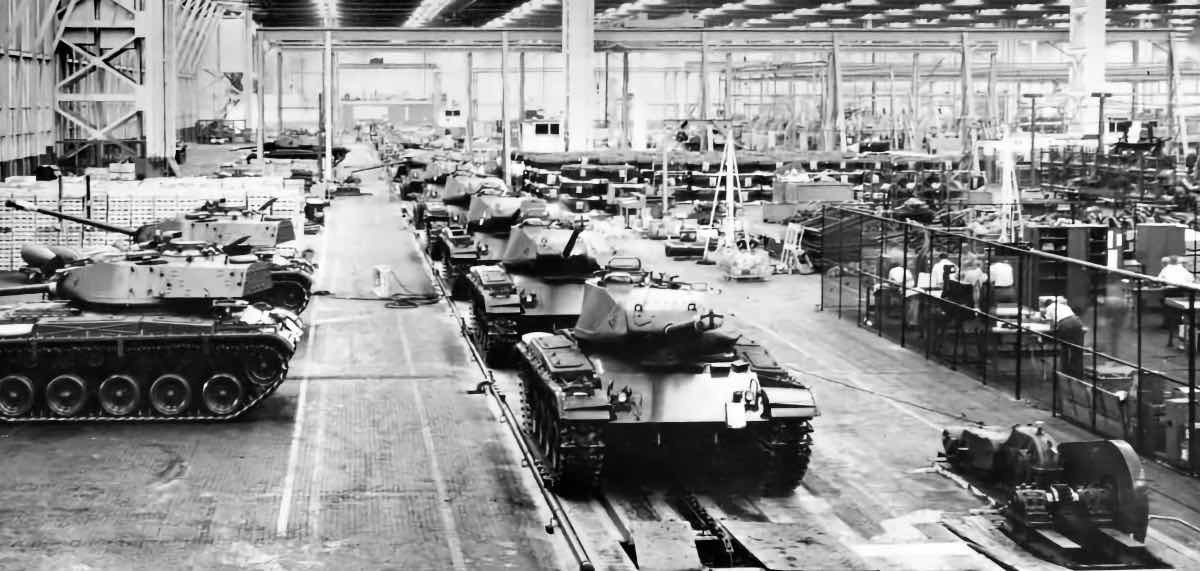
    <summary type="html"><![CDATA[<p><strong><em>The International Exposition Center, originally built as the Cleveland Bomber Plant, has seen an impressive variety of uses over its years of operation. From bomber planes and tanks to the various trade shows and events, the I-X Center has been used for countless different productions and conventions.</em></strong></p><img src="https://clevelandhistorical.org/files/fullsize/d918f614ed2aac926ea0fd41c3c6304a.jpg" alt="M41 Walker Bulldog Tanks" /><br/><p>The International Exposition Center, originally known as the Cleveland Bomber Plant, was built in 1942 with the purpose of constructing major sections of B-29 bombers for the United States during the Second World War. It was constructed and owned by the U.S. Department of Defense and was operated by Fisher Body, a subsidiary of General Motors. Following the conclusion of World War II, the Cleveland Bomber Plant was used briefly as an exhibition hall and sales center, a foreshadowing of what was to come many years later.</p><p>The workspace at the Cleveland Bomber Plant during World War II was diverse. African American men and women worked alongside white workers for attractive wages for the time. The demand for workers in the factory was so great that employees required approval from the Department of Defense to change jobs. Aside from the fabrication of B-29 bomber nose and tail sections, Fisher Body also received a contract to build and test top-secret experimental XP-75 fighter planes. The operations were so secretive that those working at the plant did not even know the specifications of the planes themselves.</p><p>After the end of World War II, the Cleveland Bomber Plant was leased to National Terminals and used as a soybean storage facility. The plant was used in this way until the beginning of the Korean War. U.S. involvement in the Korean War saw the Cleveland Bomber Plant become the Cadillac Tank Plant (or Cleveland Tank Plant). During the time of the Cadillac Tank Plant, the plant had expanded to include a photo department, a labor relations office, a full-time lawyer's office, and even a hospital with nurses and a staff doctor. This expansion, coupled with the thousands of workers at the facility, made the plant feel more like a small town in its own right than just a place of work.</p><p>The Cadillac Tank Plant produced tanks, artillery pieces, and other military vehicles with varying degrees of success. Following two years of production, the U.S. Army rejected all tanks made at the plant because of a faulty gun mechanism. In 1953, the Walker Bulldog, a light tank, was successfully put into service in Korea.</p><p>Between 1964 and 1966, Chrysler held the manufacturing contract at the plant while General Motors held the engineering contract. The relationship between these two companies was reputed to be poor. The plant was divided between these two companies, and a wall was built to protect trade secrets from one another, showcasing the lack of cooperation between the two. Chrysler would eventually lose the manufacturing bid to the Allison division of General Motors, leading to a smoother production process once again. Production continued until 1972. With United States involvement in the Vietnam War coming to an end, the U.S. government decided not to continue with the program upon the completion of the last General Motors contract.</p><p>After the Department of Defense closed the Cleveland Tank Plant, it made the site available for purchase. General Motors and the cities of Brook Park and Cleveland all showed some interest in purchasing the tank plant, but ultimately, none of them bought it.</p><p>In 1977 the plant was purchased by The Park Corporation of Charleston, West Virginia, with the intention of transforming the it into an international trade mart. Years after its purchase, in 1985 the facility reopened as the International Exposition and Trade Center, or I-X Center, and was reputedly the largest single-building exposition facility in the world. The I-X Center hosted a large variety of events such as conferences, car, motorcycle, boat, and home and garden shows, trade shows, and later the I-X indoor amusement park.</p><p>The I-X Center had created strong competition for the Cleveland Convention Center. After it opened, the I-X Center drew away both the auto and boat shows that were previously held at the downtown convention center.  Local unions tried to create new contracts that were aimed at helping the Cleveland Convention Center to keep or attract new trade shows, as the available work at the Cleveland center continued to decline. There was also a "gentlemen's agreement" between Ray Park, owner of the I-X Center, and the City of Cleveland that the I-X Center would not solicit shows that were traditionally run at the Cleveland Convention Center. Despite this agreement, however, the I-X Center offered the space and time desired by shows such as the Auto Show, and the I-X Center was picked over the Cleveland Center.</p><p>The Cleveland Convention Center went under renovations and attempted to showcase and market these renovations to remain competitive with the I-X Center and other cities. These renovations proved not to be enough as the Cleveland Convention Center would continue to operate at a loss after its most profitable shows went to the I-X Center.</p><p>The addition of 185,000 square feet of exhibit space in 2008 puts the I-X Center at a total of 2.2 million square feet, and it remains one of the largest trade show and exhibition centers in the world as of 2026. The I-X Center was closed during the COVID pandemic and was purchased and reopened by the Industrial Realty Group in 2021. Events continued until March 2026, with the Industrial Realty Group seemingly uninterested in continuing to use the I-X Center for event space.</p><p>The I-X Center remains a historic piece of Cleveland's industrial and commercial legacy. From the manufacturing of important military hardware to one of the largest exposition centers in the world, its many different uses mirror the shifting phases of Cleveland's economy.</p><p><em><strong><a href="https://clevelandhistorical.org/items/show/1081">For more (including 8 images) view the original article</a></strong></em></p>]]></summary>
    <published>2026-03-06T15:40:14+00:00</published>
    <updated>2026-05-01T00:22:38+00:00</updated>
    <link rel="alternate" type="text/html" href="https://clevelandhistorical.org/items/show/1081"/>
    <id>https://clevelandhistorical.org/items/show/1081</id>
    <author>
      <name>Jaret Glueck</name>
    </author>
  </entry>
  <entry>
    <title type="html"><![CDATA[Hart Building: A Cast-iron Landmark of the Furniture Trade]]></title>
    <summary type="html"><![CDATA[<p><strong><em>At the center of one of two remaining clusters of nineteenth-century commercial buildings on West 9th Street, a slender gray facade stands out in a row of brick-faced buildings. The five-story Hart Building is only nine feet wide, making it Cleveland’s narrowest downtown building. Named for William Hart, a Connecticut-born cabinetmaker turned furniture manufacturer-merchant, it exemplifies Cleveland’s golden age of cast-iron facades and Hart’s gradual rise from a poor teenage orphan to one of the city’s prominent business and civic leaders.</em></strong></p><img src="https://clevelandhistorical.org/files/fullsize/839cd3f2260d0ebef88c4fdd293c40ca.jpg" alt="Hart Building" /><br/><p>William Hart (1811–1892) was born in Norwich, Connecticut, and migrated to the former Western Reserve with his parents and seven siblings in 1821 or 1822. Hart’s first experience in Cleveland was sleeping in the family’s covered wagon a couple of blocks west of Public Square, where they stopped on their way to the place they settled in Lorain County. About two years later, Hart’s parents both died within days of each other, orphaning eight children. In 1825, the same year that the Ohio & Erie Canal construction began, 14-year-old William moved to Cleveland to work as a cabinetmaking apprentice to Asabel Abel. After his apprenticeship ended, he opened his own small workshop and store at 49 Water Street near present-day Lakeside Avenue in 1834. That same year, he married and took up residence a block east of the shop on Bank Street. </p><p>The young cabinetmaker worked hard to provide for his younger siblings as well as for nieces and nephews that he and his wife adopted. Hart’s fortunes rose alongside Cleveland’s in the years after the canal launched the city’s upward arc of development, and in 1843 he moved just south to a larger building at 59 Water Street. By mid-century, William Hart & Co. was one of the six furniture wholesale houses that lined Water Street. However, soon thereafter, he suffered some setbacks. First, he nearly severed his arm in a circular saw accident in 1850, leading sympathetic voters to elect him City Treasurer, then a light job that enabled him to remain focused on his furniture business. Two years later, a fire destroyed his building and entire stock. </p><p>Undeterred, in 1853 Hart reopened briefly on Bank Street while he completed a larger four-story building at 103-105 Water Street (today 1370 West 9th Street). In 1868, two years after partnering with his son-in-law Hezekiah P. Malone to become Hart & Malone, he expanded to encompass the nine-foot-wide space between his building and the newly built Crittenden Block to its south. This became 107 Water Street (now 1374 West 9th Street). To match its cast-iron facade, he covered the old building with ornamental tinwork. This was at the height of the popularity of cast-iron facades, which also covered similar buildings erected in other cities in the 1850s-80s, perhaps most notably in New York’s SoHo and Tribeca districts. Hart also added a mansard roof on the fifth floor that further unified the two buildings. Today the facades appear more distinct because the older building’s tin facade was later removed to expose the brick.</p><p>In 1874, Hart & Malone was on the leading edge of an eastward shift of retailing when it moved from Water Street to 2 & 4 Euclid Avenue at the southeast corner of Public Square, lending higher visibility in what was on the cusp of becoming the heart of downtown. Hart & Malone probably struggled amid the economic downturn after the Panic of 1873. In 1875, Hart, who had already retired a few years before, left the business in the hands of an assignee and moved to Bradford, Pennsylvania, where he invested in the oil business, only to lose much of what remained of his onetime fortune. Meanwhile, his furniture store moved a block south to 15 & 17 Prospect Street just east of Ontario Street, where it continued to unload its remaining stock until it closed in 1877. </p><p>After the departure of the furniture business, the Hart Building saw a succession of business uses. Among the longest-running was the Cleveland office of Chicago-based Fairbanks, Morse & Co., a manufacturer of scales, engines, pumps, and windmills, which occupied the building in the 1880s to 1910s. After business declined on and around West 9th Street following World War II, the Hart Building became a part of efforts in the 1970s and '80s to revamp Cleveland’s so-called Warehouse District, including the ill-fated Lawrence A. Halprin plan for Settlers Landing. Jacobs Investments bought the Hart Building in 1984 and renovated its upper floors as apartments. As the district revitalized, the ground-floor space at 1370 West 9th became an antique store in 1988 and then housed two art galleries in succession in the 1990s to 2010s. Since 1995 the Hart Building’s five residential units have been condominiums. Its 1868 addition remains as a rare remnant of a time when the Warehouse District had many tall, narrow commercial blocks.</p><p><em><strong><a href="https://clevelandhistorical.org/items/show/1062">For more (including 13 images) view the original article</a></strong></em></p>]]></summary>
    <published>2025-10-05T21:56:34+00:00</published>
    <updated>2026-04-17T19:17:43+00:00</updated>
    <link rel="alternate" type="text/html" href="https://clevelandhistorical.org/items/show/1062"/>
    <id>https://clevelandhistorical.org/items/show/1062</id>
    <author>
      <name>J. Mark Souther</name>
    </author>
  </entry>
  <entry>
    <title type="html"><![CDATA[Gund Brewery: One of Cleveland&#039;s Most Influential Families Began with Beer]]></title>
    <summary type="html"><![CDATA[<p><strong><em>George Gund brought his business skills to Cleveland's competitive brewing industry in 1898. Through the years, his family prospered through their brewing, banking, and investments, creating a fortune that became a pillar of Cleveland philanthropy.</em></strong></p><img src="https://clevelandhistorical.org/files/fullsize/57451160b8ff5a853993755018a43d57.jpg" alt="The Gund Brewery" /><br/><p>Brothers Martin and Michael Stumpf opened Cleveland’s first known brewery on Hamilton Street between Muirson (East 12th) and Canfield, just south of Lakeside Avenue. The proximity to rail service and ice from the winter lake  made the area an ideal site for a brewery to supply local saloons (before bottled beer, local commercial distribution was the standard method of the times). During the next 15 years, the brothers split as partners but each continued brewing independently in the same near-east Hamilton Street neighborhood. </p><p>In 1859, Michael Stumpf sold his operation to the newly-organized Lyon Brewery, formed by Paul Kindsvater, a popular local saloonkeeper, and brewmaster Jacob Mall. By this time, Cleveland’s brewing industry was thriving. Like most breweries in the city, Lyon was operated by a German brewmaster. They produced the lagers preferred by Cleveland’s large Eastern European ethnic communities, replacing earlier common ales. The business and facility expanded rapidly and thrived into the 1890s as Mall’s leadership role was passed to his son-in-law. In 1896, in pursuit of greater production capacity, a new larger plant was built on Davenport Street.  In the mid-1800s, Davenport Street connected Canfield Street (East 14th) with Briggs Street (East 22nd) along the edge of the downtown bluff— about 70 feet above the rail tracks along the Lake Erie shore. While local competition was fierce, growing demand generally meant there was enough business to go around. However, a new challenge was emerging as consolidated national brewers threatened local brewers’ market shares.</p><p>Meanwhile, George F. Gund (b. 1855) grew up in La Crosse, Wisconsin, where he later worked as a banker and with his father in the John Gund Brewing Company. George Gund relocated to Seattle in 1890, bought a local brewery, and expanded it. In 1897, he moved to Cleveland and purchased and renamed Jacob Mall’s Lyon Brewery to The Gund Brewing Company. Amidst all the competition, Gund refocused his business model on the individual consumer and away from the traditional saloon distribution. He built a bottling plant, upgraded working conditions and methods, and packaged three-bottle cardboard cartons in lots of eight to distribute to homes near and far. Gund’s Crystal Lager satisfied thirsty Clevelanders. The brewery continued to thrive into the 20th century under George F. Gund’s leadership while he cultivated other business interests in beverages, banking, mining, insurance, and real estate. Gund died in 1916, leaving his chair to his son, George F. Gund II.</p><p>George F. Gund II arrived in Cleveland from Seattle having finished Harvard Business School and a banking position. He personalized his arrival with Gund’s "Clevelander" beer, which sold for the next few years. In early 1919, Ohio enacted statewide prohibition rules and Gund ceased brewing beer and transferred his reserve inventory to the Pilsner Brewing Company of Cleveland to exhaust the inventory of Gund beer. During Prohibition, the Gund family refocused business away from brewing towards real estate management, banking, and various other business endeavors including decaffeinated coffee, later sold to the Kellogg Corporation and re-branded as Sanka. In the process, George F. Gund II became one of Cleveland’s foremost bankers as Chairman of the Cleveland Trust Company. His sons maintained the family’s Cleveland presence with philanthropic efforts (The Gund Foundation) and professional sports interests for the next century.</p><p>Gund Realty continued to own the Davenport property throughout the Prohibition years. The pre- and post-Prohibition eras also saw constant tensions within the industry between large national brewing conglomerates and smaller local operations in cities throughout the country. With the repeal of Prohibition came a rebirth of the local brewing industry. Gund Realty leased the Davenport facility to the Sunset (later Sunrise) Brewing Company. The new managers renovated and resumed the reliance upon bottled and canned beer with emphasis as a shipping brewer. More federal legal challenges forced another ownership change and product evolution. Sunrise emerged with its premier brand Tip Top Beer by the end of the decade. In 1939, Sunrise Brewing, still operating at the Davenport facility, was renamed Tip Top Brewing Company. More controversy ensued into the first half of the 1940s with rumors of the company’s connection to organized crime. By utilizing wartime rationing regulation loopholes, Tip Top Brewery added hard liquor sales to their beer business to gain market advantages in Cleveland saloons.</p><p>In 1944, Tip Top Brewing was sold to the Brewing Corporation of America (Carling Beer) and brewing operations ceased on Davenport Avenue. The building continued to be utilized as a beer and beverage warehousing and distributing facility for the next few decades. From the mid-1970s to the 2010s, the City of Cleveland and the Pennsylvania Railroad, along with several local banking and mortgage agencies and developers carried out property transfers, demolitions, and rezoning initiatives of the Davenport and neighboring properties as urban planning and development transformed the district.</p><p>The Davenport Avenue roadway was removed between East 14th and 16th Streets. The area once defined by Stumpf, Lyon, Gund, Sunrise, and finally Tip Top brewing operations is now occupied by Cleveland’s WKYC television studios and the Cleveland FBI headquarters building. The location that played a part in more than a century of the brewing industry’s  evolution from a local to a global scale also marked the long arc of Gund family's business and family fortunes, which still resonate in Cleveland today.</p><p><em><strong><a href="https://clevelandhistorical.org/items/show/998">For more (including 12 images) view the original article</a></strong></em></p>]]></summary>
    <published>2023-02-07T20:13:26+00:00</published>
    <updated>2026-04-17T19:17:43+00:00</updated>
    <link rel="alternate" type="text/html" href="https://clevelandhistorical.org/items/show/998"/>
    <id>https://clevelandhistorical.org/items/show/998</id>
    <author>
      <name>Jim Lanese</name>
    </author>
  </entry>
  <entry>
    <title type="html"><![CDATA[SIFCO Industries, Inc. : The Steel Improvement and Forge Company]]></title>
    <summary type="html"><![CDATA[<img src="https://clevelandhistorical.org/files/fullsize/0a307a7be070ea28ca2ad6e4a05bf44e.jpg" alt="Exterior circa 1928. " /><br/><p>Cleveland is a city that was built upon the backs of industries and although it has come to be identified with burning rivers and unavailing sports franchises, the industrial culture of the region is what drove, and continues to drive, a significant amount of the economic prosperity of the city. A strong player in Cleveland’s industrial market in existence for over a century is SIFCO Industries, Inc. located off of St. Clair Avenue on Cleveland’s east side. </p><p>SIFCO was originally founded in 1913 by a small group of men in Cleveland who set out with one goal, to improve the strength of metals. Accordingly, their operation was initially known as the Steel Improvement Company and they began to build their business by testing and enhancing the properties of steel through the use of thermal cycles. Directly next door to the Steel Improvement Company at the time was the Forest City Machine Company who manufactured hardware using many of the types of metals the Steel Improvement Company was attempting to enhance. Deeming a merger as an opportunity for growth for both businesses, the neighbors merged in 1916 to form the Steel Improvement and Forge Company. </p><p>One reason that SIFCO has been able to remain a viable entity in an industry that has seen drastic changes since the company’s conception in 1913 can be attributed to the fact that, much like the city of Cleveland itself, SIFCO possesses an affinity for adaptability. During the early years of the business when the world was entrenched in World War II, it was SIFCO who played a pivotal role in contributing to the Allies' success. The Allied Powers had tested launching torpedoes from aircrafts only to find that the propellers needed to direct the torpedoes once in the water could not withstand the force of being launched from a plane. SIFCO engineers were able to develop a forged steel alloy propeller strong enough to make the airstrikes possible. The company shifted gears and produced every propeller for aircraft-launched torpedoes used by the United States throughout the duration of the war. For this and many other wartime contributions, SIFCO was awarded the ‘E’ Pennant for Defense Manufacturing Excellence, the highest such honor bestowed on manufacturing entities, by President Roosevelt in 1942.  </p><p>Following its collections of notable wartime successes, SIFCO shifted its focus once again and reconnected with the roots of the company, improving steel. The art of forging metals has been in existence for millennia, and while the methods employed in forging metals are universally standard, the materials used are where the possibility for advancements exist. Only a few short years after the conclusion of World War II, SIFCO became the first company to forge titanium in 1949, harkening back to its pioneering of the forging of the alloy monel before the onset of the war.</p><p>One way in which SIFCO’s war involvement did change the trajectory of the company, though, is the industry in which SIFCO began to specialize in. Recognizing the growing importance of the airspace industry, both for commercial and military purposes, SIFCO established itself as a premier supplier of forged components for airspace and engine construction and retains that same identity today. </p><p>Aside from the many milestones the company had achieved in its work with metals, SIFCO also added another feather in its cap when it joined the New York Stock Exchange in 1969. The acronym SIFCO was never actually used by the company until its debut on Wall Street when the company, then referred to solely as the Steel Improvement and Forge Company as it had been since 1916, was given the symbol SIFCO to be identified by investors. In an effort to connect itself with this new moniker, the Steel Improvement and Forge Company rebranded around the name SIFCO and has used the abbreviated name in all its operations since.</p><p>In addition to its home for over century in Cleveland, SIFCO’s innovations and dedication to the craft and quality of forged metals has allowed the company to expand its operations beyond its plant on East 64th Street. With nearly one hundred and fifty employees working in its corporate offices and production shop in Cleveland, SIFCO conjointly has plants in Alliance, Ohio, and Orange County, California. In 2015, SIFCO also expanded its operations overseas with the purchase of C*Blade S.P.A. Forging & Manufacturing in Italy.</p><p>Today, SIFCO remains a robust company in the city of Cleveland, the United States, and abroad. Nearly every plane in flight today has at least one component produced by SIFCO. The business has remained in Cleveland at a time when many other companies relocated to the suburbs because of the talented workforce in the area, connections to transit, and its ties to its heritage. As a centennial celebration of SIFCO’s history, the company produced an online blog and Ebook highlighting some of SIFCO’s many accomplishments and distinguished employees. Though not immune to economic downturns, it is SIFCO’s dedication to craftsmanship and ability to work with exotic metals to produce highly specialized, durable products that has kept it a viable, growing company for over a century.  </p><p><em><strong><a href="https://clevelandhistorical.org/items/show/726">For more (including 7 images&#32;&amp;&#32;3 audio files) view the original article</a></strong></em></p>]]></summary>
    <published>2015-07-27T14:27:12+00:00</published>
    <updated>2026-04-17T19:17:41+00:00</updated>
    <link rel="alternate" type="text/html" href="https://clevelandhistorical.org/items/show/726"/>
    <id>https://clevelandhistorical.org/items/show/726</id>
    <author>
      <name>Joe Dill</name>
    </author>
  </entry>
  <entry>
    <title type="html"><![CDATA[Richman Brothers Co.: A Paragon of Welfare Capitalism]]></title>
    <summary type="html"><![CDATA[<img src="https://clevelandhistorical.org/files/fullsize/a7bf8baef6477bde5fe7910a347c767b.jpg" alt="Richman Factory Drawing, ca. 1930s" /><br/><p>The Richman Brothers Company was originally founded by Jewish-Bavarian immigrant Henry Richman Sr. and his brother-in-law and business partner Joseph Lehman in Portsmouth, Ohio, in 1853. In an effort to become closer to a bustling city, both to expand their operations and customer base, the two men relocated with their families and business to Cleveland, Ohio, in 1879. Originally named the Lehman-Richman Company, the operation took on the moniker the Richman Brothers Company in 1904 after both Henry Richman Sr. and Joseph Lehman had retired and transferred ownership of the company to Henry Sr.’s three sons Nathan, Charles and Henry Jr. </p><p>After having a presence in the region for nearly forty years, the Richman Brothers Company commissioned their first Cleveland factory to be built at 1600 East 55th Street after previously retrofitting their operations into several other pre-existing structures throughout the city. Designed by The Christian Schwarzenberg and Gaede Company and constructed by Hunkin-Conkey Construction Co., the building was designated the “Best Built Factory in Cleveland in 1917” by the Cleveland Chamber of Commerce. Later additions were added onto the structure in 1924 and 1927, which completed the 650,000 square feet of interior space still present on the site. </p><p>The factory quickly became a landmark on the East 55th Street landscape as a result of its domineering size, both inside and out. With fifteen-foot-high ceilings, large-scale windows, and even the world’s largest cutting tables at the time, measuring sixty feet long, the structure provided Richman Brothers’ employees with working conditions previously unheard of in the garment industry. </p><p>Not only were Clevelanders familiar with the building, so, too, was the federal government. After entry into World War I, the federal government approached the brothers with a proposition to turn the site over to a military occupation to be used as a hospital for returning injured soldiers. After only one year of owning the building, in 1918 the Richman Brothers readily agreed to allow the government to utilize the structure as needed, making Cleveland the first city in the country to place such a building at the government’s disposal without expense. </p><p>Their commitment to the war effort was just one element of the Richman Brothers’ reputable business practices. As a family owned and operated company, the Richman Brothers ensured that each person under their employ felt as though they were part of a family. The first industrial organization to do so, the Richman Brothers Company offered two weeks paid vacation for all employees. Similarly, the company also instituted paid maternity leave, set a thirty-six hour work week, utilized no time clocks, and offered corporate stock options. To assist employees during times of personal distress, The Richman Brothers Foundation was created which provided no interest loans to employees as needed. The brothers were viewed as such progressives that the federal government based many workplace regulation laws off of Richman standards. </p><p>The Richman Brothers also tirelessly fought to keep the unions out of their company. Pressures mounted around the middle of the twentieth century, which resulted in the company releasing a statement saying, “The union plan . . . has been one to crush our business. We think this is wrong . . . to put this kind of pressure on our family.” Confident in their business practices, the Richman Brothers believed the union to be unnecessary and felt it would restrict the benefits they were able to offer their employees. </p><p>While the name of the company implies that all three brothers were equally in control of the company, it is Nathan Richman who is credited with maintaining the company’s standards and growing the business into one of the largest men’s clothing retailers in the country. At the time of his death in 1941, two thousand employees gathered at the open-casket services to bid farewell to the last surviving Richman brother. </p><p>After Nathan’s death the company remained under the ownership of one of his nephews, who continued to successfully grow and expand the business. In 1969, the Richman Brothers merged with F. W. Woolworth Company, who kept the Richman brand viable for another three decades. As the industry changed sharply in the late 1980s, the bloated conglomerate Woolworth began to shutter some of its subsidiaries. In 1990, the Richman Brothers Company was deemed financially unstable and was completely liquidated by 1992. Since that time, the structure on East 55th Street has remained vacant with many unsuccessful reuse projects proposed to redevelop the site. </p><p><em><strong><a href="https://clevelandhistorical.org/items/show/708">For more (including 8 images) view the original article</a></strong></em></p>]]></summary>
    <published>2015-05-16T10:56:17+00:00</published>
    <updated>2026-04-17T19:17:40+00:00</updated>
    <link rel="alternate" type="text/html" href="https://clevelandhistorical.org/items/show/708"/>
    <id>https://clevelandhistorical.org/items/show/708</id>
    <author>
      <name>Joe Dill</name>
    </author>
  </entry>
  <entry>
    <title type="html"><![CDATA[Fisher Body Strike]]></title>
    <summary type="html"><![CDATA[<img src="https://clevelandhistorical.org/files/fullsize/74955f59721a65b41cabd20d106e1bf1.jpg" alt="After the Strike" /><br/><p>The Fisher Body Ohio Company in Collinwood - located on E. 140th Street and Coit Road - began production in 1921.  This new division of General Motors was one of the many industrial plants that emerged and proliferated due to the neighborhood's rail yard and Cleveland lines.  Spread across three shifts, 7,000 employees at Fisher Body worked to manufacture Chevrolet bodies almost exclusively. </p><p>At 2 p.m. on 28 December 1936, approximately 200 workers at the Fisher Body plant abruptly stopped work and staged a sit-down.  Once the news spread of the strike, 125 picketers marched on the street in support of the strike.  The workers gave their demands: They wanted their hours cut to three seven-hour shifts so layoffs could be avoided.  On holidays and Sundays the workers expected to be paid double.  Finally, they wanted the union members who discussed the settlement of their terms be paid for the time they spent negotiating.  However, negotiation proved to be long and difficult The men remained inside Collinwood's Fisher Body for more than a month. </p><p>Other General Motor plants were in the middle of a strike when Collinwood began their sit-down, and others followed.  The situation was severe enough to gain the attention of President Franklin D. Roosevelt. He was not pleased with General Motors' refusal to budge, and the federal government stepped in to see that negotiations began between strikers and General Motors Corporation, which  "account[ed] for about one-twentieth of the economic activity of the United States." </p><p>Finally, on February 12, 1937, General Motors held a conference in Flint, Michigan. The following day a band marched through the streets of Collinwood followed by members of the United Automobile Workers of America union and other Fisher Body employees.  The parade ended at Public Hall where union members voted on the agreement struck between General Motors and the U.A.W.A. </p><p>The loss of $1,800,000 in wages over the six-week period had hit both the families of the strikers and a number of Collinwood businesses hard. In Cleveland, the strike caused the greatest unemployment since 1929; the year of the stock market crash that began the Great Depression. According to the Plain Dealer, "Word of the strike settlement was received with rejoicing by the whole Collinwood district, where many of the strikers live and where merchants had felt the financial effect of the stoppage of thousands of weekly pay envelopes."</p><p><em><strong><a href="https://clevelandhistorical.org/items/show/393">For more (including 8 images) view the original article</a></strong></em></p>]]></summary>
    <published>2012-01-12T19:45:33+00:00</published>
    <updated>2026-04-17T19:17:38+00:00</updated>
    <link rel="alternate" type="text/html" href="https://clevelandhistorical.org/items/show/393"/>
    <id>https://clevelandhistorical.org/items/show/393</id>
    <author>
      <name>Heidi Fearing</name>
    </author>
  </entry>
</feed>
