<?xml version="1.0" encoding="UTF-8"?>
<feed xmlns="http://www.w3.org/2005/Atom">
  <title type="text">Cleveland Historical</title>
  <updated>2026-04-17T15:26:56+00:00</updated>
  <generator uri="http://framework.zend.com" version="1.12.20">Zend_Feed_Writer</generator>
  <link rel="alternate" type="text/html" href="https://clevelandhistorical.org/"/>
  <link rel="self" type="application/atom+xml" href="https://clevelandhistorical.org/items/browse?output=rss2"/>
  <id>https://clevelandhistorical.org/</id>
  <author>
    <name>Cleveland Historical</name>
    <uri>https://clevelandhistorical.org</uri>
  </author>
  <link rel="hub" href="http://pubsubhubbub.appspot.com/"/>
  <entry>
    <title type="html"><![CDATA[Fairhill Road Village: A Unique Planned Community ]]></title>
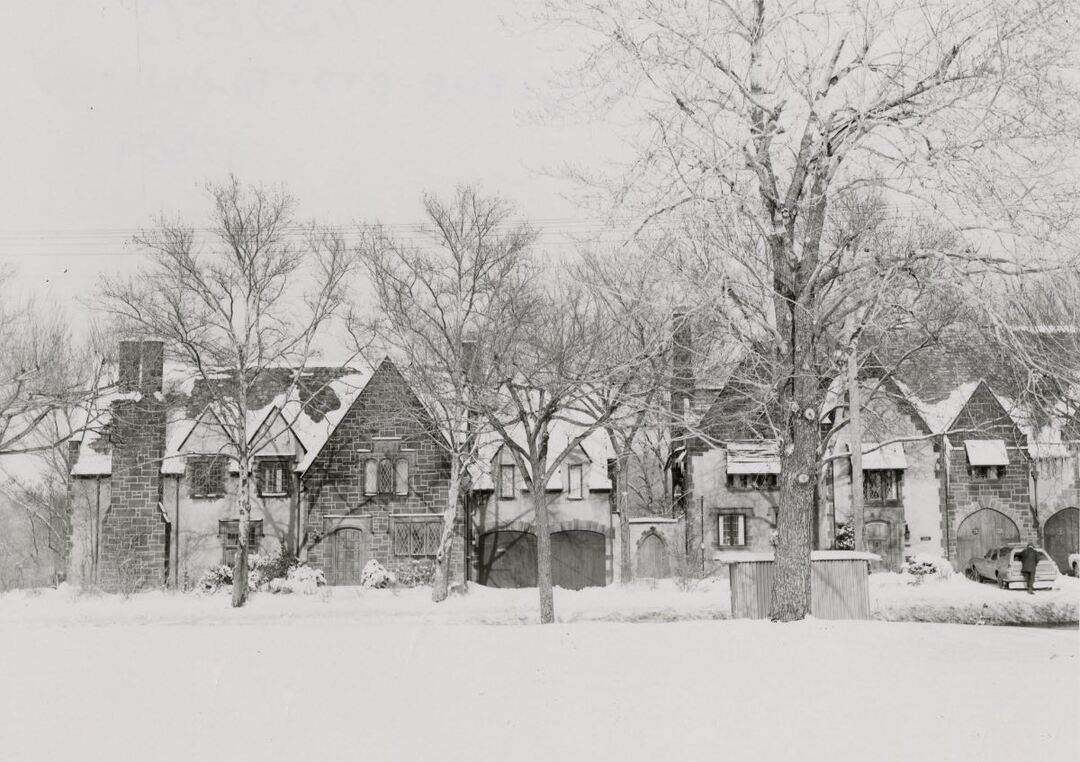
    <summary type="html"><![CDATA[<p><strong><em>"It is seldom that an entire neighborhood packs its trunks and moves in a body," wrote <em>The Architectural Exhibitor</em> in April of 1929 about a group of neighbors living around Hessler Road. The enclave of creative professionals planned to move into a community of their design, giving way to a historic development that bridges Cleveland and Cleveland Heights and urban and suburban living.</em></strong></p><img src="https://clevelandhistorical.org/files/fullsize/9caad50fe9b6e3d9b87b5fbdb316811b.jpg" alt="Fairhill Road Village" /><br/><p>Locally known as Belgian Village, Fairhill Road Village was listed on the National Register of Historic Places in 1990. Originally called Fairmount Place before the change of the development’s frontage road's name from Fairmount Road to Fairhill Road, the single-family homes combine detached and semi-detached dwellings. Today, thirteen homes comprise the Fairhill Road Village Historic District; five two-family semi-detached units built over the winter between 1929 and 1930 and three detached homes built intermittently in 1930, 1933, and 1971.
Fairhill recalls other planned communities built around the same time, notably Mayfair Lane in Buffalo, Sessions Village in Columbus, and the French Village in Philadelphia. All share the use of uniform architecture in a historic-revival style and semi-detached layout. Fairhill’s use of an unusually natural setting so close to an urban center allows it to be an exemplary model of this mode of building.</p><p>Standing on the abandoned debris created in the 1915 construction of the Fairmount Reservoir, Fairhill literally straddles the divide between urban and suburban by being built over the municipal boundary between Cleveland and Cleveland Heights. Architecturally Fairhill blends into its neighboring communities through historical revival architecture that evokes a common European heritage, a facet of suburban living. The development utilizes a style reflective of the Cotswold Hills District of England. The homes favor white varied stone and stucco with multiple gables and various recesses in the façade, creating the overall effect of an English hamlet appearing out of the forest.</p><p>The combination of shared and private space is central to Fairhill’s makeup. Originally planned as seventeen semi-detached homes by architect Antonio DiNardo, the eleven houses share a single drive with the dwellings facing a private park directly off Fairhill Road for shared use of the residents. The semi-detached units connect via their respective garages while service rooms above allow a more insular living space that looks onto private terraced gardens built at the edge of a ravine running through Ambler Park.</p><p>Landscape architect A. Donald Gray drove Fairhill’s development from conception to completion. Before moving to Cleveland, in 1920, Gray worked for The Olmsted Brothers landscape architecture firm under Frederick Law Olmsted Jr. Gray’s profession and his connections to the lauded firm show throughout Fairhill’s design.</p><p>The use of gardening to accentuate a site’s beauty and create natural boundaries was a key principle in Olmsted’s work and reflects in Fairhill’s balanced relationship between architecture and landscape. Each private terrace uses flower beds sparingly in order not to distract attention from the natural landscape. Decorative pools mirror the Doan Brook at the bottom of the ravine while simultaneously attracting birds into the garden. The additional planting of trees and shrubs at the front of the development creates a natural boundary between the homes and the roadway leading to the city.</p><p>The construction of Fairhill Road Village coincided with a culmination of development in suburban Cleveland before the Great Depression. By the end of the 1920s, Cleveland’s population had reached 900,000. The completion of the Union Terminal complex would mark Cleveland as a great American industrial center, with one of the tallest buildings in the country serving as a grand focal point for commuters going to and from their rapidly expanding suburban neighborhoods. Between 1919 and 1929 an average of 300 new homes were built annually in Shaker Heights. Literature and pamphlets were used like propaganda championing the single-family house on a large site and demonizing living close to vestiges of the city like factories, apartments, and minorities.</p><p>Nearby, John D. Rockefeller Jr. was developing the site of his family’s former country estate, <a href="https://clevelandhistorical.org/items/show/83">Forest Hill</a>, into another residential community. To promote his development, he mounted a large-scale advertising campaign in local papers that played on his bucolic childhood and promised to “revolutionize American standards of home construction” and ensure that “your neighbors are inevitably people of tastes in common with yours.”</p><p>In contrast to these commercial enterprises, Fairhill Road Village echoes the communal aspects of the Garden City Movement. Spearheaded by urban theorist Ebenezer Howard’s <em>Garden Cities of To-Morrow</em>, the Garden City attempted to alleviate the congestion of urban life by creating small, self-contained, and interconnected communities that would give residents access to the benefits of both urban and rural living while also making them stakeholders through communal ownership. Unlike Shaker Heights and Forest Hill, profit was not Fairhill’s concern. It started as a collaboration between creative professionals living on <a href="https://clevelandhistorical.org/items/show/829">Hessler Road</a> who wanted to move away from the frenzy of Cleveland towards the tranquility of Cleveland Heights while maintaining the cultural sophistication of urban life. Fairhill incorporated many of the ideas championed by the Garden City Movement through shared ownership, green space, and limited size.</p><p>The Fairmount Development Group, comprised of future residents of Fairhill, was formed to purchase and subdivide the property into individual lots. The company’s mission statement clearly outlined its objective “to get a group of interesting people to build semi-detached houses in the same style of architecture, to build these houses on small areas of land…” Through a co-op model, the residents of Fairhill pooled resources to procure the land on which to build their homes. This communal approach was unusual as shown by A. Donald Gray’s letter to architect H. O. Fullerton that showed the committee in charge of securing the loan at Cleveland Trust for the development of Fairhill was “skeptical” because the proposition “was a new idea to them.”</p><p>Inadequate finances and a lack of interested parties created an obstacle to the construction of Fairhill. To fill the appropriate number of building plots, the Fairmount Development Group members were enlisted to find interested people within their network. One Fairhill planner, J. T. Seavers, told Gray, “I’m putting it up to every family to get one more pronto, and we will not only be done but have a waiting list.”</p><p>A sense of urgency pervaded the building of Fairhill that correlated with the beginning of the Great Depression. <em>Cleveland Plain Dealer </em>business columnist, and original resident, John W. Love wrote on October 24, 1929, about his unease in Cleveland’s labor conditions amid a large building project. Love cited labor’s stable relationship with “the Vans” (<a href="https://clevelandhistorical.org/items/show/66">Van Sweringen brothers</a>) during the five-year construction of the Terminal complex as long as they didn’t “rock the canoe,” but that those agreements would end in the spring, and he urged the building to be completed before March 31 to avoid a potential strike. A week later, on Black Tuesday, he used the urgency of the telegram to communicate what must have been a growing sense of dread, writing, “Financial conditions [are] so extremely ominous that I doubt we ought to proceed with construction except with best possible guarantees of money and stability of contractor.” By April 1930, ten of the seventeen planned homes were completed in the spirit of DiNardo’s original plans if not in size.</p><p>The Great Depression crippled neighboring developments like Shaker Heights and Forest Hill. Donald Gray saw Fairhill’s innovative collaboration amongst its residents as a potential benefit in residential development during the Depression. In a letter to <em>The Ladies Home Journal, </em>Gray wrote of how the residents were able to lower the cost of building by sharing building materials because of Fairhill’s uniform style as well as sharing the expense of an architect. In a letter to <em>House Beautiful Magazine, </em>Gray stressed Fairhill’s merits, writing, “It seems to me that in these days of economy that the scheme has a great deal of interest to the general reader.” The letters show Gray’s belief in Fairhill’s social and economic benefits while demonstrating its adaptability to changing times.</p><p>The planned community allowed refuge for Cleveland’s white population to create enclaves amongst themselves. Fairhill’s co-op model and design reflected the intention to innovate in habitation, but not immune to the self-selective nativist sentiments prevalent in the 1920s. Fairhill’s formation of The Fairmount Road Association allowed members of the community to retain the social control that <em>The Architectural Exhibitor </em>alluded to in writing, “In every community, there are certain sections and sometimes individual streets to which people of kindred tastes and habits naturally gravitate.” To live, build, or sell in the development required the approval of three-fourths of the Association's trustees—a trustee was either the owner of a home or their spouse—allowing the residents to foster a social homogeneity in line with its times. Fairhill never fulfilled its objective as outlined in <em>The Architectural Exhibitor </em>of moving the original group of Hessler Road residents into a community of their design. Nevertheless, Fairhill proved to be the cross-section of creative, cultured, and professional people reflective of its origination on Hessler Road including Russell and Rowena Jelliffe, founders of Karamu House, retired movie star May Alison, and aforementioned John Love and A. Donald Gray.</p><p><em><strong><a href="https://clevelandhistorical.org/items/show/987">For more (including 10 images) view the original article</a></strong></em></p>]]></summary>
    <published>2022-11-28T20:14:38+00:00</published>
    <updated>2026-03-04T21:32:05+00:00</updated>
    <link rel="alternate" type="text/html" href="https://clevelandhistorical.org/items/show/987"/>
    <id>https://clevelandhistorical.org/items/show/987</id>
    <author>
      <name>Robert Vroman</name>
    </author>
  </entry>
  <entry>
    <title type="html"><![CDATA[Donald Gray Gardens: Great Lakes Exposition]]></title>
    <summary type="html"><![CDATA[<img src="https://clevelandhistorical.org/files/fullsize/215bcf92919ba548bb90cfeb1c650e21.jpg" alt="Sunken Garden in Donald Gray Gardens" /><br/><p>The Donald Gray Gardens were situated on 3.5 acres of lakefront just to the north of Cleveland Municipal Stadium. The gardens and the Horticulture Building (1000 feet to the west of the gardens) were built in 1936 as part of the Great Lakes Exposition. One visiting the Expo had to pay twenty-five cents to reach the gardens, entering through the building. Ironically, the gardens sat on what was once the city dump, also a haven for the homeless during the Great Depression. Winsor French of the <em>Cleveland Press</em> remarked on this saying, "Incredible, to pass a dump one day and the next to find it a garden, complete with rolling lawns and flowering shrubs, but that's the way they do things."</p><p>Hundreds of workers from the New Deal's WPA (Works Progress Administration) were in charge of planting and landscaping the gardens. The man who designed the gardens was a prominent Cleveland architect by the name of A. Donald Gray who also had a private landscaping business and served as gardening editor for the Cleveland Press. Gray accomplished the task of constructing the gardens in only sixty-eight days. He created a rich and diverse setting in his landscape with waterfalls, ferns, mosses, vines, annuals, perennials, and rhododendron, to name just a few. Different gardens existed within the space, too, such as the various nationality gardens in the "Gardens of the Nations" and period gardens representing the eras of the frontier, Civil War, World War I, and the garden of the future. Expo visitors could relax in the gardens and enjoy views of Lake Erie on one of the many benches that lined a gravel walkway. </p><p>The Horticulture Building, meanwhile, was 60 feet wide and stretched 190 feet in length, with outdoor terraces at the top two levels holding umbrella tables and floral boxes It was built with the intention of being one of the permanent gifts left behind after the two year Expo ended, along with the gardens and the East 9th Street underpass. The building was designed in a modern, oval-tiered shape. Its fifty-foot tall entrance was embellished with Roman-style murals depicting harvesting and gardening scenes intricately painted by local artists. The building was under the sponsorship of the Garden Center of Greater Cleveland with contributions from other groups such as the Mentor Headlands Garden Club and Our Garden Club of Rocky River. Chairman of the project was Mrs. Elizabeth Mather, who planted the first tree outside the gardens. There were rotating flower shows in the building each month, along with space for garden club meetings and exhibition areas. </p><p>Unfortunately, the Horticultural Building burned down in 1941, only five years after it had opened. The gardens, however, lasted longer than any other part of the Expo. Indeed, they remained in their original location north of Municipal Stadium until being dug up and destroyed during the construction of the new Cleveland Browns Football Stadium in the late 1990s.</p><p><em><strong><a href="https://clevelandhistorical.org/items/show/291">For more (including 9 images&#32;&amp;&#32;2 audio files) view the original article</a></strong></em></p>]]></summary>
    <published>2011-07-24T09:05:50+00:00</published>
    <updated>2026-03-04T21:31:59+00:00</updated>
    <link rel="alternate" type="text/html" href="https://clevelandhistorical.org/items/show/291"/>
    <id>https://clevelandhistorical.org/items/show/291</id>
    <author>
      <name>Judy MacKeigan</name>
    </author>
  </entry>
  <entry>
    <title type="html"><![CDATA[Irish Cultural Garden]]></title>
    <summary type="html"><![CDATA[<img src="https://clevelandhistorical.org/files/fullsize/cmp-irish-33dedication_34f707e0df.jpg" alt="Dedication, 1933" /><br/><p>The first Irish immigrants arrived in Cleveland in the early 1820s, with approximately 500 Irishmen and women residing in the city by 1826. Within two decades, the number had doubled, reaching 1,024 by the late 1840s. The passing of another twenty years saw an even greater increase as the Irish population in Cleveland grew ten-fold. In 1870, the U.S. Census counted almost 10,000 Irish living in the city, making up ten percent of the total population. </p><p>Most of the Irish lived around the east and west banks of the "Angle," a bend in the Cuyahoga River. Another significant community resided along Detroit Ave. Over time, however, the Irish began leaving their unique enclaves and started settling among other groups. Furthermore, the number of new immigrants began to dwindle. By 1930 there were 8,113 Irish immigrants living in the Cleveland metropolitan area. But, although the number of new immigrants was decreasing, the number of Clevelanders with Irish heritage continued to grow. By 1970, with no distinct Irish neighborhoods remaining, estimates of Irish descendants living in Cleveland varied wildly, ranging anywhere from 37,000 to 100,000. </p><p>The Irish Cultural Garden was originally dedicated on May 28, 1933. A refurbished Garden with a renovated and enlarged northern section was re-dedicated on October 3, 2009. Numerous groups have sponsored the Garden over time, including The Irish Garden Club (the original sponsor), The Ladies Ancient Order of Hibernians, and Murphy Irish Arts Center. These three groups currently share responsibility for upkeep and other activities. </p><p>The principal feature of the Irish Cultural Garden is a sandstone walk with a Celtic cross design. In 1960 the Irish Cultural Garden League dedicated a granite pillar and a bronze bust of Victor Herbert, renowned Irish-American composer and musicians' organizer. Originally placed at the northern edge of the Garden, it was moved in 2009 to its current site at the east side of the north central part of the Garden. Black granite pillars with the portraits of Irish literary figures were part of the Garden's re-dedication in 2009. Among the people honored are Samuel Beckett, dramatist, poet and writer (1906-1989), and author, playwright and poet James Joyce (1882-1941). </p><p>Writing in "Their Paths are Peace," Clare Lederer describes the natural beauty of this "greenest of the park gardens." She reports that "Irish juniper, yew and white lilac, hawthorn, lavender and wisteria have been planted, and shamrocks, cowslips, and Shannon roses form the borders. There are beds of Killarney roses and of the "Last Rose of Summer" species. Along a cinder path descending to the Irish Garden are planted Irish blackthorn, used in the making of a shillelagh, or cudgel." </p><p>The Irish Cultural Gardens was designed by Donald Gray. </p><p><em><strong><a href="https://clevelandhistorical.org/items/show/116">For more (including 5 images) view the original article</a></strong></em></p>]]></summary>
    <published>2010-12-31T13:39:17+00:00</published>
    <updated>2026-03-04T21:31:58+00:00</updated>
    <link rel="alternate" type="text/html" href="https://clevelandhistorical.org/items/show/116"/>
    <id>https://clevelandhistorical.org/items/show/116</id>
    <author>
      <name>Mark Tebeau</name>
    </author>
  </entry>
  <entry>
    <title type="html"><![CDATA[Dunham Tavern: Cleveland&#039;s Oldest Surviving Structure]]></title>
    <summary type="html"><![CDATA[<img src="https://clevelandhistorical.org/files/fullsize/lg_dunham-pc-60-90_50d7a11df9.jpg" alt="Postcard, ca. 1960" /><br/><p>Established in 1824, Dunham Tavern was originally the home of the Massachusetts-born couple Rufus and Jane Pratt Dunham. The Dunhams came to the Cleveland area in 1819 after acquiring farmland. They lived in a log cabin until the main home was built in 1824. The house was solid and well built, but not ostentatious. It consisted of two rooms downstairs and upstairs around a central hall with a one-story wing at the rear. The exterior of the house was clad with clapboard and decorated with delicate details. Simple moldings highlighted the clean lines. It was designed in a modest, American style, but built well enough to last nearly 200 years.  A separate structure housed the tenants. Since its completion the house has undergone many updates and renovations. According to the Plain Dealer "by the 1840s when the Dunhams added a tap room and sleeping quarters for stagecoach drivers along the Buffalo-Cleveland Road, bold columns, large dentils and heavier Greek Revival moldings were preferred to the more refined federal detailing of the original house." </p><p>In these early days the tavern became a political center and place where young people would go to enjoy themselves. Whig-party political meetings were often held in the tavern as well as turkey shoots and other leisure-time activities. As the city grew up around the small country house in the latter half of the nineteenth century, the Dunhams struggled to keep up with the rapid changes occurring. In 1857 the tavern ceased accepting travelers and was sold. It became a single-family home. A string of owners took care of the property during this half of the century. </p><p>After the Great Depression hit the city in 1929 the city's priorities changed. Most of the beautiful homes on Euclid Avenue were torn down. The modest Dunham Tavern remained. This was mostly likely because of one man, the Cleveland landscape architect Donald Gray who purchased the home in 1932. Gray was very well known as a designer as well as a Cleveland activist. He restored much of the original architecture from the nineteenth century and replanted the Tavern's orchard. For a time in the 1930s the tavern served as a studio for WPA artists and printmakers. When Gray felt he could no longer maintain the century-old home he established a non-profit that could, the Society of Collectors. Dunham Tavern escaped the wrecking ball that was mid-century Cleveland because of their effort and mission that was to maintain the building and collect period furniture and home items to complement the house.</p><p>The organization opened Dunham Tavern to the public as a museum in 1941. They held a semi-annual "Trinkets and Treasures" antique fair that supported the mounting bills for the historic home.  At this time there was a rise of popularity in restoring older American buildings. Looking to national examples like Colonial Williamsburg, older homes (the closer to Revolutionary era the better) became treasures and valuable structures. Today Dunham Tavern remains amidst factories and warehouses on one of the busiest streets in Cleveland. In recent years the museum tore down a 1920s textile factory which stood next to the tavern as part of an effort to return green space to the area, much like it was when the tavern was first built. </p><p><em><strong><a href="https://clevelandhistorical.org/items/show/14">For more (including 8 images&#32;&amp;&#32;1 audio file) view the original article</a></strong></em></p>]]></summary>
    <published>2010-09-14T15:28:21+00:00</published>
    <updated>2026-03-04T21:31:57+00:00</updated>
    <link rel="alternate" type="text/html" href="https://clevelandhistorical.org/items/show/14"/>
    <id>https://clevelandhistorical.org/items/show/14</id>
    <author>
      <name>CSU Center for Public History and Digital Humanities</name>
    </author>
  </entry>
</feed>
