<?xml version="1.0" encoding="UTF-8"?>
<feed xmlns="http://www.w3.org/2005/Atom">
  <title type="text">Cleveland Historical</title>
  <updated>2026-08-21T21:30:03+00:00</updated>
  <generator uri="http://framework.zend.com" version="1.12.20">Zend_Feed_Writer</generator>
  <link rel="alternate" type="text/html" href="https://clevelandhistorical.org/"/>
  <link rel="self" type="application/atom+xml" href="https://clevelandhistorical.org/items/browse?output=rss2"/>
  <id>https://clevelandhistorical.org/</id>
  <author>
    <name>Cleveland Historical</name>
    <uri>https://clevelandhistorical.org</uri>
  </author>
  <link rel="hub" href="http://pubsubhubbub.appspot.com/"/>
  <entry>
    <title type="html"><![CDATA[Zverina Log House: A Bit of Historic Czechia on Cleveland&#039;s Southeast Side]]></title>
    <summary type="html"><![CDATA[<p><strong><em>Having spent much of his childhood in a rural village in Bohemia, Czech immigrant Anton Zverina Jr. wanted to provide his American children with a glimpse of what life was like in such a village. So, in 1908, in the middle of the apple orchard in the backyard of his house on Miles Avenue, in what is today Cleveland's Union-Miles neighborhood, he built for them a traditional Czech log house to play in.</em></strong></p><img src="https://clevelandhistorical.org/files/fullsize/8d51cf25dee19c7141a341b8d0cff3c1.jpg" alt="Zverina Log House" /><br/><p>It's a long journey from the village of Čechtice, in the South Moravian region of the Czech Republic, to Cleveland, Ohio.  However, like thousands of other Czechs who left their homes  in Bohemia for America in the second half of the nineteenth century, eleven-year-old Anton Zverina Jr. made that journey with his parents and two siblings in 1874. The family settled in a neighborhood on the southeast side of Cleveland, near what is today the intersection of Broadway Avenue and East 55th Street.  The neighborhood soon filled with so many Czech immigrants that it became known locally as "Little Bohemia."</p><p>Anton's father  started several businesses in Little Bohemia, including a grocery store.  Soon, young Anton was working for him in that grocery store—but perhaps sometimes, in idle moments, he would dream of what his more rural life  in Čechtice had been like.  His father's grocery store was first located on Dille Street, near Broadway and Forest (East 37th), and then later for several years on Willson (East 55th) near that street's intersection with Broadway and Hamlet Avenues. In 1889, the Zverina family left a more lasting mark on the neighborhood when the grocery store moved into a new three-story red brick commercial building on Broadway Avenue, just north of East 55th Street.  The building, still standing today and known as the Zverina Building, was designed for Anton Zverina Sr. by fellow Czech immigrant Andrew Mitermiler, a prominent Cleveland architect who, among other historic buildings in Cleveland, designed Ceska Sin Sokol Hall  on Clark Avenue  on the city's west side..</p><p>Andrew Mitermiler had a daughter named Rose and, in 1895, six years after the Zverina Building was built, Anton Jr. married Rose.  After marrying, the two moved into an apartment on an upper floor of the building that Rose's father had designed for Anton Jr.'s father.  Here, they started their lives together.  By 1904, they were sharing the apartment with their first four children, who ranged in age from the oldest (Rose), who was six years old, to the youngest (Frances), who was a newborn.</p><p>Like his father, Anton Jr. became a successful businessman in Little Bohemia.  He expanded his father's grocery and real estate businesses, and started several new businesses of his own, including one on Blanche Avenue, near Weckerling (East 53rd) Street, just north of the CC&S railroad tracks.  There, he built several commercial buildings, the chief amongst them a factory in which he manufactured a "coffee enhancement" made from the chicory herb.  </p><p>By 1905, Anton Zverina Jr. had accumulated enough wealth to do what many other Czech immigrants in Cleveland had done once they were financially able to do so.  Anton looked to move his family out of the crowded urban environment of Little Bohemia and into a more rural setting, perhaps somewhere that reminded him of his childhood village.  He found the ideal setting in  Newburgh Township, some four miles southeast of  Little Bohemia. There, he purchased the former  M. S.  Robertson farm which consisted of about five-acres of land that fronted on the south side of Miles Avenue, near what is  today  that street's intersection with MLK Boulevard.  The farm land included a large orchard filled with apple, pear and other fruit trees.</p><p>In 1906, the year after Anton Jr. had purchased the farmland, he, Rose and their children moved into a large new house built for them on the property.  A year or so after they had settled into their new home, Anton undertook to build, in the middle of  the farm's fruit orchard,  a little piece of Bohemia for his children.  By 1908, he had constructed a large single-story log house complete with a fireplace for cooking meat on one end of its interior and a large play area for his children complete with a large U-shaped table with benches on the other end.  In 1909, one year after the log house was completed, the area of Newburgh Township in which Zverina family  now lived and which in 1907 had been incorporated as the Village of Corlett, now was annexed into the City of Cleveland. These municipal events, however, did not seem to deter the Zverina family from enjoying their little bit of Czechia.</p><p>According to daughter Frances Zverina, who grew up to become a Cleveland public school teacher as well as a horticulturalist, Anton and Rose Zverina's children—who  included youngest son Robert, born in 1911—played in the log house to their heart's content.  In addition to being a constant source of entertainment for them, the log house also served as a place for gatherings of the extended  Zverina family, for friends and their families, and for almost anyone else  in the neighborhood who needed a pleasant place to celebrate any important event. According to Frances, the log house even served in 1914 as the site of a clambake at which future Cleveland mayor Harry L. Davis was nominated to become Cleveland's next mayor. Even after Anton Jr.'s death in 1934 , the Zverina family continued to use the log house for special events and occasions, and this continued for almost three more decades until the death of Anton's wife Rose in 1962.</p><p>In 1963, Frances Zverina and her brother Justin, who had inherited the property, parceled off and donated to the Cleveland School Board the log house and about a quarter acre of land upon which it stood, to be used in the School District's gardening program, which had been started in the early twentieth century.  Frances Zverina, in addition to her job as a school teacher in the district, was also a lover of herbs, something passed on to her from her father. In the late 1960s, she successfully persuaded the Cleveland School Board to design and build a special herb garden near the log house that would enable children at nearby Miles Public School to grow, tend to, and learn all about the value of herbs to humans.  </p><p>The new herb garden and log house were a successful addition to Cleveland school's horticulture programs from the time the restoration and garden work was completed in 1970, until the program was terminated during the Cleveland School Board's 1978 financial crisis.  While the formal school program ended, the herb garden and log house were, starting in 1981, voluntarily tended to by Reverend Ralph Fotia, pastor of the nearby Shaffer United Methodist Church, and his staff, for another decade.</p><p>In 1984, while Pastor Fotia was tending to the log house and its gardens, the City of Cleveland, acknowledging the importance of the log house and its herb garden to Cleveland's history, made the log house a local landmark, but in the process erased its Czech identity, designating it simply as the "Miles Garden Log Cabin and Herb Garden."  Moreover, even though it was now a local landmark, this did not seem to help improve the condition of the log house and the surrounding gardens, which severely deteriorated over the years that followed.  In the early twenty-first century, several plans were advanced to repair and restore the building, as well as the herb garden. Only one—a cleanup of the grounds by students from Washington Park community school in 2018, was successfully completed. More recently, a community development organization in the newly designated Union-Miles neighborhood, undertook a review of the condition of the Zverina Log House, which it renamed "The Union-Miles Log House," but to date, no repairs have been done to the log house, nor does it appear that any additional restoration work to the grounds of the log house has been done.</p><p>While time may be running out for the  more than a century-old Zverina Log House, it is hoped that a way can be found by the Cleveland Metropolitan School Board, which still owns the property, with help from Union-Miles neighborhood organizations, to restore the log house and its  grounds not only as a remembrance to Cleveland's historic school garden program, but also to Czech immigrants like Anton Zverina Jr. who built this little piece of Czechia in Cleveland, and who, on a broader scale, played an important role in  the development of Cleveland's southeast side in the nineteenth and twentieth centuries.</p><p><em><strong><a href="https://clevelandhistorical.org/items/show/1057">For more (including 15 images) view the original article</a></strong></em></p>]]></summary>
    <published>2025-05-11T12:33:51+00:00</published>
    <updated>2026-04-17T19:17:43+00:00</updated>
    <link rel="alternate" type="text/html" href="https://clevelandhistorical.org/items/show/1057"/>
    <id>https://clevelandhistorical.org/items/show/1057</id>
    <author>
      <name>Jim Dubelko</name>
    </author>
  </entry>
  <entry>
    <title type="html"><![CDATA[Max S. Hayes High School: Building a Cleveland Citizen]]></title>
    <summary type="html"><![CDATA[<p><strong><em>Max S. Hayes was an inspirational leader and voice of the labor movement in the city of Cleveland during the early 20th century. With manufacturing continuing to boom after World War II, Cleveland needed vocational training more than ever before to meet the need for new workers. When city leaders decided to build a new trade school, Hayes proved a fitting namesake for it.</em></strong></p><img src="https://clevelandhistorical.org/files/fullsize/585eacd9c6b5fd63e6033efe2df4ee56.jpg" alt="Students at Max S. Hayes High School" /><br/><p>After World War II and into the 1950s, young men had more ample time and opportunity to look to their futures in a peacetime economy still dominated by industrial work, and as a result the enrollment in vocational schools on the West Side of Cleveland rose rapidly. During the war, the West Side division enrollment had averaged around 67 students, but by 1948 it had soared to 2,800 before leveling off at a slightly lower number in the following years. </p><p>In 1952, talks began about opening a new trade school on Cleveland’s West Side. The school was proposed to be opened on West 49th and Detroit Avenue. The conditions of the other trade schools on the West side were growing overcrowded, and the old Cleveland Trade School on Eagle Avenue had nowhere to expand in its densely packed downtown block. The new school’s opening was seen as ideal because it would allow more space for the influx of new apprentices in need of space.</p><p>There was dispute over whom the new school would be named after. The choice came down to William Green and Max S. Hayes. Green was the former president of the American Federation of Labor and was a conservative figure compared to Max S. Hayes. Hayes was ultimately chosen as the namesake for the school because he was a more progressive figure who stood for workers as compared to Green, who leaned towards favoring greater union cooperation with labor management. </p><p>Max S. Hayes was a Cleveland politician and writer in the early 20th century. Hayes was a member of the American Socialist Party and an advocate for workers’ unions and workers' rights in the city of Cleveland. The newspaper developed in 1891, named <em>The Cleveland Citizen</em>, was Hayes's ultimate mark on the labor and socialist politics in not only Cleveland and Ohio but in the entirety of the United States. <em>The Cleveland Citizen</em> was the first labor-focused newspaper in the United States. The paper concentrated on getting out information relevant to the city's working class. Hayes was also nominated as a candidate for Vice President of the United States on two occasions — once in 1900 under the Socialist Party and then again in 1920 as the candidate for the Farmer-Labor Party — but without success. </p><p>Upon Max S. Hayes Vocational School's opening in 1955, it met with instant success. When the school opened, there were only young men in attendance who were split up into a three-group program. The largest group included 4,000 young men who attended both day and night classes and were already working in their field and now extending their education. The second group included 2,700 students who were apprentices. Another 325 of the students were high school young men who planned on working in the field after graduation and not attending college or university. Max S. Hayes Vocational School offered 22 programs, including bricklaying, automotive, barbering, plumbing, and the list goes on. </p><p>The school has run very much the same since its opening. The primary changes have been the pivot from being a general vocational school to a school only for high school age students, and the expansion of young women also being able to attend the school. However, Max S. Hayes High School no longer exists in its original incarnation. In 2015, it was relocated to a new building on West 65th Street just a few minutes south of the original location. With the funds available, the Cleveland Metropolitan School District decided to build a new Max S. Hayes High School in order to have an updated space with new facilities to better suit its current generation of students. The school still serves as a pull school that educates students from all over the city with the goal of training the next generation of workers in Cleveland and upholding Max S. Hayes's legacy.</p><p><em><strong><a href="https://clevelandhistorical.org/items/show/1046">For more (including 12 images) view the original article</a></strong></em></p>]]></summary>
    <published>2024-12-01T23:23:36+00:00</published>
    <updated>2026-04-17T19:17:43+00:00</updated>
    <link rel="alternate" type="text/html" href="https://clevelandhistorical.org/items/show/1046"/>
    <id>https://clevelandhistorical.org/items/show/1046</id>
    <author>
      <name>Mike Webber</name>
    </author>
  </entry>
  <entry>
    <title type="html"><![CDATA[The Desegregation of Cleveland Public Schools: A 40-Year Struggle for Public School Equity]]></title>
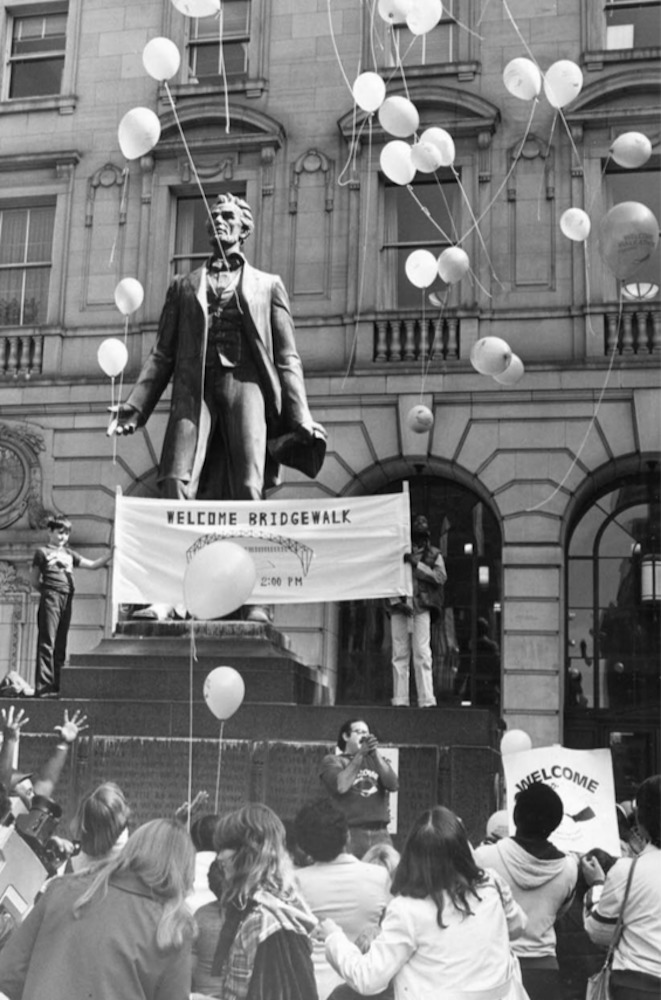
    <summary type="html"><![CDATA[<p><strong><em>A 1976 landmark federal court ruling challenged Cleveland to take long-overdue action to desegregate its public school system. Although slowed by  litigation and disputes, the school district implemented crosstown busing to try to offset longstanding residential segregation patterns rooted in discriminatory real estate and lending practices. Compared to some other cities such as Boston, Cleveland's busing program was relatively peaceful, but it nonetheless produced its share of anxiety and unrest. While most Clevelanders agreed that change was necessary, the reality of transporting students away from neighborhood schools to unknown ones across the city challenged students, parents, educators, and the greater community to weigh the costs and benefits of personal comfort and social justice.</em></strong></p><img src="https://clevelandhistorical.org/files/fullsize/7e8b5eb2d920e1b57695cfbf3a8ba9e4.jpg" alt="Bridgewalk, 1980" /><br/><p>Gathering at the Lincoln Statue in front of the Board of Education building, members of WELCOME (West-East Siders Let’s Come Together) rallied to promote a safe and peaceful start of busing to achieve racial balance in the Cleveland Schools. The federal court order and plans were in place amid community unrest concerning the transporting of students to desegregate the schools beginning in the 1979-80 school year. However the reality of transporting students to achieve integrated schools throughout the city challenged students, parents, activists, and educators to meet on Cleveland’s major east-west bridge to mount an effort to insure student safety and keep the process peaceful. Members of CORK (Citizens Opposed to Rearranging Kids) also called for the uninterrupted and peaceful implementation of the initial phases of desegregation. These rallies marked the beginning of each of three phases of student transportation during the year. Despite their feelings, citizens of Cleveland wanted a peaceful school atmosphere. </p><p>The effort that began fifteen years earlier was inspired in part by activism in the South. Yearlong protests of discriminatory student assignment policies in the Cleveland Public Schools culminated with the tragic death of a protester at <a href="https://clevelandhistorical.org/items/show/254">Stephen E. Howe Elementary School</a> in 1964. School system scrutiny and debate continued over the ensuing decade and a lawsuit known as <em>Reed v. Rhodes</em> was filed with the Federal Court in Cleveland in 1973. </p><p>  The litigation was long and complicated. Two years after the suit was filed on December 12, 1973, the late Judge Frank J. Battisti presided over a lengthy bench trial in 1975 and 1976. On August 31, 1976, Judge Battisti concluded that “the District and other Defendants, including the state board of education, had contributed, by both commission and omission, to an unconstitutional segregation of the Cleveland Public Schools.” The court permanently enjoined defendants “from discriminating on the basis of race in the operation of the public schools of the City of Cleveland, and from creating, promoting, or maintaining racial segregation in any school or other facility in the Cleveland Public Schools.” Both the state and local defendants were ordered to submit plans to desegregate the school district, which failed the court’s approval. A Special Master was appointed to develop a plan and later, on February 6, 1978, the court reaffirmed its earlier conclusion that the defendants were constitutionally liable for having maintained a de jure segregated public school system, and that these numerous constitutional violations demanded a system-wide remedy.      </p><p>The court issued a remedial order directing Defendants to implement, beginning in September 1978, a “comprehensive, system-wide plan of actual desegregation which eliminates the systematic pattern of schools substantially disproportionate in their racial composition to the maximum extent feasible.” The broad remedial order required the defendants to desegregate administrative, supervisory and teaching personnel, to desegregate the schools, to develop creative educational curriculums, and to develop methods of monitoring compliance. The district court also ordered racial balance:  “the racial composition of the student body of any school within the system shall not substantially deviate from the racial composition of the system as a whole.” Additional guarantees of student safety, counseling, extra curricular programs, transportation services were ordered among others.    </p><p>Work then began to devise a method to remedy segregation in the Cleveland schools; plans were prepared to respond to all aspects of the court ruling. Also, the court re-appointed a Special Master, retained two experts on school desegregation, established the Office of School Monitoring and Community Relations (which it charged with rigorous monitoring of desegregation implementation), and ordered the appointment of an official Desegregation Administrator to be paid by the defendants.    </p><p>In order to comply with the plus/minus 15% racial benchmark, students were assigned and bused to schools across town to achieve the requisite racial balance in each individual school. When imbalances resurfaced, they were corrected by administrative orders and students were reassigned as needed. Following additional litigation and challenges in 1977, the court ordered implementation to begin. A limited number of junior high students were transported in 1978-79 school year followed by a three-phase system-wide implementation from September 1979 to September 1980.   </p><p>Meanwhile, an unhappy community continued to protest the court approved remedies to be implemented. Pro and anti-busing advocates frequently picketed the school district headquarters, but the Court prevailed with its charge to proceed. Annually, throughout the 1980s, students were reassigned and bused to satisfy the court order. Bus rides for some students exceeded 80 minutes each way as east and west side students were assigned to cross-town destinations to balance the school populations. Despite the ongoing debate within the community, student transportation and assignments were never interrupted by civil disobedience. The intention to carry out court orders in a peaceful manner prevailed. In 1987, Judge Battisti authorized changes in pupil assignments without prior court approval if such changes were agreeable to the following three parties:  the school district, the State Superintendent, and Plaintiffs' legal counsel. During the initial six years of full implementation, the district, the monitoring agency, and the court remained engaged in detailed review of the progress and the reorganization of district management. </p><p>In the 1980s, the city school system became predominantly nonwhite as a result of white flight out of the city and school boundaries. The Cleveland School District operated approximately 130 schools, 90% of which satisfied the 15% limitation every year. Dr. Gordon Foster, who had previously served as the plaintiffs' expert witness during the liability phase of this case, issued a report in 1988 that stated the district had ended any overt segregation or discrimination and was “the only majority black, large city system in the country which is totally desegregated.” In addition, as ordered, the Office of School Monitoring and Community Relations conducted a detailed assessment of the state of compliance with all outstanding remedial orders and concluded that the defendants had substantially complied with the 15% limitation and that any deviations could not be attributed to discriminatory student assignments. While a relatively small proportion of district schools each year had enrollments that exceed the maximum deviation, no evidence suggested that this was the result of discrimination on the basis of race in the assignment of students. The Monitoring Office's assessment recommended that the parties continue to work together to move the case forward.   </p><p>In March 1992, the district court vacated over 500 orders upon joint motion of all the parties. However, there was a sense that the quality of public education had declined while the cost of operation had increased. The court thus urged the parties “not to hesitate to think about innovative programs and undertakings” that might ameliorate the situation in the school system. Judge Battisti further noted “the Court [had] not set out to run a busing company,”  and directed the parties to address whether they believed “the interests of the students in Cleveland would be better served by an alternative student assignment plan,”  and further suggested that parental and student choice become an important factor in student assignment within the Cleveland School District.    </p><p>By 1998, U.S. District Chief Judge George W. White concluded that it was time to end the quarter-century court battle over integrating the 76,500-student district, saying "the purposes of this desegregation litigation have been fully achieved." In declaring the system "unitary," the judge found that the state and district had done all that could be expected to remedy the harm created by past segregation in the changing urban district. The persistent gap in student performance between black and white students, he found, "is the result of socioeconomic status and factors directly related to it, not race." In doing so, the judge also began the process to determine how much longer state education officials would keep day-to-day control of the district. He would hold hearings soon to consider lifting the 1995 order in the desegregation case that declared the district in crisis and stripped the elected school board of authority and arrange the control of the school district under the city’s mayor-appointed school board. Nonetheless the community, though grudgingly, had also cooperated during the twenty years to maintain a peaceful desegregation process in Cleveland.</p><p><em><strong><a href="https://clevelandhistorical.org/items/show/813">For more (including 14 images&#32;&amp;&#32;1 audio file) view the original article</a></strong></em></p>]]></summary>
    <published>2017-10-03T16:37:39+00:00</published>
    <updated>2026-04-17T19:17:41+00:00</updated>
    <link rel="alternate" type="text/html" href="https://clevelandhistorical.org/items/show/813"/>
    <id>https://clevelandhistorical.org/items/show/813</id>
    <author>
      <name>Jim Lanese</name>
    </author>
  </entry>
  <entry>
    <title type="html"><![CDATA[Waverly Elementary School: The Original Site of the Historic West Side Grade School]]></title>
    <summary type="html"><![CDATA[<img src="https://clevelandhistorical.org/files/fullsize/706f3843d146c85dcc76feda58f7b7f3.jpg" alt="Waverly Elementary School" /><br/><p>The year 1884 was a good one for J. H. Schneider and the residents of the Tenth Ward, an area of the west side which today comprises much of the southeastern part of the Detroit Shoreway neighborhood. That year, Schneider, the Cleveland Board of Education member elected from the Tenth Ward, not only saw the successful completion of the building of the new West High School in his ward at the corner of Bridge and Randall Streets, but also that of the new elementary school on Waverly Avenue (today, West 58th Street), between Fir and Bayne (now Wakefield) Streets.  It was the first public elementary school built in the Tenth Ward, and became the neighborhood school for many students who formerly had to leave the ward to attend Detroit School in the Eighth Ward on what is today the corner of Detroit Avenue and West 49th Street.</p><p>The new school building, named "Waverly" after the street on which it was built, was designed by John Eisenmann, architect for the Cleveland Board of Education from 1883-1889.  He is also notable as the man who designed The Arcade in downtown Cleveland.  His Waverly School building was two stories in height.  It had an exterior facade of red brick.  There were 12 classrooms in the building, which included a basement which doubled as a playground when bad weather prevented the school children from going outside. Girls played on one side of the basement; boys on the other.  </p><p>Over the years, many west side children attended Waverly including Cleveland Housing Court Judge Raymond L. Pianka, who attended the K-6 school from 1956 to 1963.  By the time he went to school there, the fortunes of the neighborhood had begun to decline as Cleveland experienced the devastating economic adjustments of deindustrialization in the second half of the twentieth century.  Ray went to school with many children who lived in poverty or near poverty.  In a 2005 interview, Judge Pianka related a story which graphically illustrated the point.  As he told it, on one occasion local health officials came to Waverly Elementary and talked to his class about the importance of brushing their teeth.  One official asked how many kids had toothbrushes.  About one-half the class raised their hands.  Then the official asked, how many kids had their OWN toothbrush.  Only about ten-percent raised their hands.</p><p>By the time that Ray Pianka attended Waverly, additions had already been constructed onto the north and south sides of original building, the first (on the north side) by 1912, and the second larger addition (on the south side) by 1932.  So when Ray attended the school, it was considerably larger than the original 12-room structure.  Nevertheless, though larger, it was also a very old school building.  In 1979, it was torn down and a new Waverly Elementary School built on West 54th Street, between Franklin Boulevard and Bridge Avenue.  There was some irony in this relocation of the school given the fact that it had been named for the street upon which its first building was erected.  </p><p>In 2015, the Cleveland Board of Education announced plans to demolish Waverly Elementary School on West 54th Street and replace it with a new building to be constructed on the same site, but with an address on West 57th Street.  Construction was completed in 2019.  On August 8 of that year, a ribbon cutting ceremony was held at the new  building, marking the opening of the third Waverly Elementary School in Cleveland's history.</p><p><em><strong><a href="https://clevelandhistorical.org/items/show/801">For more (including 7 images) view the original article</a></strong></em></p>]]></summary>
    <published>2017-05-31T09:27:21+00:00</published>
    <updated>2026-04-17T19:17:41+00:00</updated>
    <link rel="alternate" type="text/html" href="https://clevelandhistorical.org/items/show/801"/>
    <id>https://clevelandhistorical.org/items/show/801</id>
    <author>
      <name>Jim Dubelko</name>
    </author>
  </entry>
  <entry>
    <title type="html"><![CDATA[Woodland Job Training Center: Quality Education and the War on Poverty]]></title>
    <summary type="html"><![CDATA[<img src="https://clevelandhistorical.org/files/fullsize/34e1f5b61de902f17e5378c17f23a02e.jpg" alt="General Electric Building, 1927" /><br/><p>For the hard-core unemployed in Cleveland’s Gladstone neighborhood, the Woodland Job Training Center represented a way out; a way out of poverty and unemployment, a way to a better future. When the Center opened in 1968, it was part of Superintendent Paul W. Briggs’s strategy of improving the quality of education in Cleveland. Through collaboration with General Electric Co. and funding from the U.S. Department of Labor, the Woodland Job Training Center provided job training, basic education, counseling services, and even personal hygiene and citizenship classes. In short, the Woodland Job Training Center represented a full-frontal assault on the cycle of poverty. Briggs’s idea for the Center echoed the sentiment of President Johnson and his War on Poverty. It also played into greater development plans for the neighborhood itself.</p><p>Gladstone, which ran from East 37th to East 55th streets between Woodland Avenue and the Nickel Plate Road rail yard, was often described as the “worst slum” in the city. As such, Cleveland designated Gladstone as an area for urban renewal and sought to revitalize the neighborhood without federal funding. In the late 1950s, however, efforts to convert the neighborhood to light industry stalled as the city of Cleveland found the cost of buying and clearing the land too expansive. In 1968, as federal funding rolled in to aid the development process, Mayor Carl Stokes remained committed to turning the vacant land in the Gladstone neighborhood into a viable place for light industry. Given the mandate from President Johnson to combat poverty where it lived, and Briggs’s commitment to quality education, the Gladstone neighborhood represented the perfect place for a job training center.</p><p>The Woodland Job Training Center, located at 4966 Woodland Avenue, connected the unemployed and future workers with job opportunities as they learned. The three-story, 200,000 square foot warehouse—donated by the General Electric Co.—housed classrooms while local companies rented out warehouse and office space. Students were employed part-time by partner companies in the building. The Center offered three different programs. The Job Opportunities in the Business Sector program targeted those who had gone to high school, but were now unemployed. The Work-Study Program for Dropouts paired work opportunities with education to serve those who had dropped out of high school. The Job Training for New Workers program was aimed at at-risk youth—students between 16 and 22 years old and either dropouts or potential dropouts. This program provided training in shops operated by cooperative firms. The diversity of programs offered at the Woodland Job Training Center made the center a resource to combat poverty across the spectrum of the urban community.</p><p>From the very beginning, the Woodland Job Training Center produced results. By November 1968, one hundred students had already passed through the center, received training, and found themselves employed by one of fifteen different companies in Cleveland. By the mid-1980s, the Center boasted that less than six percent of students remained unemployed six months after completion. President Johnson’s War on Poverty, however, had waned. In 1985, despite evidence that the center was successful and nearly self-sustaining, the Cleveland Metropolitan School District announced the closing of the Woodland Job Training Center, along with three other facilities, in a cost saving measure. Instead of spending money on schools and vocational programs, politicians prioritized prisons over job-training programs. Money that might have gone to keep the Woodland Job Training Center open went instead to build new, multi-million dollar prisons. </p><p>Rumors that Cuyahoga Community College might buy the Woodland Job Training Center left many people hopeful for the future. For community members, the idea of losing the job training and employment opportunities would mean dire consequences for those the center served. Without the ability to get skills training and education, the hard-core unemployed of the Gladstone area would be left with no real option but to turn to criminal activity or dependence on the welfare system to survive. On May 29, 1985, however, any thought of saving the center evaporated when a fire broke out in a third-floor broom closet. The fire department estimated damages at $20,000 and determined the cause of the fire to be arson.</p><p>Today, the building at 4966 Woodland Avenue is still owned by Cleveland Metropolitan School District, although students no longer go there. Just down the road sits the Unified Technology Center, part of Cuyahoga Community College’s efforts to provide job training. CMSD offers vocational programs at other high schools around the city, including at Max S. Hayes High School. The idea of combating systemic poverty through a concerted, collaborative effort, however, has disappeared. The mission of Paul Briggs, evidenced by the Woodland Job Training Center, ultimately remains unrealized.</p><p><em><strong><a href="https://clevelandhistorical.org/items/show/778">For more (including 9 images) view the original article</a></strong></em></p>]]></summary>
    <published>2016-12-12T10:36:18+00:00</published>
    <updated>2026-04-17T19:17:41+00:00</updated>
    <link rel="alternate" type="text/html" href="https://clevelandhistorical.org/items/show/778"/>
    <id>https://clevelandhistorical.org/items/show/778</id>
    <author>
      <name>Christopher Morris</name>
    </author>
  </entry>
  <entry>
    <title type="html"><![CDATA[West High: Cleveland Builds its First Public High School on the West Side]]></title>
    <summary type="html"><![CDATA[<p><strong><em>After Cleveland annexed Ohio City in 1854, educators on the city's new west side who wanted their own high school on their side of the Cuyahoga River struggled to find a way around a problematic state law that permitted only one public high school to exist in Cleveland.    A. G. Hopkinson, principal of a grade school for advanced students in the former Ohio City, found the solution.</em></strong></p><img src="https://clevelandhistorical.org/files/fullsize/57d75f04be781d26a912bc49da9ae253.jpg" alt="West High School" /><br/><p>There was a time when there were no public high schools west of the Allegheny Mountains.  When children living in the Midwest could only obtain a college preparatory education by attending private academies, the tuition for which only wealthy parents could afford.  That all changed, however, in 1846 when Central High School, the first free public high school west of the Alleghenies, was founded in Cleveland.  At first located in the basement of a Universalist church on Prospect Street (Avenue), it was afterwards for many years located in its own building near the intersection of Euclid Avenue and Erie (East Ninth) Street, just west of Scofield's boarding house.  </p><p>While Central High School was accessible to all Cleveland children in its first few years of operation, it was not, after the annexation of Ohio City in 1854, very accessible to Cleveland children who lived west of the Cuyahoga River.  Especially in an era when there were no motor vehicles to transport children to school and the bridges that crossed the river were far and few between.  West siders petitioned Cleveland City Council for their own high school, but a state law restricted the city to only one public high school.  According to several newspaper accounts, including one that appeared in the Cleveland Leader on June 12, 1910, it was A. G. Hopkinson, formerly principal of an Ohio City grade school for advanced students, who came up with the idea that building a "branch" high school on the west side would not violate the state law.    City Council was apparently persuaded and, on April 7, 1855, it passed legislation creating east and west "divisions" of Central High School.  Hopkinson became the first principal of the new west side high school, serving in the office until 1870.</p><p>Branch High School, as the west side division of Central High School was initially called, held its first classes on the top floor of Kentucky School, located on Kentucky (West 38th) Street near Terrett Avenue.  In 1861, West High School-- by this time everyone had dispensed with the fiction that it was a branch of Cleveland's east side high school-- moved to a new building, constructed on a small parcel of land at the intersection of Clinton Avenue and what is today West 29th Street and Dexter Place, not far from Franklin Circle. It remained at this location for twenty-three years until a growing west side population created the need for a larger school, resulting in the purchase of land and the construction in 1884 of a large two-story red brick and stone school building at the intersection of Bridge and Randall Avenues.  The west side's school age population continued to grow rapidly in the last two decades of the nineteenth century, in large part as the result of the annexations to the city of West Cleveland and Brooklyn Village in 1894.  The City responded, first in 1900, by building a second west side public high school--Lincoln High School-- at the intersection of Scranton Road and Castle Avenue, and then in 1902, by relocating West High School further to the west, on a larger site and into a larger three-story brick and stone building on Franklin Boulevard near what is today West 68th Street.  (The school building at Bridge and Randall later became a commerce high school, then  a junior high school, and was finally home to Lourdes Academy, a girls Catholic high school, from 1944 until 1971, the year the building was razed.)</p><p>West High School remained at its Franklin Boulevard location for the next seven decades.  During these years its teachers and students preserved and continued many of the traditions and school organizations which had roots in the late nineteenth and early twentieth centuries.  Organizations like the Dorian Literary Society (1881), the Castilian Literary Society (1898), the Thespian Dramatic Society (1902) and the Clionian Historical Society (1902).  At the end of every school year, the outgoing Class president passed to the incoming Class president a small wooden box called "The Casket," which contained metal tablets listing the names of graduating students from classes dating back to 1881, when the high school was still located on Clinton Avenue near Franklin Circle.   </p><p>In addition to its peculiar traditions and organizations, West High was also notable as the alma mater of a number of locally and nationally prominent Clevelanders.  For example, Mary Quintrell (Class of 1858), the first woman to run for public office in Cleveland--School Council in 1895.   James Ford Rhodes (Class of 1865) and Albert Bushnell Hart (Class of 1870), both prominent historians and both honored with Cleveland schools named in their honor.  Linda A. Eastman (Class of 1885), who, when named Librarian of Cleveland Public Library in 1918, became the first woman in the United States to hold this position in a library of such size and significance.  Alwin C. Ernst (Class of 1899), founder of the accounting firm Ernst & Ernst, today Ernst & Young.  Rear Admiral Isaac C. Kidd (Class of 1902), the highest ranking military officer to die in the December 7, 1941 Japanese attack on Pearl Harbor.  Lillian M. Westropp (Class of 1903) and her sister Clara (Class of 1904), pioneer women bankers who founded Women's Federal Savings and Loan in 1922.   And New York Metropolitan Opera star Mildred Miller (January Class of 1943) and her husband University of Pittsburgh Chancellor and retired Air Force Brigadier General Wesley Posvar (June Class of 1943).  </p><p>In 1970,  West High merged with Lincoln High, creating Lincoln-West High School, a new high school with its campus on West 30th Street in the Clark-Fulton neighborhood. After the merger, the old West High school building on Franklin Boulevard continued to serve as home to West Junior High for an additional seven years until 1977, when it was torn down to make room for Joseph M. Gallagher Junior High, a new school named after a long-time member of the Cleveland Board of Education.  With the razing of the old school buildings at the Franklin Boulevard site, and the razing of all of the other buildings that once served as its home, there no longer exist any buildings in Cleveland that stand as a memorial to West High, the city's first west side public high school.</p><p><em><strong><a href="https://clevelandhistorical.org/items/show/772">For more (including 15 images) view the original article</a></strong></em></p>]]></summary>
    <published>2016-10-29T21:39:07+00:00</published>
    <updated>2026-04-17T19:17:41+00:00</updated>
    <link rel="alternate" type="text/html" href="https://clevelandhistorical.org/items/show/772"/>
    <id>https://clevelandhistorical.org/items/show/772</id>
    <author>
      <name>Jim Dubelko</name>
    </author>
  </entry>
  <entry>
    <title type="html"><![CDATA[Collinwood High School]]></title>
    <summary type="html"><![CDATA[<p><strong><em>In 1874, a single rail stop was constructed about ten miles east of downtown Cleveland, allowing incoming trains to switch engines before entering the city. The operation quickly grew to accommodate hundreds of trains,  with thousands of workers to form a thriving manufacturing and residential neighborhood. Today, Collinwood remains a blue collar community, with deep ties to the old railyard. Collinwood High School, home of the Railroaders, has served this working community since 1907.</em></strong></p><img src="https://clevelandhistorical.org/files/fullsize/0f11c9b00df3a4c8dffcb28dbc4f0912.jpg" alt="Clark School" /><br/><p>Cleveland, Ohio's northeast corner grew from a railroad stop in the mid 1800's to a vibrant community by the turn of the century. Few people resided in the area until the Lake Shore and Michigan Southern Railroad developed a line to Painesville and Ashtabula and placed stop number 11 in "Frogsville," a swampy area about ten miles northeast of the mouth of the Cuyahoga River along the Lake Erie shoreline. By 1863 twenty families lived in the area bounded by Collamer Village to the south and Nottingham Village to the east. The railroad stop grew from a place to switch engines to enter the central city to a multi-purpose maintenance and railroad switching operation. The railroad expansion in the area brought more population and by 1876, the railroad’s well regarded chief engineer, John Collins gave his name to the settlement. By 1899 the Directory of Collinwood listed its population at 3,237 residents. 
At the turn of the twentieth century the community was responding to a growing need for schools. Originally a one room building on Collamer Avenue (now East 152 Street) and Waterloo Road served the neighborhood children. By 1864, a second red brick school was added serving all grades until 1889. That year, Clark School was built at Saint Clair Avenue and Clark Street (East 147 Street) to accommodate the growing student population. In 1892, Clark High School graduated its first class – one senior.  </p><p>Frank P. Whitney, a recent Oberlin College graduate, was hired as principal for 90 students at Clark. Frank grew up on a farm in Huron, Ohio, and spent two years teaching in the rural village of Wakeman. Following his first year at Collinwood, he rode his bicycle to New York City, boarded a steamer for England and explored English schools via bicycle for the summer. Upon his return he was appointed to lead Collinwood's schools as superintendent where he began to install programs inspired by his visit to English schools.
During this same period, Cleveland experienced its initial wave of central and southern European immigrants arriving to work, live, and settle in ethnic enclaves throughout the city. Collinwood also experienced this phenomenon. The railroad line bisected the village and provided a valuable resource for factory development and transportation access. Areas north and south of the tracks afforded plenty of land to develop residential housing for the immigrant workers. Manufacturers sought inexpensive land adjacent to the rail lines and attracted the needed human resources, first from Cleveland to the west, and later more European immigrants into the developing neighborhood. The abundant construction and factory-style work suited the people who populated the region. The neighborhood mix of residential and industrial space defined the community’s character, it blended the immigrant workforce with the manufacturing boom. Several large corporations established factories to support Cleveland’s manufacturing leadership that emerged during the end of the nineteenth century and the first half of the twentieth century. 
Meanwhile, more students required more space. In 1907, South High School was dedicated on the site where Collinwood High School now stands. During that year, a <a href="https://clevelandhistorical.org/items/show/394">tragic fire at Lakeview School</a> took the lives of 172 students and two teachers. Cleveland annexed Collinwood Village and its schools were added to the Cleveland Public Schools in 1910. Mr. Whitney joined the school district as principal (West Tech), supervisor, and assistant superintendent before returning to his Collinwood "home" in 1926 as principal of the newly built Collinwood High School. During its first year, enrollment reached 3,488 students, Ohio’s largest school at the time. In less than thirty years, the school enrollment alone exceeded the neighborhood's entire resident population.
The neighborhood reached its highest population census between 1930 and 1960. Whitney's influence continued with his leadership through 1941 as the high school thrived with high enrollments, dedicated faculty, and nationally recognized programs featuring health, citizenship, and character education and student guidance. "Railroader" football teams of the 1940s and Lady Railroader track teams of a more recent era, excelled on the track and in the classroom. Honors academics joined numerous extra curricular programs to provide students with Cleveland’s best educational opportunities throughout the new century.
Collinwood continued to reflect developments of the larger Cleveland community. By the 1960s and 1970s, <a href="https://clevelandhistorical.org/items/show/392">racial strife at the high school</a> reflected community tensions. Its mix of people, manufacturing employers, schools, and social climate reflected the rise and fall story of the rust belt urban center and its school challenges.</p><p><em><strong><a href="https://clevelandhistorical.org/items/show/695">For more (including 8 images&#32;&amp;&#32;6 audio files) view the original article</a></strong></em></p>]]></summary>
    <published>2015-03-03T13:41:43+00:00</published>
    <updated>2026-04-17T19:17:40+00:00</updated>
    <link rel="alternate" type="text/html" href="https://clevelandhistorical.org/items/show/695"/>
    <id>https://clevelandhistorical.org/items/show/695</id>
    <author>
      <name>Jim Lanese</name>
    </author>
  </entry>
  <entry>
    <title type="html"><![CDATA[Miles Standish School Garden: Horticulture Education in Glenville]]></title>
    <summary type="html"><![CDATA[<img src="https://clevelandhistorical.org/files/fullsize/3a74cbfbefcecc5f2e5e9e306e9558cb.jpg" alt="Student Gardener Harvesting Eggplants" /><br/><p>Cleveland Public Schools began its horticulture education program for students, the first such program in the United States, in 1904, around the same time as the height of success of the Glenville Race Track, located between East 88th and East 101st streets. When Glenville Mayor Fredrick Goff closed the track in 1908, only the abandoned lot remained until the Miles Standish Elementary School was constructed in 1921. Other parcels of land also provided space for the construction of nearby Empire Junior High School. In 1960 a three-acre tract was allotted for Miles Standish Elementary School's horticulture program, under the direction of Dr. Edward T. Johnson. The garden was one of seven sponsored by the board of education. The Miles Standish school garden served pupils in the 4th-10th grades. The crops grown included corn, tomatoes, peppers, beets, cabbage, corn, and eggplants. Flowers were also raised in another part of the garden. The garden also had a high tunnel hoop house and its own water supply with a built-in irrigation system.</p><p>In order to participate in the school garden, students paid an annual fee of $1.25 (or $10 in modern value) for a plot. If the plot was successful, it could yield $25-$30 ($200-$240) in fruits and vegetables. Produce from the garden was also donated to the Eliza Bryant Jennings senior living home. In addition to working twice a week in the garden, where such duties include sowing, caring for, and harvesting fruits and vegetables from their plot, students also attended horticulture classes. Students learned how to prevent insects from eating their crops, as well as basics related to crop cultivation. Miles Standish Elementary School also held an annual Open House, with various themes each year. Some of the themes included "Garden City U.S.A.," "The Enchanted Forest," and "MSG Round-Up," the latter featuring a stagecoach and gardeners sporting cowboy costumes. The Open House also ran a competitive exhibition in which students could receive ribbons for their standout vegetables.</p><p>By 1979, many of Cleveland Public Schools' gardens were in decline due to financial strain and budget cuts. This led to the demise of the Miles Standish garden for a few years, until around the mid 1980s, when several community members brought the garden back as a community garden not so much for students, but for older Glenville citizens. As of now, the Miles Standish Community Garden still stands (next to what is now called Michael R. White Elementary School), cultivating not only crops, but a connection between the community's older generations and younger generations.</p><p><em><strong><a href="https://clevelandhistorical.org/items/show/665">For more (including 7 images&#32;&amp;&#32;2 audio files) view the original article</a></strong></em></p>]]></summary>
    <published>2014-08-13T14:07:15+00:00</published>
    <updated>2026-04-17T19:17:40+00:00</updated>
    <link rel="alternate" type="text/html" href="https://clevelandhistorical.org/items/show/665"/>
    <id>https://clevelandhistorical.org/items/show/665</id>
    <author>
      <name>Julie A. Gabb</name>
    </author>
  </entry>
  <entry>
    <title type="html"><![CDATA[Glenville High School: Home of the Tarblooders]]></title>
    <summary type="html"><![CDATA[<img src="https://clevelandhistorical.org/files/fullsize/34ec361e3d595a492293be7625c457fb.jpg" alt="Original Glenville High School" /><br/><p>Glenville High School opened in 1892 on Parkwood Drive in Cleveland's east side village of Glenville. The student body grew so rapidly that even a series of early additions soon proved incapable of holding it, so a new Glenville High School building opened in 1904. Two years later, after Cleveland's annexation of the village, Glenville joined the Cleveland Metropolitan School District. Following years of migration from the Woodland neighborhood to Glenville in the early twentieth century, the red-brick two-story school reached a 90 percent Jewish student body. As the neighborhood grew and African Americans began migrating to Glenville for jobs and housing, the demographic changed to 90 percent African American by 1950. Additions were constructed in 1911, 1922, and 1939 to serve the growing enrollment, but the school found itself overcrowded by the 1950s and early 1960s. In 1963, the school was well over its 1,608-student capacity with enrollment exceeding 1,900 students. To alleviate the problem, some Glenville residents were sent to nearby John Hay High School in Fairfax. </p><p>In 1963, Cleveland citizens voted to allow the Cleveland Metropolitan School District to receive a $55 million bond, from which $3.5 million went to build a new Glenville High School, since the present school at the time was old, small, and outdated (with its old science laboratories and equipment). The new Glenville High School opened for the new school year of 1966, located at its present day location of 650 East 113th Street. While the old school had one-way hallways, shared classrooms, and wooden floors, the spacious new school had large lecture halls, updated equipment, and a large gymnasium. Glenville High School had striking similarities to John F. Kennedy High School in the Lee-Harvard neighborhood. J.F.K. was built a year earlier, and as some Glenville alumni noted, the only difference from Glenville High School was that the blueprint was flipped, where the location of J.F.K. cafeteria was on the opposite side in Glenville High School. Glenville High School maintained a rivalry with J.F.K. High School in sports, as well as neighboring Collinwood High School. Glenville at the time was known for its track-and-field team, the Glenville Tarblooders. A "tarblooder" was a robot man, named after the men who "bled tar" from working on the railroads in the early 1900s. </p><p>Glenville High School has had notable alumni, whether it be athletes from Glenville's successful football team, politicians such as former Cleveland mayor Michael R. White and Howard Metzenbaum, actors like Steve Harvey and Ron O'Neal of <em>Superfly</em> fame, and the creators of Superman. In addition to its alumni, the school prides itself on its athletics, especially the track and football teams.</p><p><em><strong><a href="https://clevelandhistorical.org/items/show/657">For more (including 7 images&#32;&amp;&#32;5 audio files) view the original article</a></strong></em></p>]]></summary>
    <published>2014-05-12T21:40:41+00:00</published>
    <updated>2026-04-17T19:17:40+00:00</updated>
    <link rel="alternate" type="text/html" href="https://clevelandhistorical.org/items/show/657"/>
    <id>https://clevelandhistorical.org/items/show/657</id>
    <author>
      <name>Julie A. Gabb</name>
    </author>
  </entry>
  <entry>
    <title type="html"><![CDATA[Observation Elementary School: &quot;On-the-job&quot; Teacher Training]]></title>
    <summary type="html"><![CDATA[<p><strong><em>The responsibility for training and licensing teachers evolved from a school district function a century ago to the current university model. Cleveland's Observation School provides a glimpse of this evolution.</em></strong></p><img src="https://clevelandhistorical.org/files/fullsize/8c462150a0e65c99f7930b422f756794.jpg" alt="Cleveland Normal School." /><br/><p>The former four-story orange brick Cleveland School of the Arts building on Stearns Road in University Circle was highlighted by three ornate terra cotta entrances.  It was built as Observation Elementary School in 1910. According to the Cleveland Restoration Society, this makes it one of the oldest school buildings in the Cleveland Metropolitan School District. </p><p>On November 20, 1907, the Cleveland Plain Dealer reported that the Board of Education purchased about 88,000 square feet of land between East 107th Street and Marlborough (now Stearns) Road to accommodate both John Hay High School and the new normal school. While John Hay awaited another 20 years of planning and debate, the Normal school was built by 1910, supplying facilities and teachers to the growing public school district. </p><p>During the earlier days of public schooling, the school districts were responsible for training teachers and normal schools were utilized for this purpose. Specifically, teacher-education efforts in Greater Cleveland resulted from the Common School Law of 1836. There was a model school, forerunner of laboratory schools, for children under 14, where prospective teachers of both sexes could gain some practical experience. Cleveland school superintendent Andrew J. Rickoff established the Cleveland City Normal School in 1872, with the first school opening on Eagle Street in 1874. Here, teachers-to-be practiced in actual [normal] school settings - while being supervised by 'critic teachers' - to develop their teaching skills. The goal was for these teacher-students to learn enough to eventually be hired to teach in the Cleveland schools. </p><p>In 1914, the state of Ohio passed legislation which governed the certification of teachers and imposed additional standards regarding their preparation. Later, a department of education was established in Mather College, where both Mather and Adelbert students could take professional education courses for certification. In 1928, the university's School of Education was managed by both the Board of Education and the university. In 1945, courses for practicing teachers were transferred to Cleveland College where professional education courses required for state certification were taken. During this transitional period of teacher education, the normal school became "Observation Elementary School". The name came from the fact that the school still provided access to a real, observable school setting to help complement teacher training at nearby Western Reserve University.</p><p>In 1981, the building again underwent a role transition. The Cleveland Public Schools were working to comply with several components of a complex federal court order to desegregate its schools. One of the strategies employed by the district was the creation of thematic and magnet schools featuring unique and focused coursework for students. The Cleveland School of the Arts was identified and located at the Observation School facility. The school's proximity to all the cultural resources of University Circle made the site and ideal choice. The Arts school prospered at the Stearns Road location until 2009 when it was moved to a temporary school building awaiting its redevelopment on stearns Road. A presentation at the Cleveland Planning Commission in November 2011 showed the design of the new Cleveland School of the Arts building, which includes an intention to salvage the historic school's terra cotta for use on the interior of the new building. Terra cotta removal started in late December 2011. Demolition was completed in 2012.</p><p><em><strong><a href="https://clevelandhistorical.org/items/show/455">For more (including 4 images) view the original article</a></strong></em></p>]]></summary>
    <published>2012-05-10T16:55:09+00:00</published>
    <updated>2026-04-17T19:17:39+00:00</updated>
    <link rel="alternate" type="text/html" href="https://clevelandhistorical.org/items/show/455"/>
    <id>https://clevelandhistorical.org/items/show/455</id>
    <author>
      <name>Jim Lanese</name>
    </author>
  </entry>
  <entry>
    <title type="html"><![CDATA[Collinwood High School Riots]]></title>
    <summary type="html"><![CDATA[<img src="https://clevelandhistorical.org/files/fullsize/94f4e6aa64bdc96b8bfd10d1b721d274.jpg" alt="Arresting Students" /><br/><p>On the morning of April 6, 1970, 350 to 400 whites, mostly students, gathered outside of Collinwood High School and began throwing rocks at the school, breaking 56 windows. Teachers told the 200 black students who attended school that day to go to the third-floor cafeteria for their protection. At 10:30 a.m., the white mob entered the school and went to the second floor. They damaged furniture, broke windows, and threw clubs at the school's music director. Afraid, the black students began breaking off the legs of chairs to arm themselves and blocking the stairs leading to the third floor with tables and chairs. Luckily, the white students left the school and the black students were escorted to buses to take them home. Teachers and policemen had to form a line in order to block the whites from attacking the students who were boarding. This was just one of many serious, racially motivated confrontations that took place in Collinwood over a fifteen-year period. </p><p>The first major incidents at Collinwood High School occurred in 1965, the same time the rest of the country was seeing racial clashes in schools. After the Supreme Court ruled that racial segregation in public schools was unconstitutional in the 1954 case of Brown v. Board of Education of Topeka, many schools in the South became places of protests and violence. Northern schools saw the same disturbances when they began to make efforts toward greater integration. In the case of Collinwood, industrialization not only increased its population, but also its diversity. According to a Cleveland Plain Dealer columnist, "with the passage of each year, the western fringes of the Collinwood area [were] being occupied by the Negro overflow from Glenville." This change in demographics, coupled with civil rights demonstrations, caused racial tensions to surface and intensify in Collinwood, particularly at the neighborhood's high school. </p><p>Finally, after fifteen years of violence in the country's schools, radical measures were being taken in some schools and by the federal government to stop the dangerous episodes once and for all. In a New York school, a committee was formed by the mayor to prevent future violence. Other schools suspended or expelled large groups of students for any racial confrontations and hired security force guards to keep the peace. In April 1969, Senator Robert C. Byrd asked Congress to pass a law that would make the disruption of any school that received federal aid a federal crime. </p><p>Cleveland's mayor Carl Stokes was prompted to follow these examples after the dangerous episode of April 1970. The mayor kept the school open but protected it with policemen backed by National Guard units in case a severe situation should arise. Nevertheless, Collinwood High School was still the scene of other racial clashes, the worst occurring in the fall of 1974. Three black students were stabbed in September of that year, and the next month another student was fatally shot by a sixteen-year-old white student. After these disturbing incidents, the racial violence at the Collinwood school began to dwindle.</p><p><em><strong><a href="https://clevelandhistorical.org/items/show/392">For more (including 8 images&#32;&amp;&#32;4 audio files) view the original article</a></strong></em></p>]]></summary>
    <published>2012-01-12T19:20:56+00:00</published>
    <updated>2026-04-17T19:17:38+00:00</updated>
    <link rel="alternate" type="text/html" href="https://clevelandhistorical.org/items/show/392"/>
    <id>https://clevelandhistorical.org/items/show/392</id>
    <author>
      <name>Heidi Fearing</name>
    </author>
  </entry>
  <entry>
    <title type="html"><![CDATA[Cleveland Board of Education Building]]></title>
    <summary type="html"><![CDATA[<img src="https://clevelandhistorical.org/files/fullsize/d233545fae7eff5f4cb358604b9c6a61.jpg" alt="Construction, 1930" /><br/><p>Until 2013, the administrative headquarters of the Cleveland Board of Education was an iconic sandstone, Beaux-Arts structure located at 1380 East 6th Street on the east side of Mall A. Listed on the National Register of Historic Places since 1975, the 1931 building was designed by Walker & Weeks, which arguably may have done more to define Cleveland architecture than any single firm. In addition to the Board of Education Building, Walker & Weeks designed Cleveland’s Public Auditorium; Federal Reserve Bank; Public Library; Severance Hall; Allen Memorial Medical Library; Lorain-Carnegie Bridge; Cleveland Municipal Stadium; Warner & Swasey Observatory; and numerous churches including St. Paul’s Episcopal, Epworth-Euclid Methodist and First Church of Christ, Scientist. </p><p>Completed in 1931, the Cleveland Board of Education Building was the last piece in the Group Plan vision for Cleveland’s three Malls (A, B and C). Around that time, the Malls were expected to replace Public Square as the center of downtown. The idea was to honor the Progressive Era and the City Beautiful Movement by creating urban paradises to counter the upheavals caused by rapid industrialization. The “re-centering” idea obviously didn’t pan out, but the Board of Education building nonetheless took its place as an aesthetically pleasing cornerstone to a space that may never have looked better than it does now. </p><p>The Board of Education building’s two-story lobby features marble columns, massive arched windows, bronze chandeliers and two Depression-era murals that flank the space: "The Progress of Education" and "The Branches of Education" by Cleveland artist Cora Holden. Further enhancing the structure is a statue of Abraham Lincoln located on the west side of the building facing the Mall. Sculpted by Max Kalish, the statue was installed in 1932 in front of the building which, at that time, faced west toward East 4th Street (East 4th was removed in 1988). Donations from Cleveland schoolchildren helped pay for the statue. Lincoln’s Gettysburg Address is carved on its base. </p><p>The Cleveland Metropolitan School District occupied only about half of the building when Drury Hotels bought it at auction in early 2013 for $4.5 million. Three years later, following a three-year, $52-million renovation, a 189-room Drury Plaza Hotel opened in the 85-year-old structure. The school district’s administrative functions are now located at 1111 Superior Avenue, in the former headquarters of Eaton Corporation. </p><p><em><strong><a href="https://clevelandhistorical.org/items/show/303">For more (including 4 images) view the original article</a></strong></em></p>]]></summary>
    <published>2011-07-27T13:33:35+00:00</published>
    <updated>2026-04-17T19:17:38+00:00</updated>
    <link rel="alternate" type="text/html" href="https://clevelandhistorical.org/items/show/303"/>
    <id>https://clevelandhistorical.org/items/show/303</id>
    <author>
      <name>Sarah Kasper</name>
    </author>
  </entry>
  <entry>
    <title type="html"><![CDATA[East High School]]></title>
    <summary type="html"><![CDATA[<img src="https://clevelandhistorical.org/files/fullsize/f2140a01cf0d071fde65169f251a1dc6.jpg" alt="The Original East High" /><br/><p>East High School was coined a "20th-century schoolhouse" when it opened its doors on November 26, 1900. The "original" East High was the talk of the town, as no other school in the city could compete with the grandeur of the $180,000 brick school building that opened at East 82nd Street and Decker Avenue. The present building, constructed just to the northwest of the original, was built in 1975 at a cost of $17 million. The Cleveland Metropolitan School District closed the school at the end of the 2009-10 school year as part of the District's Transformation Plan. </p><p>The original East High School initially offered only three courses of study — classical, English, and scientific. It was run much like a city, as students elected a senior classmate as "mayor" and nine "judges" from each class, a practice that gave East High some of its uniqueness.  The motto "Noblesse Oblige" was adopted by East High's first principal Benjamin U. Rannells in 1900, providing the guidance that each graduating class carried on as it pursued life's endeavors. East High School was also known for its sports and won various titles and championships, both locally and statewide. "The Home of the Blue Bombers," with its blue and gold school colors, grew to more than 1,200 students within five years of its opening. "Eastites," as its students were called, proclaimed and believed in "nothing but the best."</p><p>Despite the fact that the new East High School was built in 1975 amidst a declining urban neighborhood, it continued to be the pride of the community until declining enrollment and security problems led to its closure in 2010. The vacant building, which suffered widespread damage at the hands of vandals and scrap thieves, underwent a $1 million renovation, reopening in 2013 as the East Professional Center, an administrative and training complex for a number of CMSD departments.</p><p><em><strong><a href="https://clevelandhistorical.org/items/show/290">For more (including 6 images) view the original article</a></strong></em></p>]]></summary>
    <published>2011-07-23T23:00:45+00:00</published>
    <updated>2026-04-17T19:17:38+00:00</updated>
    <link rel="alternate" type="text/html" href="https://clevelandhistorical.org/items/show/290"/>
    <id>https://clevelandhistorical.org/items/show/290</id>
    <author>
      <name>CSU Center for Public History and Digital Humanities</name>
    </author>
  </entry>
  <entry>
    <title type="html"><![CDATA[Stephen E. Howe Elementary : The Fight for Equal Schools]]></title>
    <summary type="html"><![CDATA[<img src="https://clevelandhistorical.org/files/fullsize/9940672e6b1e1c8383e7d31484eb7a52.jpg" alt="Rev. Bruce W. Klunder " /><br/><p>The fight to desegregate schools in Cleveland in the post-World War II era led to a contentious and complicated debate in the city over the issues of race, freedom, and equality. Glenville's Stephen E. Howe Elementary School is central to the tale. On this site, in 1964, one man gave his life for his belief that all children should have equal access to a quality education.</p><p>Between 1950 and 1965, Cleveland's black population grew dramatically while the population of Cleveland as a whole decreased. This resulted in overcrowded schools on the city's predominantly black east side and under-enrollment in the predominantly white west side. By the early 1960s, black students were placed on waiting lists for kindergarten and subjected to half-day classes as white schools remained under-enrolled in full-day kindergarten. In response, parents formed the Relay Parents March to Fill Empty Classrooms and organized protests to challenge the inequities perpetuated by the School Board's policies.</p><p>School Board President Ralph McCallister agreed to bus some black children to under-enrolled schools in white areas, but to appease white voters his plan included stipulations that black students could not attend physical education classes, eat in the cafeteria, and could only use the bathroom once per day. As a result, African Americans looked to the Cleveland Congress on Racial Equality (CORE) and the United Freedom Movement (UFM) to take action and stand up to the school board.</p><p>When whites rioted in Little Italy in January 1964 to protest against black children being bused to schools in their neighborhood, it became clear that McCallister either would not or could not honor his September 1963 agreement to integrate the schools. The construction of new schools was seen as a less volatile alternative, especially as these schools would be built in black neighborhoods in order to maintain segregation in the district. The UFM demanded a stop to the construction of these new schools, arguing that any new schools should be built in racially mixed areas on the east side.</p><p>On April 6th, 1964, around 50 UFM protestors arrived at the construction site for the new Stephen E. Howe Elementary school, set to be built in a predominantly black area of the east side's Glenville neighborhood. On the following day, 27-year old Reverend Bruce Klunder - a founding member of the Cleveland CORE, father of two, and white - laid down behind a bulldozer as four protestors laid in front to prevent the construction from taking place. The operator, in his attempt to avoid the protestors in front, backed up the bulldozer without seeing Klunder, instantly crushing the reverend to death.</p><p>The following evening, over 2,000 people attended the memorial service for Klunder. Although these attempts to desegregate the schools were considered a failure and the new segregated schools were eventually built, Klunder's death helped to unify the black community to fight against injustice. The fight for equal schools continued, resulting in a <a href="https://clevelandhistorical.org/items/show/813">1976 federal court order</a> to desegregate Cleveland's schools through the implementation of a comprehensive busing program.</p><p><em><strong><a href="https://clevelandhistorical.org/items/show/254">For more (including 8 images&#32;&amp;&#32;3 audio files) view the original article</a></strong></em></p>]]></summary>
    <published>2011-07-16T10:16:04+00:00</published>
    <updated>2026-04-17T19:17:38+00:00</updated>
    <link rel="alternate" type="text/html" href="https://clevelandhistorical.org/items/show/254"/>
    <id>https://clevelandhistorical.org/items/show/254</id>
    <author>
      <name>CSU Center for Public History and Digital Humanities</name>
    </author>
  </entry>
  <entry>
    <title type="html"><![CDATA[Ben Franklin Elementary Gardening Program: &quot;Children Grow in Gardens&quot;]]></title>
    <summary type="html"><![CDATA[<p><strong><em>The Cleveland public school garden program was the most successful—and most emulated—garden program in the United States. Horticultural educators came from all over the country, and sometimes from other countries, to learn how to adapt the program into their cities. </em></strong></p><img src="https://clevelandhistorical.org/files/fullsize/cmp-benfrankelem-veggiesjuly33_2c1dbe6d5a.jpg" alt="Vegetable Garden" /><br/><p>In 1904, the Cleveland Public Schools began a small school gardening program as a way to beautify vacant lots. The idea quickly spread throughout the city, expanding to become a multimillion dollar education program that served 20,000 students at its peak. Generations of schoolchildren, beginning in kindergarten and continuing through the 12th grade, participated by growing food, beautifying vacant lots, and learning about the science of gardening. School gardens could be as small as a plot of land on a vacant lot or as large as a small farm with acres of land. </p><p>The larger gardens were called tract gardens and were the gems of the program, being considered as visual proof of the program's success. Garden science and horticulture became a part of the schools’ curriculum, generally with the science teacher becoming the garden teacher as well. In the second half of the 20th century, Cleveland set up a vocational horticulture program for older students, which prepared them for work and college in the fields of horticulture and earth science. If the students met the necessary prerequisites the possible programs they could enroll in were Environmental Management, Agriculture Mechanics, Ornamental Horticulture, or Small Animal Care.    </p><p>Because most teachers had a limited background in horticulture, the classes were often coordinated with a radio program that was set up by the Board of Education. The materials used in the broadcast—items like guidebooks, seeds, and tools—were sent to the teacher before the broadcast. The classes often took place at the same time as the broadcast so the students could follow along. These were likely the first radio-driven horticultural lessons in the nation.</p><p>Of all of the Cleveland school gardens, the one at Benjamin Franklin Elementary School is notable today for being the oldest and largest surviving community garden in Greater Cleveland. Located in the Old Brooklyn neighborhood, the 5.5-acre Benjamin Elementary School garden was once the second in size after the 7-acre Harvey Rice School Garden in the old Slovak-Hungarian neighborhood of Woodhill and Buckeye Roads.</p><p>In 1922 the Board of Education bought eleven acres of land from the owner of Boyert Farm, which was one of a number of large greenhouse operators in the vicinity of Brooklyn in the early 20th century. The land was then divided in half, one half for the school and the other for the garden. At first the garden was used as a nursery to grow plants to help beautify the area. After the school was completed in 1923 the students and others in the area were encouraged to rent individual plots. Plots were rented to children from grades 3 through 12, but there were plots for kindergarten through 2nd grade classes as well. The rental fee for plots not only covered the cost for the land, but also paid for the seeds, plants, fertilizer, and tools. The plots were typically 6 feet by 10 feet for third graders, and could get up to 10 feet by 30 feet for high school students.  </p><p>Karl J. Koop, the first superintendent of Benjamin Franklin, contributed much to the development and expansion of the tract garden program, not only in Cleveland, but in other cities looking to copy the program as well. Many of the techniques and programs that he implemented, such as the design and layout of a tract garden as well as the recycling of vegetation and composting, continued to be used through the 1970s.     </p><p>The Cleveland garden program, whose mantra was “Children Grow in Gardens,” came to an end in the fall of 1977. Unfortunately the small rental fee the children paid to rent the plots was never enough to cover the costs of the program. The main reason for ending the program was a growing budget deficit in the schools, and with less money one of the first programs to be cut was the school garden program. </p><p>The Benjamin Franklin Garden still exists today. However, it is a community garden rather than a school garden, and its size has been reduced somewhat to 5 acres from the original 5.5 acres. Despite its reduced size, it remains one of the largest, if not the largest, community gardens in the state. The current garden was established through an agreement between the Old Brooklyn CDC (Community Development Corporation) and the Cleveland Board of Education. There are currently over 200 plots and an average of 180 gardeners per year. The garden is run with help from staff from the Ohio State University Extension program who assist the gardeners with their plots. The OSU Extension and the City of Cleveland’s Summer Sprout program also provide seeds and plants for gardeners. In a survey of the area, the three things that Old Brooklyners love about their neighborhood are the Zoo, the monthly paper, and the Ben Franklin Garden. If the community were to have their way, the land will continue to be a gardening space for decades to come.</p><p><em><strong><a href="https://clevelandhistorical.org/items/show/142">For more (including 7 images) view the original article</a></strong></em></p>]]></summary>
    <published>2011-02-06T11:14:24+00:00</published>
    <updated>2026-04-17T19:17:37+00:00</updated>
    <link rel="alternate" type="text/html" href="https://clevelandhistorical.org/items/show/142"/>
    <id>https://clevelandhistorical.org/items/show/142</id>
    <author>
      <name>Matthew Steenbergh</name>
    </author>
  </entry>
  <entry>
    <title type="html"><![CDATA[John Hay High School]]></title>
    <summary type="html"><![CDATA[<img src="https://clevelandhistorical.org/files/fullsize/johnhay1_6b63c9d275.jpg" alt="Cafeteria Line, 1929" /><br/><p>Land for the Cleveland Public School District's new commercial high school was originally acquired in 1907 along East 107th Street in University Circle. However, disputes and discussions about the nature and design of the new high school in the Cleveland district would ensue for nearly twenty years. By 1926 a <i>Cleveland Press</i> clipping illustrated a labeled photograph of the district property along East 107th Street. Cathedral Latin School and the Normal School are labeled bordering the proposed placement of the new John Hay High School, named for the author, statesman, and political leader John Milton Hay. A <i>Cleveland Plain Dealer</i> article of September 14, 1929, cited the new school opening and dedication at that time. Taking its name from a great American statesman and Cleveland native, John Hay High School was like the school's predecessor, Longwood Commerce High School, focused on business training.</p><p>The school was ultimately created as a commercial school providing courses related to commerce, business, and office skills. As a result, enrollment at John Hay was predominantly female for many years to come and enjoyed much success graduating skilled office workers ready for employment. A May 14, 1954, article in the <i>Cleveland Press</i> was headlined "Men-Wanted Sign Out for 25 Years" and cited an 85% female graduate rate since the school's opening in 1929. A gradual redesign of John Hay's curriculum provided for a more comprehensive course of study that began to attract male students during the late 1950s and 1960s. The 'Bookeepers' changed to the 'Hornets' as male and female athletic programs were likewise designed to accommodate students seeking comprehensive studies and activities.</p><p>John Hay's reputation would change in time. With its transition to a comprehensive school, new challenges faced the administration, faculty, and students, not dissimilar to other schools in the district facing urban issues of racial and economic discord during the 1960s. The school became the site of student protests, lockouts, and other challenges in the next three decades. Disruptive students were responsible for a fire in the school in January 1968, resulting in 32 student suspensions. That November, students conducted a "wildcat strike" and held an assembly to protest a new discipline policy being imposed at the school. Several other items were on their agenda including lavatory conditions, cancellation of social events, classroom equipment complaints, and building access concerns. A cafeteria fight ensued the next day as school closed for the Thanksgiving holiday. By January 1969, parents, students, teachers, and administrators were disputing problems at the school, alleging drug trafficking, intoxicated teachers, and bad neighborhood influences. By February, more unrest was brewing as students called for "Black Unity." In late February and early March, John Hay was closed for more than six school days following student protests and grievances with the school district. Grievances were resolved and an orderly reopening of the school ensued on March 6.</p><p>Throughout the 1970s and 1980s as the Cleveland Schools worked to implement a federal desegregation order, John Hay remained a center of action and protest within the district. John Hay was temporarily closed in 2008-09 for remodeling before reopening to serve students as a thematic health care education facility in partnership with the Cleveland Clinic.</p><p><em><strong><a href="https://clevelandhistorical.org/items/show/44">For more (including 8 images&#32;&amp;&#32;4 audio files) view the original article</a></strong></em></p>]]></summary>
    <published>2010-09-19T10:02:43+00:00</published>
    <updated>2026-04-17T19:17:36+00:00</updated>
    <link rel="alternate" type="text/html" href="https://clevelandhistorical.org/items/show/44"/>
    <id>https://clevelandhistorical.org/items/show/44</id>
    <author>
      <name>CSU Center for Public History and Digital Humanities</name>
    </author>
  </entry>
</feed>