<?xml version="1.0" encoding="UTF-8"?>
<feed xmlns="http://www.w3.org/2005/Atom">
  <title type="text">Cleveland Historical</title>
  <updated>2026-04-17T13:43:45+00:00</updated>
  <generator uri="http://framework.zend.com" version="1.12.20">Zend_Feed_Writer</generator>
  <link rel="alternate" type="text/html" href="https://clevelandhistorical.org/"/>
  <link rel="self" type="application/atom+xml" href="https://clevelandhistorical.org/items/browse?output=rss2"/>
  <id>https://clevelandhistorical.org/</id>
  <author>
    <name>Cleveland Historical</name>
    <uri>https://clevelandhistorical.org</uri>
  </author>
  <link rel="hub" href="http://pubsubhubbub.appspot.com/"/>
  <entry>
    <title type="html"><![CDATA[Landmark Office Towers: The Professional and Corporate Heart of the Terminal Group]]></title>
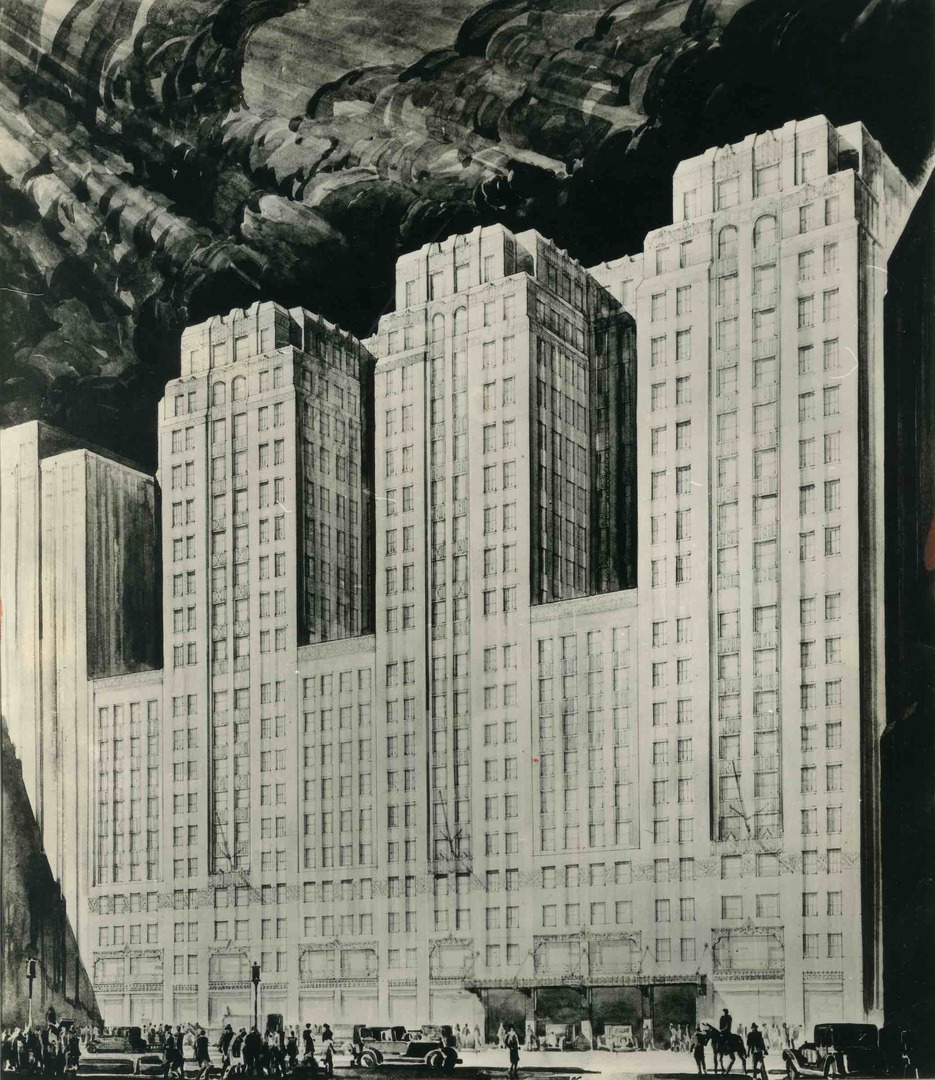
    <summary type="html"><![CDATA[<p><strong><em>Tower City Center, with its Public Square entrance, iconic tower, and flanking hotel and casino, has long overshadowed the office buildings to its rear despite their shared lineage as heirs of the Van Sweringen brothers’ vision. Yet the Landmark Office Towers complex on West Prospect Avenue deserves more attention for its splendid architectural details, novel interior features, and place in the history of some of Cleveland’s most significant corporate giants. </em></strong></p><img src="https://clevelandhistorical.org/files/fullsize/cf17bb9783a0e01e8bcbc10cdc20b577.jpg" alt="Original Rendering of Builders Exchange Building" /><br/><p>The three adjoining buildings that comprise Landmark Office Towers were originally conceived as part of Oris P. and Mantis J. Van Sweringen’s Cleveland Union Terminal complex, the “city within a city” the brothers launched in the 1920s. Designed by Graham, Anderson, Probst & White of Chicago and built between 1929 and 1930, the buildings occupied an entire city block bounded by Prospect Avenue, Huron Road, Ontario Street, and West 2nd Street, all of which were built as viaducts above the railroad tracks entering the Union Terminal. </p><p>In keeping with the idea of a city within a city, each building focused on a different sector: the Medical Arts Building was built for physicians’ and dentists’ offices; the Builders Exchange Building was devoted to businesses associated with the building trades; and the Midland Bank Building was dedicated to banking institutions and other business firms. The buildings included passageways connecting them with each other and with other components of the Terminal complex. A skybridge over Prospect, planned to link the Medical Arts Building with Higbee’s department store, was never added. </p><p>The three buildings were all built with structural steel frames clad with gray limestone on the lower four floors, cream face brick above, and terra-cotta trim near the tops. Detailed Art Deco motifs graced each facade, and the complex featured setbacks and light wells to break their bulk and provide ventilation. Inside, they featured travertine marble floors, fluted pilasters, plaster ceilings with ornamental friezes, and bronze elevator doors. The three-story lobby of the Midland Bank Building featured a wood-burning fireplace, a mezzanine, and pillars and panels carved from the trunks of seven giant oak trees. The trees were selected from an English estate and transported by steamship from Liverpool. The Builders Exchange Building included Guildhall, a tenth-floor restaurant inspired by a 15th-century London namesake, and a two-story demonstration house called the <a href="https://clevelandhistorical.org/admin/items/show/1028">Home in the Sky</a> on its two top levels.</p><p>The introduction of such an expansive block of choice office space soon after the onset of the Great Depression had a profound impact on downtown, precipitating a consolidation of business and professional activity around the Terminal and leaving older office buildings with hard-to-fill vacancies. Four major corporate headquarters relocated to the complex between 1930 and 1935. Two were local: Sherwin-Williams moved its offices from its Canal Road property into portions of the Midland Building and Builders Exchange Building, while Standard Oil Co. of Ohio (Sohio) left the East Ohio Gas Building on East 6th for the Midland Building. The Midland Building also attracted the Erie Railroad headquarters away from New York City in 1931 and Republic Steel from Youngstown in 1935. The arrival of the latter led the Medical Arts Building to be renamed the Republic Building. </p><p>Yet the Depression also forced the complex to grapple with challenges. In 1932, Midland Bank went bankrupt and merged into Cleveland Trust, closing its offices in its namesake building. Three years later, the Van Sweringen Company went bankrupt. Thereafter, ownership of the towers complex was administered by the Prospect Terminals Building Co., a subsidiary of Cleveland Terminal Building Co. In 1940, the Cleveland Builders Exchange left for a new headquarters on Euclid Avenue, and Sherwin-Williams expanded to the floors that had housed the Exchange's Home in the Sky. At that time, the building was named the Guildhall Building.</p><p>In 1950, Cleveland Terminal Building Co. sold the entirety of the Union Terminal group except the rail station in 1950 to the 66 Trust of Philadelphia. That same year, the four main tenants of the towers complex — Republic Steel, Erie Railroad, Sohio, and Sherwin-Williams — formed RESS Realty (a portmanteau of their names) to coordinate leasing of office space in the three conjoined towers. For the 35 years that followed, the complex harbored a workforce of around 5,000 people. </p><p>In 1986, ten years after the Erie-Lackawanna Railroad (formerly Erie Railroad) closed its Cleveland headquarters following its merger into Philadelphia-based Conrail, Sohio completed its move from the Midland Building to its new 45-story headquarters on Public Square. Following the departures of these firms and Republic’s recent merger into LTV Steel, RESS Realty was administered by only LTV and Sherwin-Williams. In the year preceding Sohio’s exit, RESS Realty renovated and rebranded the LTV-Guildhall-Midland Building complex as Landmark Office Towers. </p><p>During the renovations, Sherwin-Williams bought the complex, bringing its ownership back to Cleveland. Changes included a central lobby for the elevator banks serving all three buildings, along with the revitalization of the Midland Building’s lobby, which Sohio had modernized into offices with dropped ceilings in 1970, as the Van Sweringen Arcade. The bank’s vault became Haymarket Restaurant, later Piperade, and then Hyde Park Chophouse until the space closed in 2011. </p><p>The renovation and promotion succeeded in turning around the towers at a critical time. After Sohio moved out, the complex’s occupancy dropped from 100% to 62%, but upon completion of the renovations, it bounced back to 90%. Landmark Office Towers had a nearly four-decade run until its owner, Sherwin-Williams, sold the complex to Detroit-based Bedrock in 2023 ahead of the paint and coatings company’s move to its new 36-story headquarters tower on Public Square. Today, the future of the complex seems tied to Bedrock’s Riverfront Cleveland project, but its precise use is uncertain. Office demand in downtown districts has not recovered from the pandemic collapse of 2020, and conversion of such a massive structure to residential use is costly. But the towers — with their Art Deco flourishes, contribution to a big-city atmosphere, and central location in an evolving downtown — deserve a new, bold vision.</p><p><em><strong><a href="https://clevelandhistorical.org/items/show/1084">For more (including 21 images) view the original article</a></strong></em></p>]]></summary>
    <published>2026-04-03T13:57:15+00:00</published>
    <updated>2026-04-04T22:02:25+00:00</updated>
    <link rel="alternate" type="text/html" href="https://clevelandhistorical.org/items/show/1084"/>
    <id>https://clevelandhistorical.org/items/show/1084</id>
    <author>
      <name>J. Mark Souther</name>
    </author>
  </entry>
  <entry>
    <title type="html"><![CDATA[The Home in the Sky: &quot;A Doll&#039;s House for Grown-Ups&quot;]]></title>
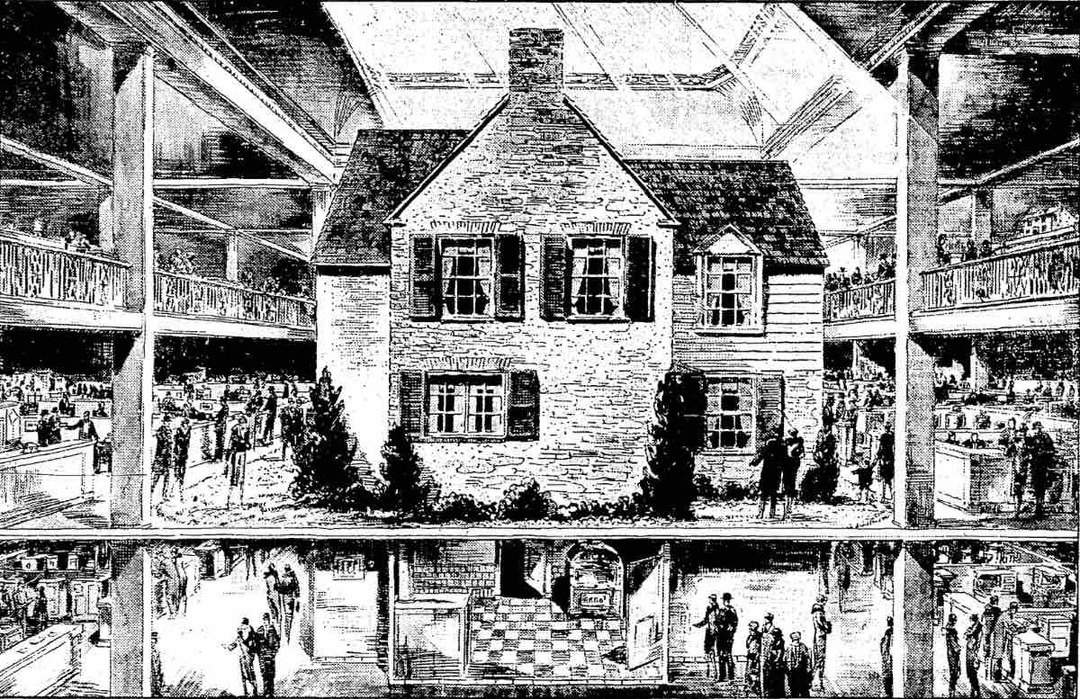
    <summary type="html"><![CDATA[<p><strong><em>On the evening of Friday, April 4, 1930, members of the Builders Exchange (a nonprofit building trades association) dined with their families in the Guildhall, a restaurant on the tenth floor of the association’s headquarters building in the Terminal Group. After dinner, they rode elevators up to the Exchange’s brand-new indoor model home exhibit, known as the Home in the Sky. Governor Myers Y. Cooper delivered a dedication speech broadcast from Mount Gilead, Ohio, and pressed a radio-control button to remotely illuminate the home. The next day, airplanes circled the skyscraper and dropped “festoons of roses.” Then Mayor John D. Marshall and his wife turned the key to officially open the house to the public. Speaking amid a worsening Great Depression that threatened the construction industry, Marshall predicted reassuringly, “Here home ownership will be fostered.” By the close of the opening weekend, an estimated 10,000 people had viewed downtown's novel new attraction.</em></strong></p><img src="https://clevelandhistorical.org/files/fullsize/4b4740dd1eeaf73422d3577dc9b7cd09.jpg" alt="Drawing of the Home in the Sky" /><br/><p>The Home in the Sky was a 39 x 31 foot, two-story, six-room, Colonial-style house erected by Building Arts Exhibit Inc. in a 51-foot-tall open court on the 17th and 18th floors of the Builders Exchange Building. A gallery on the 18th floor enabled close inspection of the house's second story and roof. The house showcased the latest building materials, home decoration and furnishings, all surrounded by a landscaped lawn and additional "Building Arts" displays. The Home in the Sky emerged from plans by the Builders Exchange in the late 1920s. In cooperation with the American Institute of Architects Cleveland Chapter and the Better Homes Association, it held a statewide contest in 1929 to design the house. Fred J. Abendroth of Dunn & Copper Architects in Cleveland won first prize, beating about 2,500 other contestants. The house’s conservative design mirrored that of the nearby Terminal Tower, which mimicked 20- to 30-year-old skyscrapers in New York and Chicago rather than embracing the modernism of Art Deco.</p><p>The house's conservative architecture was perhaps best evoked in the Cleveland Builders Supply Company’s explanation of the use of “Cleveland Rustic” face brick for much of the exterior: “Vision, with closed eyes, a home of brick nestled amongst groups of trees and masses of flowering shrubs; a home, not glaringly new in appearance, but reflecting the softened, weathered touch which is Nature’s gift alone; a home redolent with the atmosphere and age-old glamour which typifies the architecture of our forefathers. This pictures, briefly, the effects created by ‘Cleveland Rustics’ in ‘The Home in the Sky.’”</p><p>The May Company’s home decorating department furnished the Home in the Sky. The house’s first floor featured a vestibule with coat closet; a living room with a bay window, a fireplace, and wooden mantel flanked by bookcases with a door opening onto a garden porch; a dining room; a modern kitchen with the latest electric appliances and a breakfast nook. The second floor included a stair-hall, three bedrooms with closets (one of them a nursery), and a green and mauve bathroom. In the basement was a pine-paneled recreation room with a fireplace, bright-red leather lounge chairs, and laundry with “electrical labor-saving devices designed to lighten the work on the modern home-maker.”</p><p>Visitors were free to roam the house on their own or to take a guided tour led by Florence LaGanke, who also served as the exhibit’s director of women’s activities. They could not only see a range of materials and furnishings in what the <i>Plain Dealer</i> called "a doll's house for grown-ups" but also obtain expert advice on construction, furnishings, home management, and even landscaping and gardening techniques. WTAM also broadcast a regular biweekly program from the exhibit to explore such topics. Clubs were also welcome to reserve space for their meetings. </p><p>In its first year, the Home in the Sky attracted 300,000 visitors. As novel as the Home in the Sky was, however, the Builders Exchange wanted to ensure that there was always something new to see so that Cleveland’s would make return visits. In May, as Clevelanders’ attention turned to the outdoors, it debuted a “summer cottage” and horticultural exhibition on the 18th floor and partnered with a number of local organizations to offer an eight-day gardening clinic. To make the garden as useful as possible, the exhibit builders hauled in tons of soil donated by gardeners all over Cuyahoga County and representing common types in the Cleveland area: “Raw Parma subsoil that has not seen the light of day for 6,000 years is there. Then there is well worked clay loam from the W. G. Mather estate, prize winning garden soil from Lakewood, the much maligned but fertile soil of downtown Cleveland, sands of Euclid Avenue, clay of the Heights. Your soil will be represented,” one newspaper article assured. The exhibit also displayed a flagstone terrace, a hedgerow, shrubs, and a backyard garden with “onions, spinach, beets and other homely vegetables.” </p><p>For a time, updates continued. In the fall of 1930, the Home in the Sky received a top-to-bottom refurnishing, this time by Higbee’s. The following spring, it opened a new exhibit called Sky City, a model streetscape lined by rows of homes exhibiting “building products in their proper settings.” It also featured the “Court in the Sky,” a courtyard to showcase different floor materials. In 1934, <a href="https://clevelandhistorical.org/items/show/958">Kinney & Levan</a> assumed responsibility for furnishing the Home in the Sky, along with the newest addition to the Builders Exchange exhibit, the American Institute of Architects Cleveland Chapter–designed “House of Tomorrow.” However, coverage of the Home in the Sky exhibit dropped precipitously thereafter. Occasional mentions suggest that it remained open but was not promoted. In 1941, the Builders Exchange moved to Euclid Avenue and East 18th Street and Sherwin-Williams took over its former space to house some of its operations formerly handled at its Canal Road facility. It is not recorded how the Builders Exchange dismantled the Home in the Sky.</p><p>The Home in the Sky was surely one of the nation's most ambitious demonstration houses because of its novel location atop a skyscraper. But downtown Cleveland also saw several other demonstration houses in the 1930s. Four of them appeared on the grounds of the Great Lakes Exposition in 1936. Two of those served as commemorative replicas of the log cabins that had once housed early settler Lorenzo Carter and future President James A. Garfield. (Local interest in commemoration had led civic leaders to build a <a href="https://clevelandhistorical.org/files/show/11993">log cabin</a> on Public Square for the city’s 1896 centennial and would later inspire a <a href="https://clevelandhistorical.org/items/show/286">replica</a> of Carter’s cabin in the Flats on the occasion of the U.S. Bicentennial in 1976.) In contrast, the other two were showcases for the home construction and real estate industries. Nestled between City Hall and the Cuyahoga County Court House were a small brick demonstration house built by Cleveland Builders Supply Co. and a large wood-frame, columned mansion constructed by the Cleveland Lumber Institute and furnished by the Halle Bros. Co. The Halle House invited visitors to see how they could recapture the flavor of colonial Virginia in their own homes by shopping Halle’s. In 1939, yet another demonstration house, this one sponsored by the American Legion, opened to the public on Euclid Avenue at East 21st Street in front of the Legion’s headquarters (now the site of CSU’s Student Center). Known as the Low Cost Demonstration Home, the diminutive Cape Cod measured only 28 x 26 feet and surely reflected the harsh reality that a decade of depression posed for the building trades. </p><p>Two decades later, the city’s building trades had a new reason for downtown demonstration homes. Unlike in the context of the Great Depression, when the Builders Exchange attracted Clevelanders to the city center in hopes of inspiring them to build new homes on the suburban periphery, by the 1950s, civic leaders were grappling with the consequences of outward population movement for the central city. In 1955, on the cusp of federal urban renewal, the National Retail Lumber Dealers Association unveiled Operation Demonstrate on the Mall, adopting the slogan “Live Better Where You Are.” The organization split in half and hauled two “age-blacked shells” of houses from Charity Avenue (a street that would in a few years be obliterated for the St. Vincent urban renewal project) to the Mall, where they were rebuilt and renovated to become Operation Demonstrate’s Traditional House and a Contemporary House. After the demonstration ended, the houses were put up for sale, to be moved by the buyer. Ultimately, the houses were loaded onto a barge at the foot of East 9th Street and ferried fifty miles west to Huron, Ohio.</p><p>The Home in the Sky, along with other demonstration houses, was a symbol of the ascendancy of the idea of housing as a consumer product. Fearing the effects that the Great Depression (and, later, urban decay) might have on homeownership, those with a profit stake in the private housing market used demonstration houses to entice the public into a marketplace with countless materials and products that might make the American Dream their reality. In that sense, a visit to the Home in the Sky was not unlike how people today browse Zillow, watch HGTV, or visit the Home & Garden Show at the I-X Center for home buying, remodeling, landscaping, and gardening inspiration.</p><p><em><strong><a href="https://clevelandhistorical.org/items/show/1028">For more (including 14 images) view the original article</a></strong></em></p>]]></summary>
    <published>2024-06-29T16:35:12+00:00</published>
    <updated>2026-04-03T15:13:14+00:00</updated>
    <link rel="alternate" type="text/html" href="https://clevelandhistorical.org/items/show/1028"/>
    <id>https://clevelandhistorical.org/items/show/1028</id>
    <author>
      <name>J. Mark Souther</name>
    </author>
  </entry>
</feed>