<?xml version="1.0" encoding="UTF-8"?>
<feed xmlns="http://www.w3.org/2005/Atom">
  <title type="text">Cleveland Historical</title>
  <updated>2026-04-17T14:57:01+00:00</updated>
  <generator uri="http://framework.zend.com" version="1.12.20">Zend_Feed_Writer</generator>
  <link rel="alternate" type="text/html" href="https://clevelandhistorical.org/"/>
  <link rel="self" type="application/atom+xml" href="https://clevelandhistorical.org/items/browse?output=rss2"/>
  <id>https://clevelandhistorical.org/</id>
  <author>
    <name>Cleveland Historical</name>
    <uri>https://clevelandhistorical.org</uri>
  </author>
  <link rel="hub" href="http://pubsubhubbub.appspot.com/"/>
  <entry>
    <title type="html"><![CDATA[Cleveland Thermal Energy: District Heating in the City]]></title>
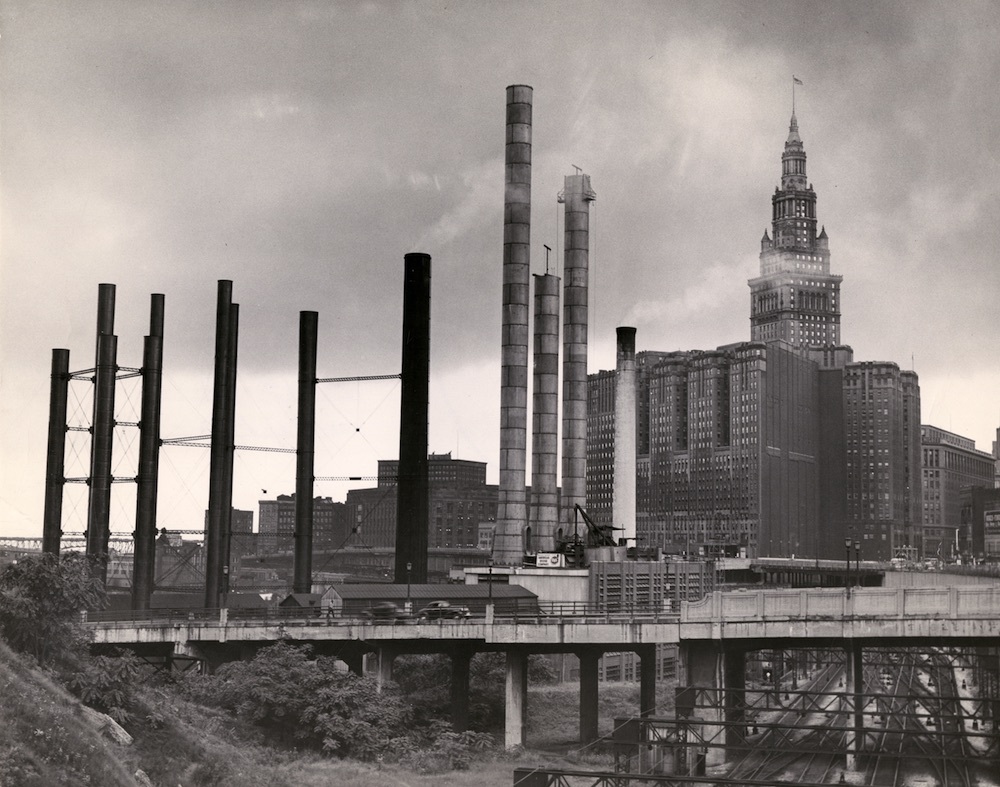
    <summary type="html"><![CDATA[<p><strong><em>A product of electricity generation and innovative engineering at the turn of the century, Cleveland's extensive network of underground pipes supplies steam heat and chilled water to make several downtown facilities comfortable in all seasons.</em></strong></p><img src="https://clevelandhistorical.org/files/fullsize/cd87a92dac07b445b8891ce19d8b42e0.jpg" alt="&quot;A Giant Trio of New Stacks&quot;" /><br/><p>District heating and cooling denotes the network of delivery of thermal energy to a group of proximate buildings or structures from a central source. The concept was first recorded with the use of Roman hypocausts, a hot air furnace, designed to warm a close group of buildings. The design evolved during the Renaissance to tap hot springs’ heat and energy to channel warmth to nearby buildings, inspiring further architectural development to incorporate thermal energy into urban development. By the 17th century, several countries in Europe, England, and Scandinavia relied upon hot water and steam to centrally heat neighboring buildings, both factories and residences. The efficiency of these systems attracted awareness across the Atlantic, and as technology evolved during the 19th century the Exhibition of 1851 marked the heating of several exhibits including the Crystal Palace via a separate boiler. During the next 25 years, European and American cities, including London, New York, Philadelphia, and Springfield, Illinois, boasted district heating. Later in the century, the cooling of structures was added to the district energy distribution concept. More cities throughout the United States incorporated heating and cooling systems into urban developments.</p><p>District heating in Cleveland evolved as part of the pioneering electric generation industry spawned by Charles Brush’s street lamps on the city’s Public Square. During the 1890s Brush Electric joined Cleveland Electric light to form General Electric Light Company which evolved into Cleveland Electric Illuminating Company by 1894 to respond to the increasing demand for electric service throughout the city. Between 1895 and 1906, the design and development of CEI’s Canal Road generation plant attracted worldwide attention via the advanced engineering used to generate electricity and steam at the site. Located on the east bank of the Cuyahoga River, clean water access was available but not ideal as upstream mills and factories polluted the resource as CEI looked to develop the byproduct of coal-fired electricity generation into a district heating business. By 1910, the Canal Road plant switched to city water to generate steam and expand its reach into the downtown area. </p><p>During the second decade of the 20th century, CEI continued to respond to the demand for increased regional electric and local steam power with progress on the infrastructure to deliver the energy. Competition for customers also grew during this period. Other local steam plants arose to supply power to proximate factories and institutions as the area developed. Among these competitors were Bradley, Cleveland, and Cuyahoga Light and Power Companies.   </p><p>A new generation plant was built at East 20th Street and Hamilton Avenue in 1924 to complement Canal Road production of both electricity and steam. The Canal Road plant was re-engineered, demolished, and rebuilt in 1928. Over the next twenty years CEI expanded its steam business to serve more than 660 customers bounded by Prospect Avenue north to Lake Erie and the Cuyahoga River east to East 24th Street. CEI continued to be recognized as a leader in the district heating technology and business, setting a national example. In 1946, the Canal Road plant ceased electric power production and turned to steam only. Two years later, CEI constructed three 235-foot colossal smokestacks at the Canal Road plant to provide greater draft for new boilers at the plant. The stacks were 12 feet inside diameter and 13 feet outside diameter steel and brick construction. During construction, workers ascended and descended the inside of the stacks while standing on a crane ball. The three tall stacks replaced ten smaller stacks and became a ‘landmark’ sight along Ontario Avenue visible from Public Square looking south. Only one remains today.</p><p>CEI continued to operate the steam generation and heating business throughout the next four decades amid legal and political disputes during an era of deregulation of public utilities, fierce competition with Cleveland Public Power (the city owned power company serving local customers), and corporate mergers and acquisitions. In 1982, several steam buildings left CEI for cheaper heat from natural gas sources. By the mid 1980s, Cuyahoga County's downtown facilities were CEI’s number one steam customer and Cleveland State University was second among downtown customers. One notable eight-year dispute between Cleveland State University and CEI over rates was ultimately settled in 1987 when CEI sold both plants and the steam operation to Youngstown’s Catalyst Thermal to operate as Cleveland Thermal Energy Corporation (CleTEC).</p><p>CleTEC operated the steam heating and expanded chilling operations for the next 28 years. During that time, corporate control of CleTEC changed hands twice until it was bought by the Canadian firm Corix in 2015. Corix moved to phase out the less eficient Canal Road plant in favor of the upgraded Hamilton Avenue plant with high-efficiency steam production using clean-burning natural gas. The Canal Road Plant closed in 2017.</p><p>Today, "Cleveland Thermal’s pipeline spans more than 30 million square feet throughout the Downtown Cleveland footprint. This pipeline delivers district steam and chilled water 24 hours a day, 365 days a year to downtown customers."</p><p><em><strong><a href="https://clevelandhistorical.org/items/show/953">For more (including 12 images) view the original article</a></strong></em></p>]]></summary>
    <published>2021-11-15T17:09:31+00:00</published>
    <updated>2026-03-04T21:32:05+00:00</updated>
    <link rel="alternate" type="text/html" href="https://clevelandhistorical.org/items/show/953"/>
    <id>https://clevelandhistorical.org/items/show/953</id>
    <author>
      <name>Jim Lanese</name>
    </author>
  </entry>
  <entry>
    <title type="html"><![CDATA[Nela Park: &quot;A University of Light&quot;]]></title>
    <summary type="html"><![CDATA[<img src="https://clevelandhistorical.org/files/fullsize/56e79a2ea63e93a874d74d37a9a6ba8c.jpg" alt="GE Lighting Institute at Night" /><br/><p>The National Electric Lamp Association (NELA) formed in 1901 under Franklin Terry and Burton Tremaine.  Much of NELA's light-bulb innovation stemmed from, and competed with, both Charles F. Brush's arc light technology, and Thomas Edison's incandescent lamp technology.  GE became a major stockholder in NELA as soon as 1902, and provided the former facilities of the Brush Electric Co. as a new home for NELA.  GE's stake in the company become so substantial, 75%, federal courts ordered GE to dissolve the company in 1911.  GE quickly absorbed NELA and successively gained ownership of NELA's new industrial complex in the suburbs, Nela Park.</p><p>The location for Nela Park was known as Panorama Heights, a place where German immigrants held vineyards prior to the parks development.  Nela Park was designed by New York landscape architect Frank E. Wallis in a Georgian style.  The finished product was the first ever industrial park, costing roughly $400,000 in 1913. The actual move from the old Brush Electric Co. factory on East 45th Street to Nela Park on Noble Road took nineteen hours to complete on April 18, 1913.</p><p>The "park" was developed with the acquisition of 44 land parcels between 1911 and 1925, as well as a few more in the 1930s and ’50s. Ultimately, its 71-acre campus stretched between Noble and Belvoir Roads in East Cleveland and reached into Cleveland Heights to the east for a few blocks. Construction of eleven buildings by 1915 provided facilities for engineering, manufacturing, administration, maintenance, utilities, operations, and lamp laboratories. Eight more facilities were added by 1930, and four more in the 1950s brought Nela’s campus to its present status as a comprehensive lighting development center. Throughout this period, the Nela “camp” was developed on the campus grounds to house recreational, assembly, event, and dining facilities. Its annual holiday light display started in 1924.</p><p>The business park also contained several features to appease employees including a decent cafeteria, general library, a dispensary that provided dental, nursing, and medical care, a barber shop, transportation office, ample garage parking, and a local bank branch.  Nela Park also provided a range of recreational facilities such as tennis courts, baseball fields, an in-ground swimming pool, bowling alleys, and even an auditorium. Due to its reputation as a leading innovator in electrical lighting research and development, and university campus environment, it doesn't come as much of a surprise that Nela Park developed a reputation as a "University of Light."</p><p>A century after Nela Park was built, a centenarian time capsule was unearthed. Originally sealed and buried on March 25, 1912 in front of a crowd of high-ranking employees, the capsule was concealed within a cornerstone of Marketing Building #307 for 100 years to the day before its exhumation in 2012. The capsule contained a newspaper, photos, and most notably several incandescent light bulbs, which in 1912 were a state of the art development. To the delight of the hundreds of current and former employees who witnessed the opening of the time capsule, one of the bulbs was placed on display and successfully produced light despite being stowed away for an entire century. The President and CEO of GE Lighting took the opportunity to point out how appropriate it was that such a lamp still functioned, citing that GE's Nela Park was responsible for the development of quality, energy-efficient lighting products that benefited countless individuals and organizations. Another time capsule was ceremonially buried in  2013 at Nela Park. Among its contents was a GE Energy Smart 60-watt replacement LED bulb with a 22-year service life when operated three hours a day. </p><p>By the latter half of the 2010s, General Electric Corporation was undergoing reorganization of its business model and priorities to include the divestiture of the lighting business. In 2020, Savant Systems Inc., of Massachusetts, acquired GE Lighting from General Electric, preserving its name and keeping maintaining its century-long lighting operations intact. Two years later, GE Lighting sold Nela Park to Milwaukee-based Phoenix Investors, with plans to consolidate its operations in one building and attract other tenants to the remainder of the Georgian-style campus.</p><p><em><strong><a href="https://clevelandhistorical.org/items/show/78">For more (including 13 images&#32;&amp;&#32;3 audio files) view the original article</a></strong></em></p>]]></summary>
    <published>2010-11-09T15:43:59+00:00</published>
    <updated>2026-04-11T17:30:47+00:00</updated>
    <link rel="alternate" type="text/html" href="https://clevelandhistorical.org/items/show/78"/>
    <id>https://clevelandhistorical.org/items/show/78</id>
    <author>
      <name>Matthew Sisson</name>
    </author>
  </entry>
  <entry>
    <title type="html"><![CDATA[Public Square: Two Centuries of Transformation]]></title>
    <summary type="html"><![CDATA[<img src="https://clevelandhistorical.org/files/fullsize/1310959b1a93a8e6400ea5b6dfba963f.jpg" alt="Postcard View" /><br/><p>Laid out by Moses Cleaveland's surveying party in 1796 in the tradition of the New England village green, Public Square marked the center of the Connecticut Land Company's plan for Cleveland and, soon, a ceremonial space for the growing city. In 1856, Cleveland's first fountain was constructed on the square. Four years later a statue of Battle of Lake Erie hero Commodore Oliver Hazard Perry was erected in the center of the square, leading City Council to rename Public Square as Monumental Park. In 1865, Clevelanders watched returning Civil War regiments as they mustered on Public Square, and later generations would greet returning veterans from subsequent wars. Public Square also provided a space for viewing the caskets of fallen U.S. Presidents Abraham Lincoln and James A. Garfield in 1865 and 1881, respectively. In perhaps its most notable moment in the 19th century, in 1879, Public Square garnered international attention when inventor Charles F. Brush showcased one of the world's first successful demonstrations of electric streetlights there.</p><p>Adding to the reputation of Monumental Park, a statue of Moses Cleaveland rose on the northwest quadrant in 1888, and on July 4, 1894, the 125-foot-tall <a href="https://clevelandhistorical.org/items/show/332">Soldiers' and Sailors' Monument</a> was dedicated on the square's southeast quadrant in honor of Civil War veterans, at which time Perry's monument was moved, first to Wade Park. Although protests halted an 1895 plan to erect a massive new City Hall across the northern half of Public Square with an arch to permit Ontario Street traffic to pass underneath, in the following year the city marked its centennial with a large arch over Superior Avenue just east of Ontario and a replica of an original log cabin in the northeast quadrant. </p><p>In addition to its symbolic value, Public Square has also been a transit hub since the 19th century, first as a point of arrival for stagecoaches, and later as the hub of streetcar, interurban railway, and bus lines. Traffic patterns around Public Square were a source of much controversy in the 19th century. In the 1850s, supporters of a fully enclosed square erected a fence around its entire perimeter, preventing traffic from entering. Eventually the transit demands of an expanding city won out, and in 1867 roads once again passed through the center of Public Square.  Since that time, Public Square has labored under often-conflicting demands that it serve simultaneously as symbolic space, transit hub, and park. The opening of the Cleveland Union Terminal in 1930 prompted a sprucing up of Public Square, including the removal of a pavilion and a rustic bridge over an artificial stream that had occupied the square's southwest quadrant for decades. In their place was a large open lawn that provided a tidier "front yard" for the tallest building in the world outside New York. In the years that followed, transit use gradually eclipsed whatever parklike qualities the space had held.</p><p>In 1943 a new transit plan called for a new central subway station under Public Square. Ontario Street was to be depressed beneath Superior Avenue, and the Soldiers' and Sailors' Monument was to be relocated elsewhere. A Plain Dealer reporter quipped that the statue's removal "alone is almost worth the cost."  The 1940s and 1950s passed with no action on building a subway system. A 1958 plan proposed by architect Howard B. Cain, whose Park Building offices overlooked Public Square, envisioned closing Ontario, depressing Superior below grade, removing the Soldiers' and Sailors' Monument, and creating a Rockefeller Plaza-influenced sunken plaza with an ice-skating rink. Dubbed International Square, Cain's transformation--no doubt inspired by the expanded world trade that boosters claimed the impending opening of the St. Lawrence Seaway would produce-imagined shops and restaurants representing many nations. The next year, a new downtown master plan revived the idea of a subway under Public Square, this time affecting only its southern half. The plan also called for lowering the level of the northern half of the square, moving the Soldiers' and Sailors' Monument to the northeastern quadrant and building a sunken ice rink in the northwestern quadrant.  Like Cain's plan, this part of the downtown plan languished when county commissioners nixed the subway project. In the wake of the subway defeat, a 1960 plan to close through streets in Public Square and construct a 1,600-car underground garage likewise failed.  </p><p>Yet, the dream of remaking Public Square did not disappear. In the 1970s, urban planner Lawrence Halprin brought his imaginative renewal ideas to Cleveland. Halprin recommended turning Euclid Avenue into a pedestrian mall and remaking Public Square into a more parklike space. Iris Vail, wife of Plain Dealer publisher Thomas Vail, and other Garden Club of Cleveland women held a "Beautification Ball" in the Arcade in 1975 to raise $100,000 to finance a specific blueprint for the square. They hired Don M. Hisaka of Cleveland and Sasaki Associates of Massachusetts to design the new Public Square but then decided they did not like his minimalist, modernistic vision for the space. Instead, they spearheaded a more traditional parklike redo of the northeastern quadrant as a demonstration. Over the ensuing decade, Public Square was remade quadrant by quadrant as city, county, state, and federal funds, along with Cleveland Foundation and Garden Club monies--in all $12 million, augmented the original $100,000 raised by the Garden Club.  </p><p>Opened with laser-show fanfare just in time for Cleveland's sesquicentennial in 1986, the revamped Public Square sported parklike spaces and, in the southwest quadrant, a brick and granite terraced plaza with an artificial waterfall. In maintaining Superior and Ontario as through streets, the 1980s Public Square remake fell well short of decades of visions for reuniting the four isolated quadrants. In 2002 the New York-based Project for Public Spaces visited Cleveland and urged reunification of the square, calling it one of the world's most dysfunctional public spaces. Mayor Frank Jackson's appointed Group Plan Commission, a blue-ribbon committee inspired by Daniel Burnham's famed "Group Plan" of a century before, set out to make both the Mall and Public Square reach their potential as appealing destinations for locals and visitors. The commission approved a plan by James Corner, known for his innovative High Line project, which transformed an abandoned elevated railroad in New York City into a linear park. With the announcement of Cleveland's selection to host the 2016 Republican National Convention, civic leaders rallied to raise the $32 million needed make the long-awaited reunification of Public Square a reality.</p><p><em><strong><a href="https://clevelandhistorical.org/items/show/22">For more (including 17 images&#32;&amp;&#32;3 audio files) view the original article</a></strong></em></p>]]></summary>
    <published>2010-09-16T09:12:46+00:00</published>
    <updated>2026-03-04T21:31:57+00:00</updated>
    <link rel="alternate" type="text/html" href="https://clevelandhistorical.org/items/show/22"/>
    <id>https://clevelandhistorical.org/items/show/22</id>
    <author>
      <name>J. Mark Souther</name>
    </author>
  </entry>
  <entry>
    <title type="html"><![CDATA[Cleveland Electric Illuminating Co.: &quot;Convenience-Cleanliness-Brightness-Luxury&quot;]]></title>
    <summary type="html"><![CDATA[<img src="https://clevelandhistorical.org/files/fullsize/da9d9b33fcf9bd94db235ca97999c0a4.jpg" alt="Charles F. Brush" /><br/><p>The firm founded in 1892 as the Cleveland General Electric Co. by Charles F. Brush became the Cleveland Electric Illuminating Company (C.E.I.)  just two years later and established its headquarters offices in the Cuyahoga Building on Public Square. C.E.I.'s stint in the Cuyahoga Building was short-lived, however. The company transferred its headquarters into the 75 Building, on the northwest corner of Public Square in 1914. C.E.I. outgrew its facilities at 75 Public Square as the demand for electrical power rose, and in 1956 broke ground to construct its own Illuminating Building right next door at 55 Public Square. C.E.I. signed a fifteen-year, $408,000 lease to occupy the first five floors of the Illuminating Building. Despite occupying all fourteen floors of the old 75 Building, the Illuminating Building offered 17% more space on those initial five floors alone. The monumental 1958 move included some 800 dolly-loads of office equipment and an additional 500 desks. Nevertheless, the move was completed in less than eighteen hours as workers never stepped foot outdoors thanks to existing pedestrian tunnels connecting one building to the other.</p><p>At the turn of the twentieth century, C.E.I. ran advertisements offering to wire homes with electricity for a price of $38.50, touting the benefits of domestic electricity, "Convenience-Cleanliness-Brightness-Luxury."   Eventually, the company became famous for its 1940s-1960s ad campaign, which promoted Cleveland as "the best location in the nation." This ad campaign aimed to attract major industries to Cleveland, and promoted C.E.I.'s contribution to the overall welfare of Northeast Ohio by emphasizing its own role in expanding business, industry, job opportunities, and improving the overall quality of life.</p><p>A massive workforce strike erupted in the midst of the "best location in the nation" ad campaign. On April 24, 1957 the members of Utility Workers Local 270 voted a resounding 1,754-63 in favor to strike against C.E.I.   Workers demanded that C.E.I. do away with its right to make job changes and transfers without informing the union, as well as re-negotiate wages to obtain a "substantial" increase. The strike ended on May 7 after a grueling fifteen-hour negotiation. The fifteen-day strike became the longest of its kind in C.E.I.'s prominent history, which had only witnessed a single six-hour strike in 1945. Resolutions involved a new two-year contract with a general wage increase of five percent, or the equivalent of ten to fifteen cents per hour.</p><p>During the 1960s, C.E.I. became pressured to respond to the increasing demand for nuclear power, and began to invest in nuclear power plants in collaboration with Toledo Edison in 1970.  The decade of the 1970s witnessed the widespread energy crisis, which drove up the price of coal dramatically. Likewise, domestic energy costs for consumers skyrocketed, and C.E.I. lost a considerable amount of customers. In order to stay afloat, C.E.I. merged with Toledo Edison in 1986 to form Centerior Energy. A little over a decade later in 1997, Centerior Energy combined with Ohio Edison and Penn Power to form FirstEnergy, which controls the electric system for northern Ohio and western Pennsylvania.</p><p><em><strong><a href="https://clevelandhistorical.org/items/show/20">For more (including 10 images&#32;&amp;&#32;1 audio file) view the original article</a></strong></em></p>]]></summary>
    <published>2010-09-15T14:44:34+00:00</published>
    <updated>2026-03-04T21:31:57+00:00</updated>
    <link rel="alternate" type="text/html" href="https://clevelandhistorical.org/items/show/20"/>
    <id>https://clevelandhistorical.org/items/show/20</id>
    <author>
      <name>Matthew Sisson</name>
    </author>
  </entry>
</feed>
