<?xml version="1.0" encoding="UTF-8"?>
<feed xmlns="http://www.w3.org/2005/Atom">
  <title type="text">Cleveland Historical</title>
  <updated>2026-05-10T00:17:06+00:00</updated>
  <generator uri="http://framework.zend.com" version="1.12.20">Zend_Feed_Writer</generator>
  <link rel="alternate" type="text/html" href="https://clevelandhistorical.org/"/>
  <link rel="self" type="application/atom+xml" href="https://clevelandhistorical.org/items/browse?output=rss2"/>
  <id>https://clevelandhistorical.org/</id>
  <author>
    <name>Cleveland Historical</name>
    <uri>https://clevelandhistorical.org</uri>
  </author>
  <link rel="hub" href="http://pubsubhubbub.appspot.com/"/>
  <entry>
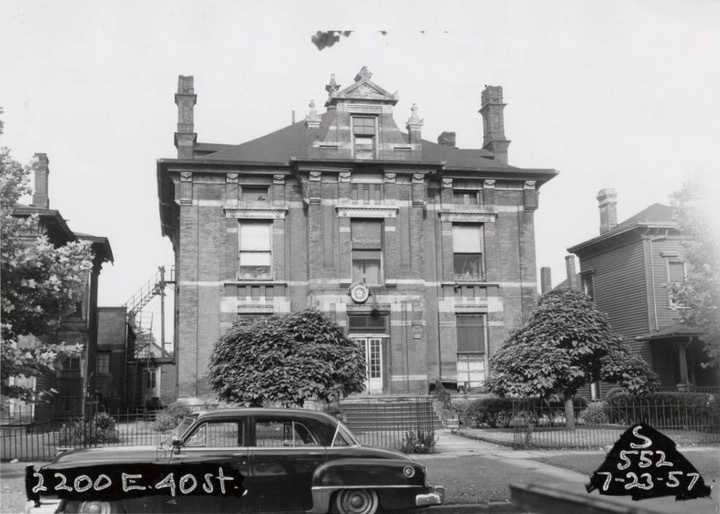
    <title type="html"><![CDATA[Liberty Hall: The Universal Negro Improvement Association in Cleveland ]]></title>
    <summary type="html"><![CDATA[<p><strong><em><div style="text-align:left;">“Cleveland Garveyites regularly paraded through the city’s black belt, proudly wearing their all-black military styled uniforms and carrying the UNIA’s red, black, and green flag. The flag signified black pride and African Liberation.” – Erick McDuffie</div></em></strong></p><img src="https://clevelandhistorical.org/files/fullsize/9f6020557f2245326d7c63447c2b8dce.jpg" alt="&quot;Liberty Hall&quot; / The Jacob Goldsmith House " /><br/><p>After the Great Migration a new nationalist movement arose in African American communities across the U.S., with Marcus Garvey as its spearhead. Founded by Garvey in 1914, the Universal Negro Improvement Movement (UNIA) stressed black pride, community solidarity, connecting the racial struggles in the U.S. to those of black people across the world. Garvey protested white colonization and called for “all men and women within the reach of the blood of Afric[a]" to be proud of their race.” The UNIA by-laws provided a script for each member oath to the organization that included a pledge to “the redemption of my motherland Africa.” This pride in African heritage in the UNIA is evident even in their anthem, “Ethiopia, Thou Land of our Fathers.” Garveyism and the UNIA gained influence in the Midwest, and more specifically in Cleveland, which would house the UNIA headquarters throughout the 1940s and again in the 1970s and 1980s. </p><p>During Marcus Garvey’s visit to Cleveland in May 1920, he spoke to more than 400 people at <a href="https://clevelandhistorical.org/items/show/643">Cory United Methodist Episcopal Church</a>. The audience's exuberant response demonstrates how Garvey’s Pan-African message truly captured the lives of those present. Inspired by Garvey’s message, the UNIA in Cleveland became a major force in local politics, as illustrated in continuous coverage of its Cleveland activates in Garvey’s newspaper <em>Negro World</em>. These efforts helped expand the Cleveland UNIA (Division 59) to more than 5,000 members by 1922, and by 1923 it claimed 15,000. This was the same year that the Cleveland UNIA, through the small donations of organization members, was able to purchase a stately three-story mansion located at 2200 East 40th Street. Liberty Hall, as it was later named, was located in the heart of the Central neighborhood. This building served not only as the headquarters space for the UNIA but also as a bustling African American community center, committed to uplifting black peoples in Cleveland and globally. </p><p>Initially, following Garvey’s mail fraud conviction and deportation, he reorganized the international UNIA at the 1929 convention, forming the Universal Negro Improvement Association and African Communities League, August 1929 of the World (UNIA-ACL). Although some charters fought Garvey on his changes, the Cleveland UNIA remained loyal and received its new charter as Division 133 from the UNIA Parent Body in 1930. It was during this time that the chapter started to face factionalism and decline. Issues with intra-racial strife, sexism, and class issues, among others, caused initial decline for the organization. Debates also focused around the issues of dancing, drinking, smoking, and women’s behavior. The black middle class, which comprised most of the Cleveland chapter, traditionally associated these activities with the recklessness of the black urban working-class. During the Depression many African Americans on Cleveland’s East Side started to migrate toward other black power groups, including the Future Outlook League (FOL) and the National Association for the Advancement of Colored People (NAACP) as a result of this strife within the organization. </p><p>The UNIA-ACL Cleveland branch, however, committed itself to the ideals of Pan-Africanism throughout the 1940s. In August 1940, James R. Stewart, who was serving as a UNIA-ACL commissioner for the state of Ohio and as president of the Cleveland branch, was elected acting president general at the time of Garvey’s death. By October, Stewart had established Cleveland as the new location for the UNIA-ACL Parent Body headquarters. The Parent Body remained in Cleveland until 1949. Part of what led to the chapter's downfall during this time was Stewart's push for voluntary African American repatriation to Liberia. Similar to Garvey, Stewart believed that the repatriation would assist in civilizing Africa and solving the American race issue. In the case of Cleveland, most African Americans were more concerned about obtaining full citizenship and rights in the U.S., rather than emigrating to Africa. These ideas, in conjunction with other black rights organizations like the FOL and NAACP supporting black rights at home, led to a continuing decline in membership. Stewart decided to take Liberian citizenship for himself in 1949, moving the Parent Body to Monrovia, Liberia. After Stewart’s death in 1964, the Parent Body moved to Chicago where it remained until 1975. </p><p>When the Civil Rights and Black Power movements arrived to Cleveland in the 1960s, the Cleveland UNIA-ACL was playing a marginal role at best. Garveyism during this time, however, took on a new life though new local Black Power organizations comprised of young black nationalists who consciously saw themselves as Garveyites. Inspired by Garvey’s defiant call for black self-determination, young black Clevelanders formed other Black Nationalist groups such as the House of Israel and the <a href="https://clevelandhistorical.org/items/show/777">Afro-Set</a>. Most of this new generation of Garveyites was unaware of the UNIA-ACL, but rather had come to Garveyism through the Nation of Islam or other veteran black nationalists. Kwame Nkrumah, the leader during Ghana’s independence, is said to have been greatly inspired by Garvey. In the U.S., Malcolm X is also said to have been influenced by Garvey in his desire to make a unified black pride on an international scale. In Cleveland’s more recent past, and even today, as the struggle for black rights rages on, people remember the influences of Garvey, and the UNIA-ACL, and the role they played in shaping the black power movements still present today.</p><p><em><strong><a href="https://clevelandhistorical.org/items/show/898">For more (including 9 images) view the original article</a></strong></em></p>]]></summary>
    <published>2019-12-09T02:46:38+00:00</published>
    <updated>2026-04-17T19:17:42+00:00</updated>
    <link rel="alternate" type="text/html" href="https://clevelandhistorical.org/items/show/898"/>
    <id>https://clevelandhistorical.org/items/show/898</id>
    <author>
      <name>Rebekah Knaggs</name>
    </author>
  </entry>
  <entry>
    <title type="html"><![CDATA[The Glenville Shootout: Racial Conflict and Conspiracy in Cleveland]]></title>
    <summary type="html"><![CDATA[<p><strong><em>Following the end of the hour-long gunfight that took place in Glenville on July 23, 1968, three white policemen, three black nationalists, and one black civilian lay dead in the streets of east Cleveland. Why did it happen and who was to blame?</em></strong></p><img src="https://clevelandhistorical.org/files/fullsize/f3135ded34a34d0bb9e1803f7589d18c.jpg" alt="Policemen duck for cover during the Glenville Shootout" /><br/><p>On the evening of July 23, 1968, shots rang out in Cleveland’s predominantly black east side neighborhood of Glenville. Though it is unknown who fired the first shot, it is known that the Cleveland Police Department and the Black Nationalists of New Libya, a militant black nationalist group led by Fred (Ahmed) Evans, played a part in the fierce, hour-long gun battle now commonly referred to as the 'Glenville shootout'. Once gunfire died down, three white policemen, three black nationalists, and one black civilian lay dead in the streets of Glenville. After, rioting ensued for three straight days and resulted in the damaging or destruction of 62 buildings. Both during and after the riots, black Glenville residents were brutalized by white policemen fueled by racism and resentment from the deaths of fellow officers. Glenville would never be the same again.</p><p>Many black Clevelanders during the early-to-mid 1960s viewed white city authorities (as well as members of the Cleveland police department) as antagonistic white supremacists who did nothing to stop the urban decay, racism, discrimination, and violence that plagued their communities. Civil rights and black nationalist groups in Cleveland aimed to improve social and economic conditions for black Clevelanders but were often met with violent opposition from white residents, policemen, and city authorities. Racial tensions often culminated in episodes of intense racial violence, as was seen in neighboring communities, like <a href="https://clevelandhistorical.org/items/show/7">Hough</a>, throughout the 1960s. In 1967, the election of Carl Stokes, the first black mayor of a major city, helped calm racial tensions in Cleveland — but only temporarily.</p><p>Fred (Ahmed) Evans, leader of a militant black nationalist group known as the Black Nationalists of New Libya, faced constant conflict with white authorities and police throughout his life. To authorities, Evans’s black nationalist ideology and militant tendencies represented a threat to the perpetuation of white supremacy which their authority relied upon. Following the assassination of Martin Luther King Jr., Evans became increasingly concerned about what he saw as a white police state and began amassing a cache of weapons for the purpose of defending himself and his community. Tensions between Evans and the Cleveland Police Department reached a peak in the summer of 1968 when police surveillance was ordered on Evans’s 12312 Auburndale Avenue apartment following reports to city hall that Evans was planning to stage an attack against the police department. Though this report was unverified, police patrol cars (manned by white policemen) were stationed outside Evans’s apartment for several days prior to the shootout — despite black officials’ warnings to do precisely the opposite. </p><p>Neither the Cleveland police department nor members of New Libya agree to this day on exactly how or why the ensuing confrontation ended in violence. According to police, Evans orchestrated the shootout and was thus the one to blame; according to Evans and other black nationalists, police aggression and violence had instigated the shootout. Ultimately, the version of events told by city hall and the police department swayed the white public and media; blame for the bloodshed and destruction was placed solely on Evans while police racism, aggression, and violence went ignored. Evans’ trial jury was composed of seven white Clevelanders who were all, throughout the course of the trial, exposed to various forms of media, despite rules forbidding it. White members of the prosecution used racial slurs against Evans’ black defense team but were never disciplined. While it was proven that Evans had hidden in an attic during the gunfight and had never personally fired a single shot, this did not matter to the white judge and jury — Evans was charged with and convicted of first-degree murder. Evans originally received the death penalty, but was later re-sentenced to life in prison where he died of cancer in 1978.</p><p>Though it remains unknown exactly who initiated the shootout, it is known that the Cleveland police department had a history of largely antagonistic relations with Evans and black residents of Glenville which ultimately culminated in the events of July 23, 1968. Stokes’s decision to temporarily enact black community policing as a means of preventing additional deaths after rioting began lost him favor with many white Clevelanders, the police department, and city hall. Stokes was succeeded by Ralph Perk, a white ‘law-and-order’ mayor who stamped out any chance that black nationalist groups in Cleveland had of improving their social and economic situations. Glenville has still not fully recovered from the events of that night; the continued existence of vacant lots, burned-out buildings, and violent interactions with white police in the following years served to remind its residents that the conditions which had ultimately led to the shootout and riots had continued to endure. It has been suggested by both sides that the Glenville shootout was a conspiracy on some level - but whether the events that took place that July night were a conspiracy by the Black Nationalists of New Libya to ambush the police force or a conspiracy by the Cleveland police department to disrupt and destroy black nationalism in Cleveland is matter that also remains contested to this day.</p><p><em><strong><a href="https://clevelandhistorical.org/items/show/858">For more (including 11 images) view the original article</a></strong></em></p>]]></summary>
    <published>2018-11-21T19:48:40+00:00</published>
    <updated>2026-04-17T19:17:42+00:00</updated>
    <link rel="alternate" type="text/html" href="https://clevelandhistorical.org/items/show/858"/>
    <id>https://clevelandhistorical.org/items/show/858</id>
    <author>
      <name>Riley Habyl</name>
    </author>
  </entry>
  <entry>
    <title type="html"><![CDATA[The Afro Set: Black Nationalism and Cleveland&#039;s East Side in the Late 1960s]]></title>
    <summary type="html"><![CDATA[<img src="https://clevelandhistorical.org/files/fullsize/ea57c0c0ce31388d691c350622a09504.jpg" alt="Mayor Carl Stokes and Harllel Jones Watch a Drill Team" /><br/><p>The vacant lot at 8127 Superior Avenue N.E. sits quietly in the midst of an East Side neighborhood that has seen a great deal of upheaval and civic unrest. In the late sixties, the lot was the home of the Afro Set Black Nationalist Party for Self Defense storefront as well as the headquarters of the group of the same name. Founded by Harllel Jones (later Harllel X) in late 1968, the Afro Set was largely a response to the rise of Black Nationalist sentiment due to escalating racial and socio-economic tensions that were prevalent not only in Cleveland but across the country. Jones had grown up in the East Side neighborhood of Hough, and his experiences there helped shape the Afro Set’s Nationalist core.  </p><p>Cleveland’s East Side was a victim of the migration to the suburbs that most urban centers suffered in the post-World War II era, and more critically, of the economic policies of the 1950s and 1960s that caused the rapid dereliction of what had become a series of predominantly black neighborhoods, with Glenville and Hough (the neighborhood where the Afro Set was located) suffering some of the worst decay and lack of governmental aid. Administrations prior to the election of Mayor Carl Stokes were marred by a racially conservative tendency to ignore urban neighborhoods, often tying up (or underfunding) desperately needed resources as well as ignoring the overpopulation, poor sanitation, and high unemployment rates in such areas. While Mayor Stokes’ programs such as Cleveland: NOW! were intended to address these issues, tensions in neighborhoods like Hough produced increasing levels of hostility towards even their own residents, with riots breaking out in the late 1960s following racial confrontations. Black Nationalists like those of the Afro Set would argue that such instances were almost inevitable given the charged atmosphere of the era. </p><p>Black Nationalism began as a movement predominantly among urban African Americans who focused on the belief in self-regulated black agency within the larger nation. As with the Civil Rights movement of the same era, Black Nationalists were concerned with the rights and discrimination that dominated postwar America, but the Nationalists were generally convinced that a nonviolent approach to the tensions between black communities and the establishment was ineffectual at best. Therefore Nationalist groups such as the Afro Set, while promoting black community values and a return to African culture, were more militarily inclined and also included a focus not just on black agency but also on separation of black society from the national whole.</p><p>The Afro Set was a beneficiary of the Cleveland: NOW! program, which represented Mayor Carl Stokes’ attempt to help blighted communities through a series of grants that were used in hopes of promoting a more positive urban experience. Jones’ Afro Set was not only a storefront that sold African cultural items and gave urban black youths a place to work, it was also meant to be a community and cultural institution where area people could come and hear lectures on prominent blacks such as Marcus Garvey and Malcolm X, as well as receive lectures on black culture in general. However, the message of black cultural identity tended to get lost in the coverage that men such as Jones received in the press: Black Nationalists were generally seen as overtly violent and communistic militants who threatened the status quo, and interviews from Jones and his compatriots tended to verbally confront the press and authority figures such as the police with thinly veiled threats and rhetoric. That is not to say that all Nationalists were focused on violent revolution, and even Jones did eventually move his focus to helping men reintegrate into the society that he had vehemently opposed; but the legacy of violence, and the bias shown towards groups like the Afro Set means that today’s urban blacks have little to show from an era that caused so much upheaval and social change; there are far too many vacant lots that are fading back into the landscape with their stories fading from memory.        </p><p><em><strong><a href="https://clevelandhistorical.org/items/show/777">For more (including 7 images) view the original article</a></strong></em></p>]]></summary>
    <published>2016-12-11T21:06:44+00:00</published>
    <updated>2026-04-17T19:17:41+00:00</updated>
    <link rel="alternate" type="text/html" href="https://clevelandhistorical.org/items/show/777"/>
    <id>https://clevelandhistorical.org/items/show/777</id>
    <author>
      <name>Toni Berry</name>
    </author>
  </entry>
</feed>
