Filed Under Aviation

Cleveland National Air Races

The National Air Races finally came to Cleveland Municipal (now Cleveland-Hopkins International) Airport in 1929. Local businessmen Louis W. Greve and Frederick C. Crawford played a big role in bringing the event to Cleveland. Both men were involved in the the city's thriving aviation industry with Greve's Cleveland Pneumatic Tool Company making landing gears and Crawford's Thompson Products (later TRW) involved in the production of aircraft engine valves.

The Cleveland National Air Races of 1929 kicked off with a grand parade down Euclid Avenue watched by over one hundred thousand spectators. A $3 million aviation exhibit opened at the Cleveland Public Auditorium at the same time. Meanwhile, the event's organizers built a permanent grandstand at the airport which could seat 50,000 spectators. Overflow crowds (a common occurrence) were accommodated with temporary stands. The ten-day event, held in late August and early September, proved to be wildly successful, and the Air Races returned to Cleveland in 1931, '32, '34, '35, '37, '38, '39, '46, '47, '48, and '49.

The most popular parts of the Air Races were the fast-paced, closed-course races. The 1929 Thompson Trophy Race, for example, featured planes flying five laps around a ten-mile circuit. Cross-country races, timed to end in Cleveland during the Air Races, were also held. The inaugural Powder Puff Race of 1929 featured women competitors (including Amelia Earhart) flying from California to Cleveland. Blimp rides, parachuting competitions, and military demonstrations kept the fans entertained between races.

The dangerous nature of aviation at this time was surely part of the appeal that drew crowds to the Air Races. Indeed, crashes were common, and fatalities sometimes occurred. The closed-course races in particular, with pilots jockeying for position mid-air, could be incredibly dangerous. In 1949, Bill Odom crashed his P-51 World War II fighter plane into a house in Berea during the Thompson Trophy Race, killing himself and a mother and child inside. Afterwards, Berea and other cities near Cleveland Airport passed laws barring races from being held in their airspace. For this and other reasons, 1949 would be the last National Air Race held in Cleveland. In fact, the event as a whole went on hiatus after the crash before being revived in Reno, Nevada in 1964. The Cleveland National Air Show began that same year at Burke Lakefront Airport, though its focus was on aviation demonstrations, and races only occurred infrequently.

Video

US Army propaganda film, 1929 In this film, produced by the US Army in 1929, the crowd at the Cleveland Air Races - including famed aviator, Charles Lindbergh - watch as Army airmen demonstrate military formations and other stunts.
Newsreel: Birdmen, 1934 In this 1934 Fox Movietone newsreel, the crowd at the air races watches military airmen, parachutists, and daredevil aviators, including Milo Burcham, "the world's greatest upside-down flyer."

Images

1932 National Air Races Poster
1932 National Air Races Poster "Screen print depicting an airplane as it flies up and out of poster to right hand corner, with visible slip stream. Other aircraft fly in background next to racing pylon. Text reads: National Air Races; Higher speeds, greater thrills, gigantic night spectacle, seat prices greatly reduced, free auto parking; Cleveland, Ohio." Source: National Air and Space Museum Creator: National Aeronautic Association Date: 1932
Air Races Opening Parade
Air Races Opening Parade The Cleveland Press caption for this photograph reads: "Lining Euclid Avenue for five miles, a crowd of 100,000 persons viewed the Flower Pageant opening the 1929 National Air Races in Cleveland, August 24." Source: Cleveland Press Collection, Michael Schwartz Library Special Collections at Cleveland State University Date: August 1929
Blanche Noyes and Her Plane
Blanche Noyes and Her Plane Clevelander Blanche Noyes stands in front of her plane, "The Miss Cleveland," which she used in the 1929 Women's "Powder Puff" Air Derby. The all-woman derby began in Santa Monica, California and ended in Cleveland in front of the crowd at the National Air Races. The Halle Brothers department store sponsored Noyes. Earlier in 1929, Noyes became the first woman to receive a pilot's license in Ohio. Noyes's most memorable race was the 1936 Bendix Trophy Race from New York to Los Angeles. Noyes and co-pilot Louise Thaden (the winner of the 1929 Women's Air Derby) won the race in the first year that women pilots were allowed to compete with men. Source: Cleveland Memory, Michael Schwartz Library Special Collections at Cleveland State University Creator: Edgar B. Smith Photographs Date: August 13, 1929
1929 National Air Races Official Program Cover
1929 National Air Races Official Program Cover This program cover depicts an airplane flying past a black-and-white checkered pylon as stylized, smartly dressed spectators look skyward. Source: Wikimedia Commons Creator: National Aeronautic Association Date: 1929
Air Race Accident
Air Race Accident Accidents, sometimes resulting in pilot fatalities, were an unfortunate reality at the National Air Races. In this photograph taken in Cleveland during the 1929 Air Races, a crowd gathers around the wreckage of a plane crash in a field nearby the airport. Twenty years later during the 1949 Thompson Trophy Race, pilot Bill Odom crashed his plane into a home in Berea, killing himself and two occupants – a mother and her infant child – inside. This was the final year that the National Air Races were held in Cleveland. Source: Cleveland Memory, Michael Schwartz Library Special Collections at Cleveland State University Creator: Cleveland Press Date: 1929
Jimmy Doolittle Wins
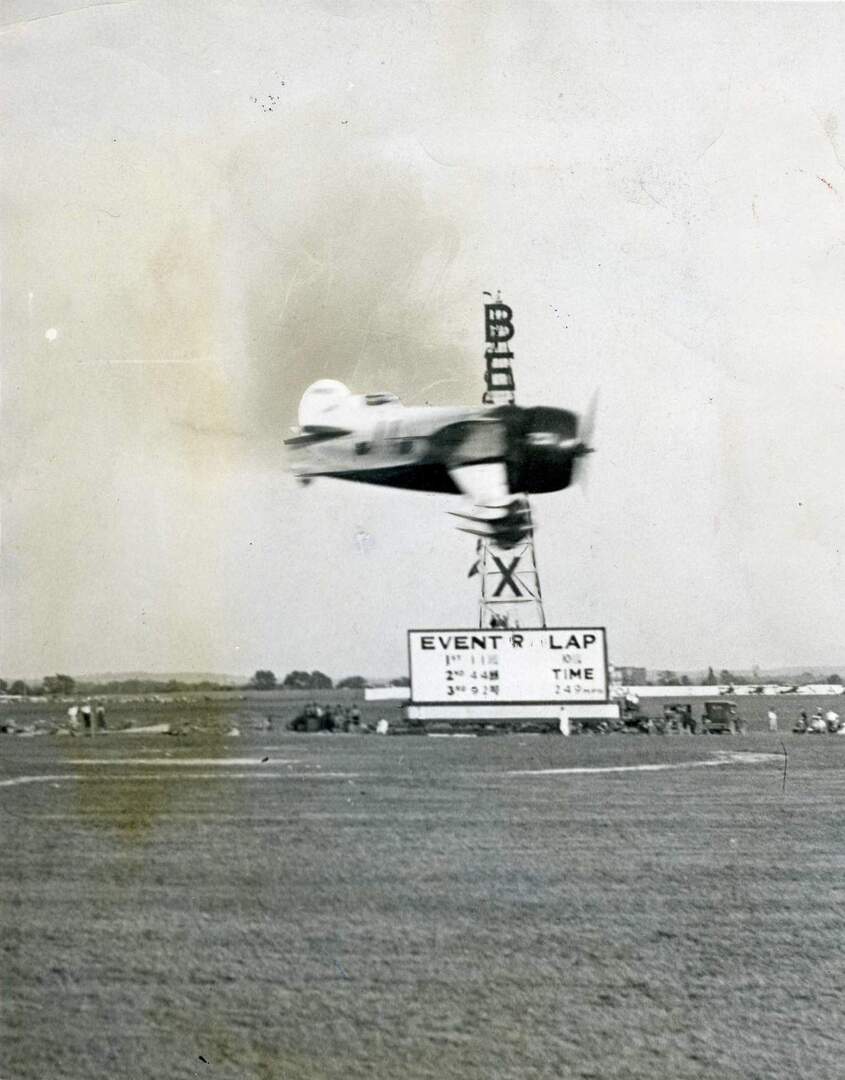
Jimmy Doolittle Wins This photograph from the 1932 National Air Races shows Jimmy Doolittle winning that year's Thompson Trophy Race. Doolittle's plane is passing in front of one of the pylons (covered with an advertisement for the Bendix Corporation) that marked the turns on the race's closed 10-mile course. That year, Doolittle flew a Gee Bee "Model R-1" that averaged over 250 miles per hour. Source: Cleveland Memory, Michael Schwartz Library Special Collections at Cleveland State University Creator: Acme Newspictures Date: September 5, 1932
Crowd at 1935 Air Races
Crowd at 1935 Air Races The grandstands are packed for the 1935 National Air Races. Source: Cleveland Memory, Michael Schwartz Library Special Collections at Cleveland State University Creator: Acme Newspictures Date: September 2, 1935
Kids at 1935 Air Races
Kids at 1935 Air Races Children wearing sunglasses scan the sky for action. Source: Cleveland Memory, Michael Schwartz Library Special Collections at Cleveland State University Date: September 4, 1935
Parking Lot for Air Races
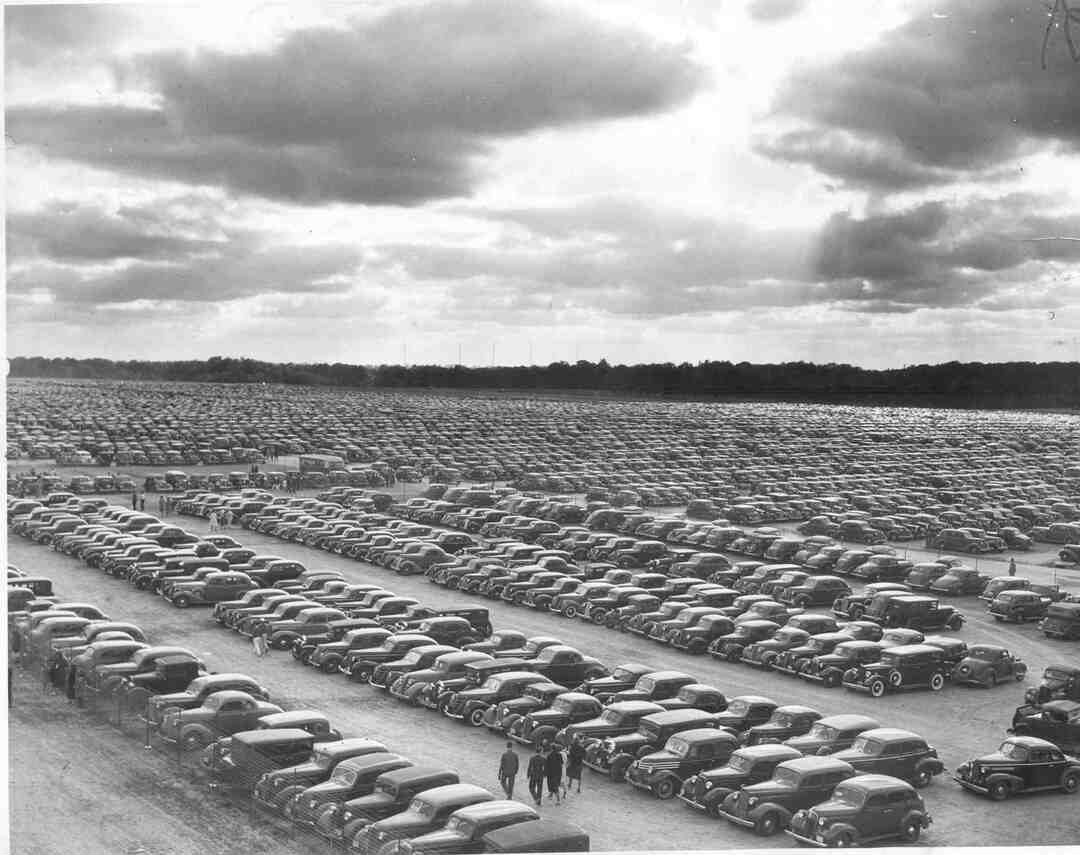
Parking Lot for Air Races The parking lot was located behind the grandstands at the 1937 National Air Races. Source: Cleveland Press Collection, Michael Schwartz Library Special Collections at Cleveland State University Date: 1937
Cooling Off
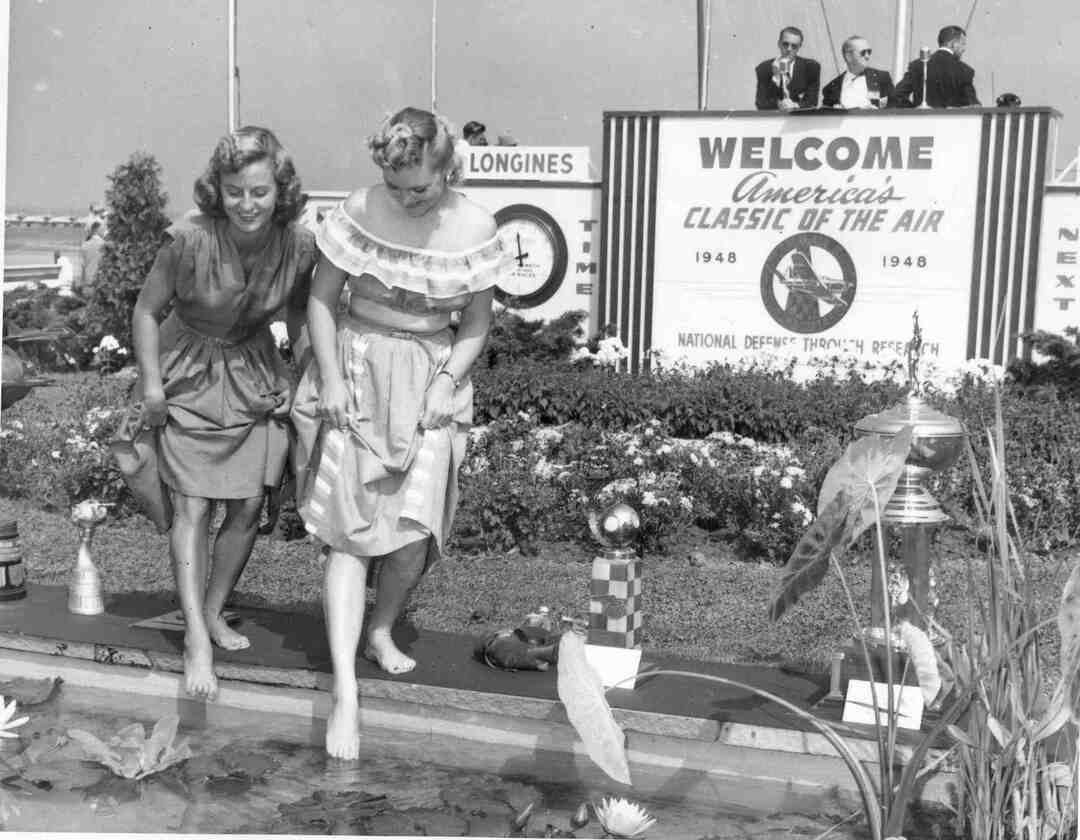
Cooling Off Two women cool off during the 1948 National Air Races. One of the slogans for that year's races, "National Defense Through Research," can be seen on a sign in the background. Source: Cleveland Press Collection, Michael Schwartz Library Special Collections at Cleveland State University Date: 1949
1949 Air Race Map
1949 Air Race Map This map, marked with the locations of the seven pylons the pilots were to navigate around, shows the route for a closed-course race held at the 1949 National Air Races. Source: Cleveland Press Collection, Michael Schwartz Library Special Collections at Cleveland State University Date: 1949

Location

Cleveland-Hopkins International Airport

Metadata

Michael Rotman and F.X. O'Grady, “Cleveland National Air Races,” Cleveland Historical, accessed April 17, 2026, https://clevelandhistorical.org/index.php/items/show/151.